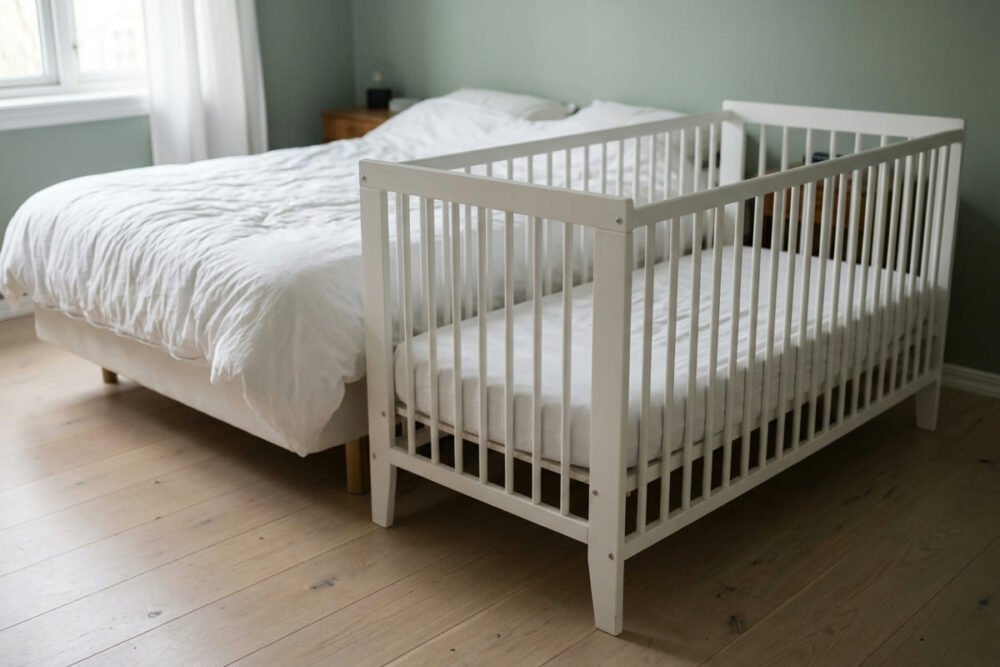
Your baby should sleep on their own firm, flat surface, in your room, for at least the first six months. That is the whole answer, and it fits on one line.
The rest of this page is for the part that does not fit on one line. What counts as a surface, what happens when the only thing that settles them is your chest, and what the guidance actually says about the feed at four in the morning.
The one line, and who says it
The American Academy of Pediatrics says babies should sleep on a firm, flat surface of their own, in the room where the parents sleep, for at least the first six months. Its guidance on preventing SIDS puts the preferred length at up to a year, and says the crib should stay within arm’s reach of your bed.
The scale is worth knowing once and then not dwelling on. According to the AAP, around 3,500 babies in the United States die suddenly and unexpectedly during sleep every year, most of them from SIDS or from accidental suffocation or strangulation. Unless a piece of the guidance says otherwise, all of it applies until the first birthday.
Two words in that first sentence carry the weight, and they are the two that blur at night. Own and room. Room sharing is recommended. Bed sharing is not. Those sound like one conversation and they are two.
What counts as a sleep surface
Firm has a test. The AAP says a firm surface is one that does not indent when your baby is lying on it. Flat has a number: any surface that inclines more than 10 degrees is not safe for a baby to sleep on.
That leaves four objects. A crib, a bassinet, a portable crib, or a play yard that meets Consumer Product Safety Commission standards. A mattress made for that specific frame, fitted tightly, one fitted sheet, and nothing else in there at all.
The rest of the nursery aisle is where it gets confusing, and the AAP is specific about it. Inclined sleep products, hammocks, baby boxes, in-bed sleepers, nests and pods, compact bassinets, travel bassinets and baby tents count as an option only if they comply with the June 2021 CPSC rule requiring infant sleep products to meet the existing federal safety standards for cribs, bassinets, portable cribs and play yards. If a product does not meet those standards, the guidance is to avoid it. Anything that was never sold for sleep in the first place is a flat no, and the AAP names Boppy pillows and Dock-a-Tots as its own examples.
The nap that happens somewhere else
Babies fall asleep in car seats, strollers, swings, infant carriers and slings, and they do it constantly. The AAP’s instruction is to move them onto a firm surface, on their back, as soon as possible.
Nobody pretends that is convenient. It is probably the most resented line in all of safe sleep guidance, because the transfer is the exact thing that wakes them and you have just spent forty minutes getting to this point. The guidance still says move them.
If you do not have one of those four things tonight
This part usually gets left out of the summaries, which is odd, because the AAP puts it in writing. In an emergency, a box, a basket or a dresser drawer with thin, firm padding will do temporarily, and the baby moves to a CPSC-approved surface as soon as you can get one. The AAP also points parents at their local Social Services agency, because organizations throughout the United States provide free or low cost sleep surfaces.
A safe place to sleep is a thing money buys, and the guidance says so out loud instead of pretending otherwise. If tonight is that night, a drawer on the floor beats the couch by a distance this page gets to in a minute.
Room sharing is not bed sharing
Room sharing means the crib, bassinet, portable crib or play yard stands in your bedroom, close to your bed. The AAP recommends it for at least the first six months and says it can lower the risk of SIDS by as much as 50 percent. It is also, in plain terms, easier. You hear the first noise instead of the fourth, and the night feed no longer involves a hallway. Whether any of that produces more sleep is a separate question with its own answer.
Bed sharing is the baby in the bed with you, and the AAP does not recommend it under any circumstances, including for twins and other multiples. The NHS goes about it differently, listing situations where a bed must never be shared, among them a baby born before 37 weeks or weighing less than about 5.5 pounds at birth. On one point the two are identical and neither leaves any room: never sleep with your baby on a sofa or in an armchair.
Between those two paragraphs is where most real nights happen, so the guidance has something to say about that too.
Four in the morning
This is the part worth reading twice, because it was written for the night you are actually having rather than the one in the pamphlet.
If you bring your baby into your bed to feed or to comfort them, the AAP says to put them back in their own sleep space before you go to sleep. And if there is any possibility at all that you might fall asleep with the baby in your bed, clear it first. No pillows, no loose sheets, no blankets, nothing that could cover a face, head or neck, and nothing that could overheat them. As soon as you wake, the baby goes back.
Then comes the number that reorganizes the whole picture. According to the AAP, the risk of sleep-related infant death is up to 67 times higher when a baby sleeps with someone on a couch, a soft armchair or a cushion.
Look at where that figure sits next to the others. The AAP puts bed sharing at more than 10 times higher when the adult is fatigued, has taken medication that makes waking harder, or has used alcohol or drugs. It puts bed sharing with a baby younger than four months at 5 to 10 times higher, and with a baby born preterm or at low birth weight at 2 to 5 times higher. The couch is the largest number on the list. The couch is also, very often, where a parent ends up precisely because they were trying not to fall asleep in the bed.
So the practical version is the one the AAP writes down. Decide before you are exhausted, not during. If there is any chance of falling asleep, the bed gets cleared first, and the couch and the armchair are out entirely.
Once they start rolling
Always place your baby down on their back, for every nap and every night. The AAP says that once a baby rolls comfortably both ways, back to tummy and tummy to back, you do not have to keep turning them over. What matters from then on is that there is nothing in the crib to roll into. No blankets, no pillows or pillow-like toys, no quilts, no stuffed toys, no bumper pads.
Rolling is also the moment the swaddle has to stop, and that has its own timing and its own signs.
The blanket question answers itself once the crib has to stay empty. Layers of clothing or a wearable blanket instead, and the AAP’s rule of thumb is one more layer than you would wear in the same room. No weighted blankets, sleepers or swaddles, on or near your baby. No hat indoors once you are home from the hospital. If you are trying to work out whether the room is too warm, the signs are on the baby, not the thermostat.
What to actually do tonight
- Move the crib or bassinet into your room, within arm’s reach of your bed.
- Strip it. Mattress made for that frame, one fitted sheet, nothing else.
- Check the incline. More than 10 degrees off flat and it is not a sleep surface.
- Back sleeping, every nap, every night.
- One more layer than you are wearing. No hat, no weighted anything.
- Decide now where the night feed happens, and make it the cleared bed rather than the couch.
None of that makes the first months restful, and the rest of what helps a newborn sleep is a different list. This one is just the room.
When to call the doctor
The AAP’s own note on these recommendations is to talk to your pediatrician if you have questions about any of them, and that is worth taking literally if your baby was born preterm or at a low birth weight, or if you have been told something different by someone you trust.
Reflux is the usual one. The AAP says that even babies with gastroesophageal reflux disease should sleep flat on their backs, and that a baby’s airway anatomy and gag reflex are what stop back sleeping from being a choking risk. If that does not match what you were told, that is a conversation for the office rather than a decision to make alone at midnight.
The short version
- Own surface, your room, at least six months and preferably up to a year.
- Firm and flat. No indent under the baby, no more than 10 degrees of incline.
- A crib, bassinet, portable crib or play yard. Fitted sheet, nothing else in it.
- The AAP puts the risk of sleep-related infant death up to 67 times higher on a couch, soft armchair or cushion. Never sleep there with your baby.
- Asleep in a car seat, stroller or carrier? Move them to a firm surface when you can.
- No safe surface at home tonight: a drawer with thin, firm padding, and ask your local Social Services agency about a free one.
Sources
- American Academy of Pediatrics, HealthyChildren.org, “How to Keep Your Sleeping Baby Safe: AAP Policy Explained”, Rachel Y. Moon, MD, FAAP
- American Academy of Pediatrics, HealthyChildren.org, “Preventing SIDS”
- National Health Service (UK), “Reduce the risk of sudden infant death syndrome (SIDS)”
A note on this post. Written and edited by the NewBloom editorial team. NewBloom is not written by doctors, nurses or midwives, and nothing here is medical advice. We read the current guidance from bodies like the AAP, the CDC and the NHS and write down what it says, with every claim traced to its source and named in the sentence where it appears. General guidance is not the same as an answer about your baby. Your pediatrician, midwife or health visitor can see your child and we cannot, so anything here that raises a question about your own baby is a reason to ask them. If something is wrong right now, contact your doctor or your local emergency number. More about how we write these posts.