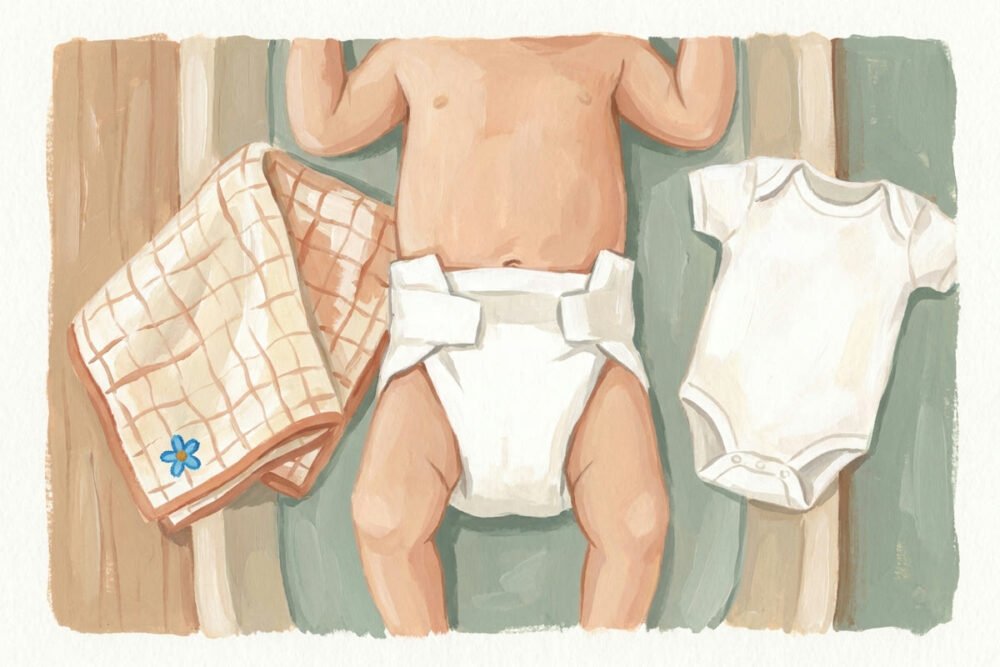
Keep it dry, keep it outside the diaper, and otherwise leave it alone. According to the American Academy of Pediatrics there is no need to use alcohol on the umbilical cord stump, and no bandage either, because the stump is not a cut that is closing over. It is tissue drying out, and drying is the entire mechanism by which it comes off.
That is the part that feels wrong for the first two weeks. There is something in the middle of your baby that looks like it wants attention, and the guidance is mostly a list of things to stop.
Everything on the list is something you stop doing
The AAP’s instruction for the stump is two words long. Keep it clean. The same page says plainly that there is no need to use alcohol on it, and a second AAP page adds that no bandage is required, because the stump needs air. Being open to the air and outside the diaper is what helps it along.
Outside the diaper is the only part of this that takes any effort. Fold the front of the diaper down below the cord so urine cannot soak it. You will do this at three in the morning with one hand, badly, and then redo it, and by the end of the first week it will be automatic.
Water is the other thing you are keeping off. The AAP says to stick to sponge baths until the stump falls off, because a stump that gets wet can lead to infection. The NHS is narrower still on the everyday version and says you only need to wash around the cord at all if it has gotten dirty with urine or stool, using fresh cotton balls and warm water, then patting it dry. There is a whole separate question hiding in that, which is what washing a newborn actually looks like before the cord falls off.
Neither the AAP nor the NHS gives any instruction for helping the stump come off sooner, and that absence is itself the instruction. Nothing in the guidance describes the stump as a job you finish.
It has about three weeks, and the AAP’s own pages do not agree on the middle
This is worth knowing before you go looking, because you will find different numbers and assume one of them is out of date. The AAP’s page on umbilical cord care says the stump should dry and fall off by the time your baby is 3 weeks old, and that if it is still there beyond that, a doctor’s visit is needed. The AAP’s page on bathing says it usually happens by about one or two weeks. A third AAP page, on the cord itself, gives about 1 to 3 weeks.
Read together they say the same thing. The range is one to three weeks, most of it happens in the middle, and three weeks is the line that turns waiting into an appointment. If you are on day eleven holding a page that said one week, you are inside the range and nothing has gone wrong.
You are going to look at it every diaper change, so here is the whole list
The AAP actually recommends checking the stump at every diaper change, which cuts both ways. It means nothing gets missed, and it also means you inspect the thing eight or ten times a day for two weeks.
Start with what is normal, because that is the part nobody puts first. According to the AAP, a few drops of blood on the diaper around the time the stump falls off are normal. What is not normal is the cord actively bleeding, and the AAP says to call your baby’s doctor immediately if that happens.
Infection of the stump has a name, omphalitis, and the AAP describes it as uncommon. It also gives a short list of what to contact your pediatrician about:
- Foul-smelling yellowish discharge from the cord
- Red skin around the base of the cord
- Crying when you touch the cord or the skin next to it
A second AAP page adds yellow or white pus, swelling or redness around the belly button, and any drainage that is yellow or brown, and says to call right away if you see them.
Hold on to the third one on that list. It is the only item that does not show up in a photograph, and it is the one you can find in the dark. The other two need you to be looking at the right moment under decent light. Pain shows up the second you touch it.
What is left behind is usually also a leave-it-alone
Two things commonly turn up after the stump goes, and both of them sound worse than the guidance treats them.
The first is an umbilical granuloma. The AAP describes it as a small reddened or brownish mass of scar tissue that stays on the belly button after the cord has fallen off, and it drains a light yellowish fluid. It usually goes away in about a week. If it does not, the AAP says a pediatrician may need to help dry it or chemically cauterize the tissue, which is a short in-office thing rather than the ordeal it sounds like.
The second is an umbilical hernia, which is what you are seeing if the area pushes outward when your baby cries. The AAP explains it as a small hole in the muscular part of the abdominal wall that lets tissue bulge out when pressure rises, says it is not a serious condition, and says it usually heals by itself in the first 12 to 18 months. In the unlikely event it has not closed by three to five years of age, surgery may be needed.
Do not put tape or a coin on the navel. The AAP names both, says it will not help the hernia, and says it may cause a skin rash. This advice gets passed down families with real confidence, which is exactly why the AAP bothers to print it.
When to call the doctor
Call the same day, or immediately where the AAP says immediately, for any of these:
- The cord is actively bleeding, not a few spots at the point it comes off
- Foul-smelling yellowish discharge, yellow or white pus, or drainage that is yellow or brown
- Red or swollen skin around the base of the cord or around the belly button
- Your baby cries when you touch the cord or the skin beside it
- The stump is still attached past three weeks
A newborn with a fever needs a call regardless of what the belly button looks like. In the first weeks that is not a wait-and-see situation, and it is not a question this page can answer for your baby. The first month brings a long run of things that look alarming and are not, including most of what turns up in the diaper, and the way to tell the difference is a person who can see your child.
The short version
- No alcohol, no bandage. The AAP says the stump needs air and just needs to be kept clean and dry
- Fold the diaper down below the cord so urine stays off it
- Sponge baths only until it falls off, and only wash around the cord if it has gotten dirty
- A few drops of blood as it comes off are normal. Active bleeding is a call
- One to three weeks is the range. Still attached at three weeks is an appointment
- A lump or a bulge afterward is usually a granuloma or a hernia, and both are mostly left alone. No coins, no tape
The other thing worth saying is that this stretch is short and it is loud with advice. Somebody will tell you to swab it with alcohol, somebody else will tell you to keep it covered, and both were standard once. In the middle of a newborn week, when the feeds are running into each other and nobody has slept, the useful news is that this particular job asks almost nothing of you.
Sources
- American Academy of Pediatrics, HealthyChildren.org, “Umbilical Cord Care in Newborns” (last updated 7/6/2025), adapted from Caring for Your Baby and Young Child: Birth to Age Five, 8th edition
- American Academy of Pediatrics, HealthyChildren.org, “Your Baby’s Umbilical Cord: 5 Surprising Facts for New & Expectant Parents”, David Kaufman MD FAAP
- American Academy of Pediatrics, HealthyChildren.org, “Bathing Your Baby”, Dipesh Navsaria MPH MSLIS MD FAAP (last updated 7/6/2025)
- National Health Service (UK), “Washing and bathing your baby” (page last reviewed 23 July 2024)
A note on this post. Written and edited by the NewBloom editorial team. NewBloom is not written by doctors, nurses or midwives, and nothing here is medical advice. We read the current guidance from bodies like the AAP, the CDC and the NHS and write down what it says, with every claim traced to its source and named in the sentence where it appears. General guidance is not the same as an answer about your baby. Your pediatrician, midwife or health visitor can see your child and we cannot, so anything here that raises a question about your own baby is a reason to ask them. If something is wrong right now, contact your doctor or your local emergency number. More about how we write these posts.