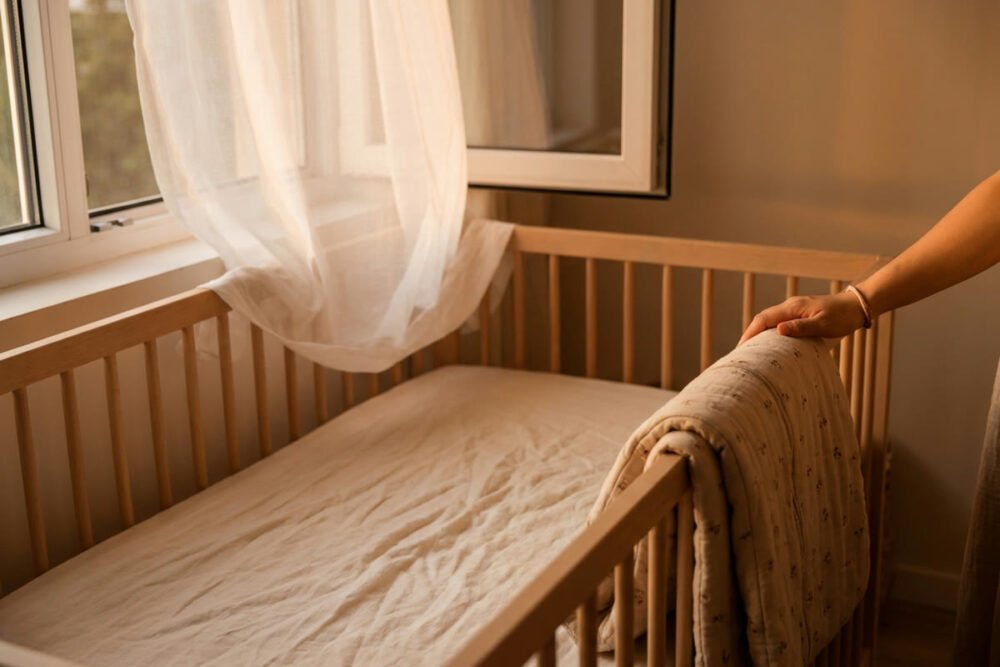
Feel the back of your baby’s neck, or their chest. That is where the NHS says to check, and it adds the part that saves a lot of unnecessary worry: do not worry if their hands or feet feel cool, because that is normal.
Almost everyone checks the hands. Hands are what is sticking out of the blanket at 2am, so hands are what gets touched, and a cold hand on a perfectly warm baby has sent a lot of people looking for another layer their baby did not need.
Why it is worth getting right
The American Academy of Pediatrics puts overheating on its safe sleep list rather than its comfort list. Overheating can increase the risk of SIDS, and the AAP’s guidance is simply not to let your baby get too hot. The NHS says the same thing and adds the mechanism, which is that babies overheat because of too much bedding or clothing, or because the room is too hot.
Those are the only three levers. Bedding, clothing, room. Everything below is one of the three.
The signs, roughly in the order you notice them
The AAP lists them plainly. A baby could be too hot if you notice sweating, damp hair, flushed cheeks, heat rash and rapid breathing.
Damp hair is usually the one that gets there first, because it survives the trip from the crib to your shoulder. Sweating on the back of the neck is second. Heat rash tends to show up the next morning rather than in the moment, which is a slightly annoying way to find out you were a layer over.
How many layers is right
The AAP gives a rule of thumb that is easier to use than any product chart: your baby only needs one more layer than you would wear in the same environment to be comfortable.
One more than you. Not one more than you would wear outside, and not one more than the packet on the sleeping bag suggests. If you are lying on top of the covers in a t-shirt because it is August, one more layer than that is not very much at all.
There is a second AAP line that catches people in the first weeks: do not put a hat on your baby while indoors once you are home from the hospital. Hospitals hat newborns, so the hat comes home in the bag, and it keeps getting used because it looks like part of the outfit.
The room
The NHS gives a number. Keep your baby’s room at a temperature between about 16C and 20C, which is roughly 61F to 68F, and it suggests monitoring it with a room thermometer rather than guessing.
That number is lower than most people’s houses in summer, and there is no point pretending a thermometer fixes a heatwave. What it does do is settle the argument in the room. If it reads 24C, adding a sleeping bag is not the answer to a fussy night.
What to change tonight
The NHS is specific about the order of operations. Remove one or more layers of clothing or bedding if your baby’s skin is hot or sweating. Use lightweight blankets, sheets or a baby sleeping bag rather than heavy ones.
It also names the things that should never be part of the setup at all: babies should never sleep with a hot water bottle or an electric blanket, next to a radiator, a heater or a fire, or in direct sunlight. Direct sunlight is the one that moves. A crib that was in shade at bedtime is not necessarily in shade at seven in the morning.
Keep the AAP’s safe sleep rules intact while you do it. Soft objects and loose bedding stay out of the sleep area, so the answer to a hot night is taking something off the baby, not swapping a sleeping bag for a loose sheet.
The bit nobody does: taking the hat off in the car
This is the most useful sentence on the NHS page and the one least likely to be followed. Remove hats and extra clothing as soon as you come indoors or enter a car, a bus or a train, even if it means waking your baby.
Even if it means waking your baby. The NHS wrote that clause on purpose, because it knows exactly what everyone does instead. A baby who finally went down in the car seat, still wearing the outdoor layer, in a car that has been sitting in the sun, is the whole reason the sentence exists.
The short version
- Check the chest or the back of the neck, not the hands. The NHS says cool hands and feet are normal.
- Signs the AAP lists: sweating, damp hair, flushed cheeks, heat rash, rapid breathing.
- One more layer than you would wear in the same room. That is the AAP’s whole rule.
- The NHS puts the room at about 16C to 20C, roughly 61F to 68F.
- Too hot means take a layer off, not add a lighter blanket. Loose bedding stays out either way.
- No hat indoors once you are home from the hospital, and hats come off in the car even if it wakes them.
If your baby is still swaddled, that is a layer with its own set of rules, and the AAP says swaddling itself raises the chance of overheating. The full answer to that one is in when to stop swaddling and how to do it safely. For everything else about the sleep setup, the newborn sleep basics cover the surface and the routine.
Sources
- NHS, “Reduce the risk of sudden infant death syndrome (SIDS)”, page last reviewed 25 November 2025
- American Academy of Pediatrics, HealthyChildren.org, “How to Keep Your Sleeping Baby Safe: AAP Policy Explained”, Rachel Y. Moon MD FAAP
- American Academy of Pediatrics, HealthyChildren.org, “Swaddling: Is it Safe for Your Baby?”, Rachel Y. Moon MD FAAP and Danette Glassy MD FAAP, last updated 15 July 2022
A note on this post. Written and edited by the NewBloom editorial team. NewBloom is not written by doctors, nurses or midwives, and nothing here is medical advice. We read the current guidance from bodies like the AAP, the CDC and the NHS and write down what it says, with every claim traced to its source and named in the sentence where it appears. General guidance is not the same as an answer about your baby. Your pediatrician, midwife or health visitor can see your child and we cannot, so anything here that raises a question about your own baby is a reason to ask them. If something is wrong right now, contact your doctor or your local emergency number. More about how we write these posts.