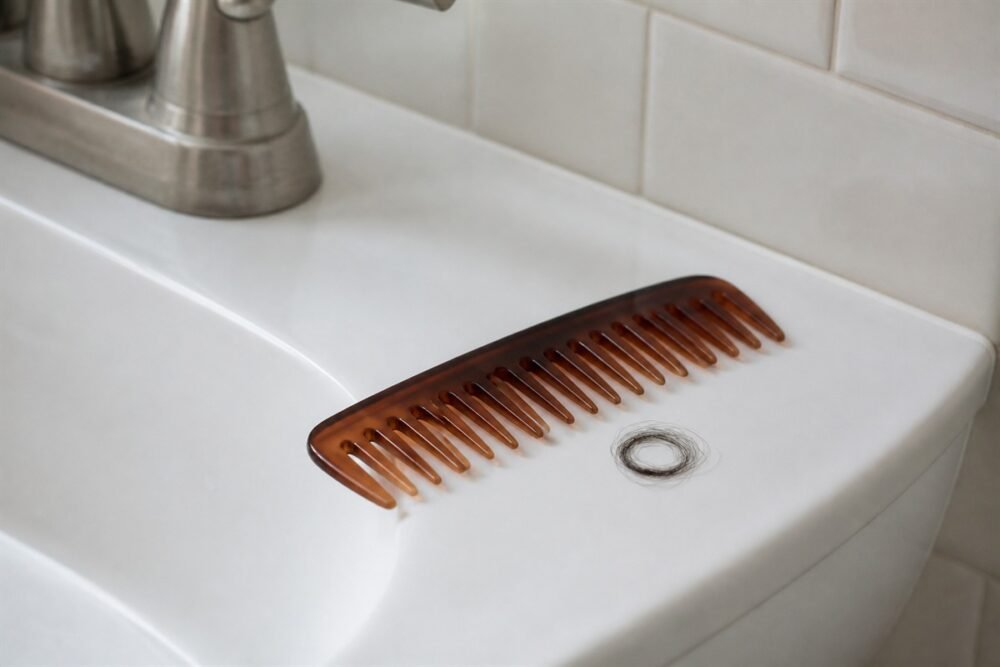
There is no day postpartum hair loss stops. It slows, across months, and the reason that matters is that you are almost certainly trying to read today’s shower drain as a verdict, and it cannot be one.
The shape of it is known. The American Academy of Dermatology puts the peak at about four months after giving birth, with most women back to their normal hair growth by their child’s first birthday. What is missing from every version of that sentence is where all of it goes, and the answer is that it is still in your house.
You have started counting, and the number was never going to help
After my first baby I used to gather the hair off the shower drain, roll it into a wet clump and stick it on the tile wall so I could deal with it at the end. By the time I got out there were usually three of them up there in a row, and I never once counted a single strand, because I did not want a number I would have to think about.
The number would not have told me anything anyway. Normally, MedlinePlus says, you lose roughly 50 to 200 hairs from your head every day out of a scalp that holds about 100,000, and I would like you to sit with how wide that normal range already is before you have had a baby at all.
Two hundred is four times fifty and both of them are ordinary. So a handful in the drain is not a measurement, it is a handful, and the only thing it can honestly be compared against is the handful from a month ago, which you did not keep.
I have done this three times now and here is the thing I find genuinely embarrassing. I remember the start of it differently each time. With one of mine I would swear it began at six weeks and with another I would swear it was much later, and I have no idea which of those memories is doing me a favor, because it never once occurred to me to write down a date.
Nobody keeps the baseline. That is not a personal failing, it is what the first four months are. It does mean the drain is a bad instrument, and it means the calmest thing you can do with it is empty it and go.
It does not stop. It slows.
What I wanted, all three times, was a date. Something like the six week mark, a line you cross where the thing is over and you can stop bracing for the shower. That date does not exist and looking for it is its own small misery.
Here is the actual shape, and it is made of curves rather than lines. Shedding after this kind of stress often is not noticed for weeks to months after the event itself, MedlinePlus says, and then decreases over six to eight months. Hair loss connected to childbirth, the same page says, often goes away after six months to two years.
Two years is in there. I want to leave that in rather than quietly round it down, because a number you were not warned about is the one that makes you think something has gone wrong with you specifically.
What is underneath it is not damage. The AAD is clear that this is not true hair loss at all but excessive shedding, telogen effluvium, driven by estrogen levels falling back down after the pregnancy, and that you do not have to do anything to remedy it.
The scale of it is bigger than I expected when I finally read it as a number. Physical or emotional stress can push one half to three quarters of the hair on your scalp into shedding, MedlinePlus says, and it typically comes out in handfuls when you shampoo, comb, or just run your hands through it.
Handfuls. The word is right there on the page, which means the thing that made you go looking for this in the first place is the thing the page describes as normal.
There is a detail in that list of triggers that nobody joins up for you. MedlinePlus names six: a high fever or severe infection, childbirth, major surgery or major illness or sudden blood loss, severe emotional stress, crash diets that are short on protein, and certain medicines including birth control pills, beta blockers, some antidepressants and NSAIDs.
Read down it as your own year. Childbirth is one line. Major surgery is another. Sudden blood loss is another. Severe emotional stress is another, and I have never met anybody who came through the first three months without at least brushing that one.
The list is not a scoreboard and I am not saying more items means more hair. I am saying that if you have been quietly wondering why yours seems bigger than your friend’s, the answer may simply be that your year had more of that page in it than hers did, and that nothing about it is a verdict on how you are handling any of it.
Do nothing is a strange prescription to be handed at four months postpartum, when doing nothing is the one thing you have not had a chance to try in months. It took me until my second to hear it as permission rather than as a shrug.
After my son I noticed short hairs standing straight up along both temples, the kind that will not lie down for anything. I decided they were the new ones coming back and I have carried that belief for years now without a single person ever confirming it for me. It is possible I simply needed something in the mirror to be evidence of the good half.
The other thing I tried, after my first, was cutting it all short. I had heard it helps and I want to report honestly on what it did. It did not change how much came out. It shortened the amount of time I spent on it in the morning by a few minutes, which at that point in my life was not nothing, and it made the strands on my shirt less visible, which is a different kind of relief than the one I was shopping for.
That is roughly all any product does here too. The AAD’s own tips run to volumizing shampoo and lighter conditioner, and the same page says outright that no single ingredient makes one better than the rest, which is a fairly honest thing for a dermatology body to print. It is cosmetics, not treatment, and if it makes you feel more like yourself in the mirror at seven in the morning then it has done the job it can actually do. Just do not wait for it to move the number.
The other thing that changes nothing is how hard you are working. I say that because the question about moving your body again and the shedding question tend to arrive in the same month, and the timeline for one of them has nothing to say about the other.
The hair is not gone, it is somewhere
Nothing I read told me the part that actually surprised me, which is that the hair does not disappear. It relocates. For months after my first, it came out of exactly three places in my house and I could have drawn you a map.
The rubber seal around the washing machine door. The brush roll of the vacuum, wound so tight I needed to cut it off. And the slot where the car seat buckle goes, which I found while trying to work out why the buckle had started feeling stiff.
Once you know that, two things get easier. The first is that you stop being startled by it, which sounds small and is not, because being startled fifteen times a day by evidence of a thing you already know is happening is its own tax.
The second is that you get slightly deliberate about the three or four places in your own house where it collects, and you check them on purpose instead of finding them by accident. Mine were a washing machine, a vacuum and a buckle. Yours will be different and you already half know what they are.
And one of those places is not furniture.
Around a toe
When my youngest was a newborn I was changing her on the floor and saw a dark line across the base of one toe. It was a single hair of mine, wrapped twice. It came off with my fingers in about ten seconds and left a faint mark that was gone by the next day, and I have never forgotten how ordinary the moment looked from the outside.
This has a name and it is worth knowing before you meet it rather than after. A hair tourniquet, as the AAD describes it, is what happens when a shed strand wraps around a baby’s toe, finger or another body part, and a single strand can wrap tightly enough to cut off circulation or cause an infection.
The likelihood of it is very rare and the AAD says so in the same breath, which is the correct order to hold those two facts in. This is not a thing to start scanning for at three in the morning. It is a thing to know the shape of.
What made mine easy to spot was luck rather than vigilance. I was not looking. It was simply dark against her skin in ordinary afternoon light, and both her feet happened to be up in front of me because I was doing up the snaps.
What to do about one, if you find it, is three steps in the AAD’s order. Look for a loose end and gently unwind it. If there is no loose end you can find, use something to cut it carefully, a small pair of scissors or a small knife. And if it will not come off because it is wound too tight or has worked into the skin, that is medical help, meaning a call to your baby’s doctor or a trip to the emergency room, because sometimes a doctor has to remove it.
What I do now takes four seconds and lives inside something I was doing anyway. At bath time, when the fingers and toes are already in my hands and already uncurled, I run a thumb along them. It is not a check I set an alarm for. It is attached to a thing that already happens every couple of days, which is the only reason it survived past the first week.
Fists are where they hide, since a newborn’s fingers spend most of the day curled shut. Bath and diaper changes are the two moments a day when everything is open.
When it is not shedding
The whole point of knowing the ordinary shape of this is so that you can notice something that is a different shape. That is the only reason to spend this many words on a thing that resolves by itself.
MedlinePlus lists nine things that are worth contacting a provider about, and they are worth reading as a set rather than matching one at a time: losing hair in an unusual pattern, losing it rapidly or at an unusually early age, pain or itching along with the hair loss, skin on the scalp under the area that is red, scaly or otherwise abnormal, acne or facial hair or an abnormal menstrual cycle, a woman with male pattern baldness, bald spots in the beard or eyebrows, weight gain or muscle weakness or intolerance to cold or fatigue, and areas of infection on the scalp.
Read that list again and notice how many of the items are not about hair. Weight gain, cold, fatigue and muscle weakness sitting in a hair loss list is the page telling you that hair is sometimes a symptom of something with a thyroid in it, and that is exactly the thing that gets waved off after a birth because every one of those words also describes a normal Tuesday with a newborn.
Handfuls in the shower with none of the rest of that is the ordinary story. Handfuls plus a scalp that hurts, or plus patches with edges, or plus feeling cold in a warm room for months, is a different conversation and it is a short one.
There is also a clean back stop on the far end. If your hair has not come back to its normal fullness after a year, the AAD says that is the point to see a dermatologist, because something else may be going on and the treatment depends on what it is.
The place to raise any of it is the appointment you already have. This is exactly the kind of thing that gets dropped from the postpartum visit because it feels cosmetic next to everything else on the list, and then there is no next appointment for months.
The short version
- The drain is not an instrument. Empty it and leave.
- Stop waiting for a stop date. There is a slope, not a cliff, and the slope is measured in months.
- The reason it is not damage is also the reason nothing you buy will speed it up. Buy the shampoo if the mirror is what is hurting. Do not buy it expecting a change in the number.
- Find the three places in your house it collects and check them on purpose. It is much better than meeting it by surprise.
- Open the fists and look at the toes once a day, inside something you already do. Bath time, or the diaper change.
- Hair alone is the ordinary story. Hair plus a sore scalp, patches, or months of being cold and exhausted in a way that does not track with the nights, gets said out loud to someone.
Sources
- MedlinePlus Medical Encyclopedia, National Library of Medicine, Hair loss, review date June 3, 2025, updated by Ramin Fathi, MD, FAAD
- American Academy of Dermatology Association, Hair loss in new moms, last updated October 2, 2025, reviewed by DiAnne Davis, MD, FAAD and others
A note on this post. Written and edited by the NewBloom editorial team. NewBloom is not written by doctors, nurses or midwives, and nothing here is medical advice. We read the current guidance from bodies like ACOG, the CDC and the NHS and write down what it says, with every claim traced to its source and named in the sentence where it appears. General guidance is not the same as an answer about your own body. Your doctor, midwife or health visitor can examine you and we cannot, so anything here that raises a question about your own recovery is a reason to ask them. If something is wrong right now, contact your doctor or your local emergency number. More about how we write these posts.