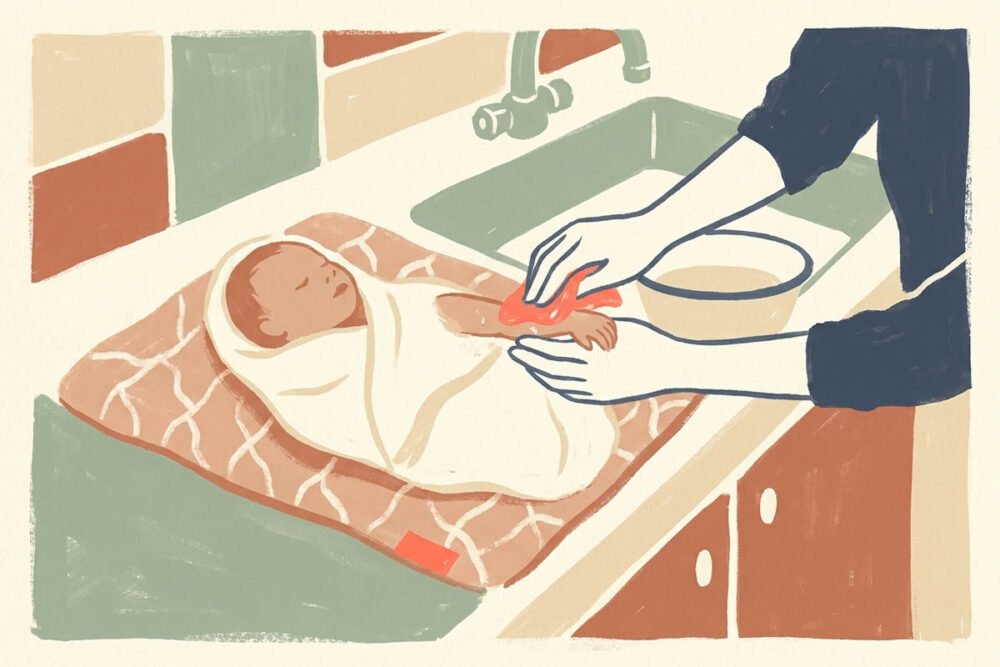
A sponge bath is not a bath with less water. It is a diaper change that grew: your baby stays wrapped in a towel from start to finish, and the only part of them in the open air is the part you are washing right now.
Once I understood that, the whole thing stopped being intimidating. The washing is easy. The actual skill, the one nobody names, is keeping a tiny person warm while you do it, and the towel does most of that for you.
Set up like a diaper change, not a bath
With my first, I treated it like a miniature bath. I undressed her completely on the changing table in her room, laid her on the cold vinyl, and then went looking for the washcloth. She cried from the first second to the last, and I concluded that my baby hated being washed. She did not. She hated being naked and cold while her mother rummaged.
So the setup is the whole opening move. The AAP’s list for it is short: a basin of water, a washcloth dampened in water with no soap in it, and a dry towel, all within reach before you begin.
The surface matters less than the nursery catalogs imply, and you do not need to buy one. The same AAP page allows a changing table, a bed, the floor, or a counter next to the sink, padded if it is hard. The one hard rule rides on height: above the floor, a safety strap or your hand stays on the baby the entire time, because a wrapped baby is still a baby who can roll.
The NHS adds the two conditions that decide the mood before you start: a warm room, and a baby who is awake and content rather than hungry or exhausted. By my third, the whole operation lived on the counter beside the kitchen sink, permanently set up, and it took less ceremony than a diaper change with a blowout involved.
The order is a one-way street: cleanest to dirtiest
The face goes first, and the face gets plain water only. The AAP’s sequence starts with washing your baby’s face with the damp cloth, keeping water out of their eyes and mouth, then dipping the cloth back in the basin before doing the rest of the body, and, last of all, the diaper area.
The eyes get their own protocol, and it is stricter than the rest of the face. The NHS says to wipe gently around each eye from the nose outward, with a fresh cotton ball for each eye, so nothing sticky or infected travels from one eye to the other. Ears are outside only: wipe around them, never inside them, and never with a cotton swab.
The reason the diaper area goes last is hygiene. You are moving from the cleanest territory to the dirtiest, and the one-way street means nothing travels backward toward the face.
My own reason is less elegant. With my son, opening the diaper was reliably the exact moment he peed, with the accuracy of a scheduled event. The first time, it caught the clean washcloth, the towel, and my sleeve, and I stood there recalculating my whole approach to this operation while he looked enormously pleased with himself. Saving that district for the end means that whatever happens when you get there, the rest of the baby is already washed, dried, and covered. Two reasons, same order, both learned the hard way by somebody.
The towel does most of the work
Here is the mechanic that makes the whole thing calm. The AAP says to wrap your baby in a dry towel and uncover only the part of their body you are actively washing. One arm comes out, gets washed, gets dried, goes back under. Then a leg. The baby is never lying there naked, which means the baby is never lying there cold, which is most of what the crying was ever about.
The difference this made in my house was not subtle. The same daughter who screamed through the stripped-naked version lay there blinking at the ceiling through the wrapped version, mildly interested, as if the two events were not even related.
The places that actually need attention are the folds, because folds are where milk and lint go to live. The creases under the arms, behind the ears, around the neck, and in the genital area get deliberate visits, says the AAP. Drying works the same way: pat carefully, folds included, rather than dragging a towel across skin that is still brand new.
The cord stump gets the least attention of anything on the baby. The NHS says to wash around it only if it is dirty with pee or poop, then gently pat it dry, and the rest of the time you leave it alone entirely. What leaving it alone looks like across the full two weeks is its own short subject.
And talk while you work. Your voice is the one piece of equipment that calms the baby and costs nothing, and narrating has a second job nobody mentions: it keeps your own hands slow, and slow hands are warm-baby hands.
How often, and when this ends
Less often than instinct says. According to the AAP, three baths a week during the first year may be enough. Newborns rarely sweat or get dirty enough to need more, and extra washing mostly buys you dry skin. If a sponge bath feels like it barely counts as washing, that is because a newborn barely needs washing.
The era ends when the cord stump falls off, which the AAP puts at about one or two weeks of age. A stump that hangs on past that window has stopped being a waiting problem, and that one goes to your baby’s doctor instead of back on the shelf.
Once the umbilical area has healed, the first real baths should be as gentle and brief as possible, and the AAP builds in the retreat before anyone needs it: if your baby protests, go back to sponge baths for a week or two, then try again. Retreat is in the instructions. You are not failing at bath time by using it.
The tub, when it arrives, is a different country with real border rules, water amount and temperature and the never-step-away rule among them, and we walked through all of it in the two weeks before the tub. The sponge weeks ask none of that of you. That is their quiet advantage, and it is why I stopped rushing to leave them.
The short version
- I set up a diaper change, not a bath. Everything in reach before the first snap is undone.
- Wrapped start to finish. One limb out at a time, washed, dried, back under the towel.
- The order runs one way, face to diaper, and I have two good reasons never to reverse it.
- Fewer washes than instinct says. Newborns are cleaner than anyone believes.
- When the stump goes, the tub era starts small, and retreating to the towel is allowed.
Sources
- American Academy of Pediatrics, HealthyChildren.org, “Bathing Your Baby”, Dipesh Navsaria MPH MSLIS MD FAAP
- National Health Service (UK), “Washing and bathing your baby”, page last reviewed 23 July 2024
A note on this post. Written and edited by the NewBloom editorial team. NewBloom is not written by doctors, nurses or midwives, and nothing here is medical advice. We read the current guidance from bodies like the AAP, the CDC and the NHS and write down what it says, with every claim traced to its source and named in the sentence where it appears. General guidance is not the same as an answer about your baby. Your pediatrician, midwife or health visitor can see your child and we cannot, so anything here that raises a question about your own baby is a reason to ask them. If something is wrong right now, contact your doctor or your local emergency number. More about how we write these posts.