If your pregnancy was healthy and your delivery was vaginal and uncomplicated, you do not have to wait six weeks to start moving. The American College of Obstetricians and Gynecologists puts the safe start at a few days after giving birth, or as soon as you feel ready.
What nobody hands you along with that answer is that “exercise” in it is not one thing. Movement comes back in tiers. The bottom tier, the walking and stretching kind, was never locked. Only the top tier has a waiting room, and even that door swings on your body and a conversation, not on the calendar by itself.
I did not know any of this with my first. I am writing it down for the version of you that is where I was eight years ago, sitting very still and waiting for permission.
Six weeks was the answer to a different question
With my eldest I treated the six-week mark like a law with my name on it. I turned down slow walks around the block. Then I showed up at the checkup like it was a starting gun and asked, out loud, which day I was allowed to begin.
The visit itself is real and worth taking seriously, and we have a whole post on what the six-week postpartum checkup actually covers. But that appointment answers a narrower question than the one I carried into it. It clears you for the hard tier. It was never the tollbooth for all movement.
ACOG’s page on exercise after pregnancy does not use the six-week number at all. For a healthy pregnancy and a normal vaginal delivery, the answer it gives is a few days after birth, or as soon as you feel ready. The wall I sat behind for a month and a half appears nowhere on it.
The number is not fake, though. It guards a real door. It is just a much smaller door than the one I imagined, and everything below it was open the whole time.
The tier that was never locked
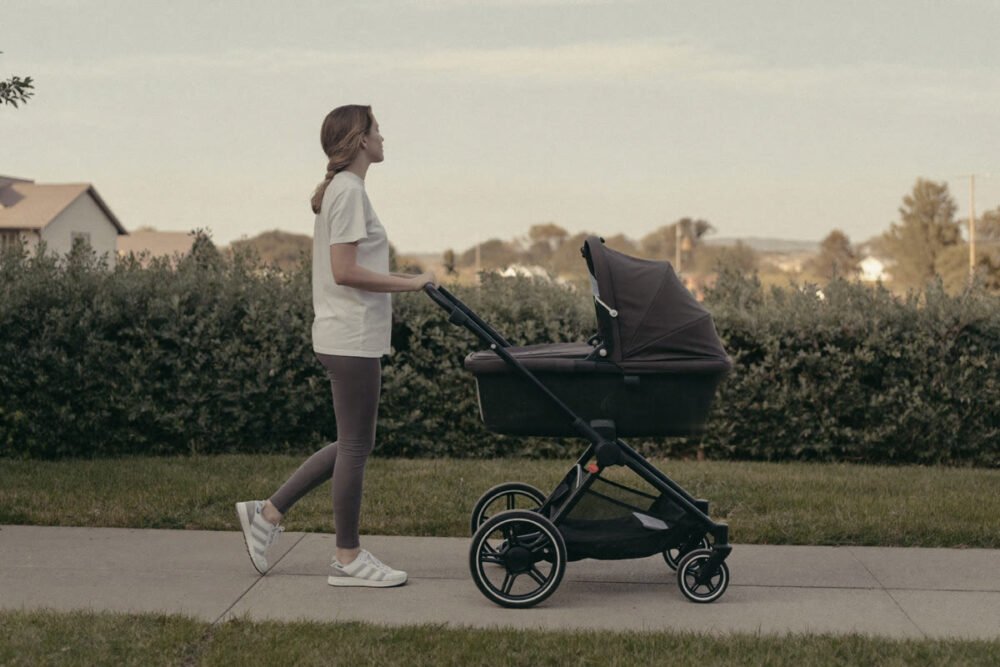
The bottom tier does not look like exercise, which is why nobody defends it. It is the stroller walk. It is the slow stretch on the living room floor next to the baby, and the pelvic floor work no one can even see you doing.
What counts as gentle? The NHS answer is blunt: after a straightforward birth, gentle exercise starts whenever you feel up to it, and walking and pelvic floor exercises are exactly what it means by gentle.
The weekly target ACOG sets is 150 minutes of moderate effort, and it lets you cut that into ten-minute pieces. Three ten-minute walks in a day count in full. That is not a consolation version of the target for tired people. That is the target.
My second baby is where I learned the other half of this. There is no rest tier in a house that also contains a toddler. I was carrying my three-year-old up the stairs before my milk had settled, and nobody called that strength training, but my back knew exactly what it was. The guidance is written for a body at rest, and the rulebook has never been up our staircase.
ACOG does ask for deliberate muscle work too, at least two days a week alongside the walking, with pelvic floor exercises part of that picture. It also lists a reason to bother that has nothing to do with a scale: exercise may help prevent postpartum depression.
None of it waits for a date. It waits for you to feel like it, which some days is the harder gate.
What your body did while you were pregnant
The reason the bottom tier is gentle is not ceremony. My old sports bra taught me that. I dug it out in the early weeks with my second, and it was a different garment on a different body, and I stood there recalculating everything else I had assumed still fit.
Pregnancy loosens you, and it does not tighten you back up on a schedule. The NHS notes that ligaments and joints stay more supple and flexible for a few months after birth, which raises the risk of injury if you stretch or twist too hard, and that the lower back and core muscles are usually weaker than they were.
The same NHS page is where my bra discovery turns out to be standard issue: do not rely on your pre-pregnancy sports bra, because your back and cup size have likely changed, and get measured again. Your feet may have changed size too.
If you are nursing, ACOG’s preparation notes are practical to the point of tenderness. Feed the baby or pump before the workout so you are not exercising with engorged breasts, and wear a bra that actually supports the chest you have now.
None of this argues for sitting still. It is just the reason the tiers exist, and the bottom one is shaped like the body you have now, not the one from before.
The tier with a waiting room
There is a tier that genuinely waits, and it is the one people usually mean when they ask the question. Running, and anything else high-impact.
This is where the six weeks actually lives. The NHS points high-impact exercise at your six-week checkup: get advice there before you start it. That is the original meaning of the number, a conversation before the top tier, not a padlock on the bottom one.
A cesarean birth or a delivery with complications moves the whole ladder, not just the top rung. ACOG’s instruction there is to ask your ob-gyn when it is safe to begin exercising again, before anything else.
The NHS gives the same instruction a wider address, your midwife, health visitor or doctor, before starting anything strenuous, and it is honest about why: recovery from a complicated delivery simply takes longer.
If that is you, nothing in the cheerful walking talk above is aimed over your head. Your tiers are real too. You just do not get to skip the conversation that puts them in order, and that is a matter of sequence, not of rank.
And for the athletes: if vigorous training was your normal before pregnancy, ACOG leaves the door open to working back up to it, with one condition attached. Talk with your ob-gyn first.
The signals that outrank the calendar
My third taught me how this is actually graded. Somewhere in the second month I took a walk that was one street too long, and by evening my legs felt borrowed, like I had rented them from someone fitter and the deposit was coming due. Nothing hurt, exactly. I had just found my line the way you really find it, from the wrong side, and the next walk was shorter.
“Feel ready” is scattered all through the official language on this, and with my first I read it as filler. It is not filler. It is the instrument. You rarely find out you were ready by passing some test. You find out you were not, gently, and you adjust.
ACOG’s stop rule is six words long: stop exercising if you feel pain. Not push through it, not stretch it out. Pain outranks the plan, whatever week it is.
The one hard number the NHS attaches to any of this is not a date, which tells you everything. Swimming waits until seven days after your postpartum bleeding has stopped. Read that clock again. It starts from something your body does, not from the day you delivered. Every clock the guidance actually sets runs that way.
Bleeding is its own subject with its own thresholds, and if yours is changing direction instead of tapering off, that question outranks exercise entirely. Take it to our post on how long postpartum bleeding lasts and when to call first.
The short version
- The walk was never forbidden. Start smaller than feels impressive and let the stroller set the pace.
- Save the checkup conversation for the tier that needs it. Bring your running question to that appointment, not your walking one.
- Surgical or complicated birth: your timeline gets written with the person who saw your chart, and that is a different starting line, not a slower lane.
- Pain is a stop sign, not a toll. And a walk that leaves you wrecked by evening was the wrong size, not proof that you are behind.
Sources
- American College of Obstetricians and Gynecologists, “Exercise After Pregnancy” (FAQ131), last updated September 2022, last reviewed October 2024
- National Health Service (UK), “Keeping fit and healthy with a baby”, page last reviewed 20 April 2026
A note on this post. Written and edited by the NewBloom editorial team. NewBloom is not written by doctors, nurses or midwives, and nothing here is medical advice. We read the current guidance from bodies like ACOG, the CDC and the NHS and write down what it says, with every claim traced to its source and named in the sentence where it appears. General guidance is not the same as an answer about your own body. Your doctor, midwife or health visitor can examine you and we cannot, so anything here that raises a question about your own recovery is a reason to ask them. If something is wrong right now, contact your doctor or your local emergency number. More about how we write these posts.