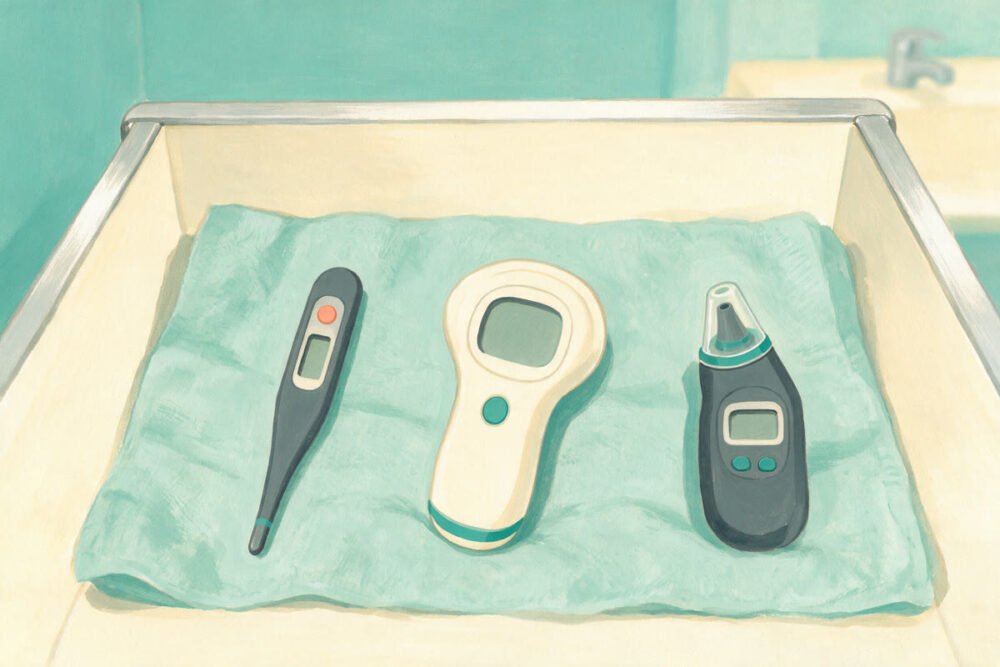
For a newborn, the reading that counts is a rectal one taken with a digital thermometer, and the AAP puts fever at 100.4 degrees Fahrenheit or higher. The reason it has to be that specific is not fussiness about accuracy. It is that the instruction telling you when to call has the measuring method built into the sentence.
Which means the number on your thermometer is only a number when the method behind it is one the guidance recognizes, and what decides that is your baby’s age, not what happens to be in your drawer.
One method belongs to this age, and it is probably not the one in your drawer
Somebody gave us an ear thermometer before my first was born. It was a nice one, it came in a box with a molded plastic insert, and it went into the drawer next to the bathroom sink where it stayed for the entire first year. I used it. She was a few weeks old and I stood in the dark holding it to the side of her head and read a number off it and believed the number.
It was months before I found out that thermometer was not built for a baby that age at all.
Here is the sorting, which the AAP scatters across a page organized by device and which is much more useful organized by how old your baby is:
| Method | Who it is for |
|---|---|
| Rectal, digital | The most accurate reading, and the AAP calls it the best one especially for infants under three months |
| Forehead, temporal artery | Next most accurate after rectal, and usable at any age |
| Ear, tympanic | Six months and older only. Younger babies have ear canals too narrow for it to be reliable |
| Oral | Not until a child is four |
| Armpit, pacifier thermometers, forehead strips | Screening only. The armpit is the least accurate of the lot |
Look at that table with a two week old in the house and most of it disappears. Oral is years away. The ear is half a year away. What is left is rectal, and forehead as the runner up.
The screening row is the one worth being careful about, because those devices are not broken and they are not useless. They are for the question “should I look into this properly”, and the trouble is that at 2am the answer they give feels like a conclusion. Feeling a forehead with the back of your hand is in that same category. It is quick, and the AAP is clear that it is not exact, and it has never once stopped a parent from doing it first.
Do it first. Then get the number.
One thing the AAP is unambiguous about, and it belongs here rather than anywhere else: do not use a mercury thermometer. If there is a slim glass one in the back of a drawer in this house, it is not a backup, it is a thing to get rid of.
The trigger is written in one method. That is why the method matters.
This is the part that reorganized how I think about the whole subject, and I did not work it out until my third.
The AAP tells you to call the pediatrician right away for a baby two months old or younger with a rectal temperature of 100.4 degrees Fahrenheit or higher. Read that sentence slowly. The measuring method is inside the trigger. It is not “a temperature of 100.4”, it is a rectal temperature of 100.4, and the two are not interchangeable at that age because the other methods available to you at that age are not accurate enough to carry the decision.
So when you take the reading a different way and it comes back at 100.2, you do not have a baby below the line. You have a baby whose temperature you have not taken in the way the line was written for.
I learned this from the other end, on the phone, with my first. I gave a number. I was asked how I had taken it. I had not thought of that as a separate piece of information, because in my head the number was the fact and the thermometer was just the tool that produced it. It is the other way around. The method is part of the fact.
Fever itself is not the enemy here, and it helps to hold that at the same time. A raised temperature is the body’s natural response to fighting infection, which is how both the AAP and the NHS describe it. What makes the newborn window different is not that the fever is more dangerous in itself, it is that a very young baby has fewer other ways of telling you something is wrong.
For its own baseline the NHS sets a high temperature at 38C and treats under three months at 38C or above, and three to six months at 39C or above, as the points where a parent should be getting medical advice rather than watching. That is a different health system with a different phone number on the end of it, so use it as a sense of where the lines sit rather than as your instruction. Your instruction is the one in the paragraph above, with the method in it. The one piece of arithmetic that carries across cleanly is that 100.4F and 38C are the same temperature written twice.
The list with no thermometer on it
Everything above can make it sound like the number is in charge. It is not, and this is the section I would want somebody to read even if they skipped the rest.
The AAP says to call the pediatrician right away if your child:
- Is two months old or younger with a rectal temperature of 100.4 degrees Fahrenheit or higher, or if the fever rises above 104F repeatedly at any age
- Looks very ill, is unusually drowsy, or is very fussy
- Has been in a very hot place, such as an overheated car
- Has other symptoms, such as a stiff neck, severe headache, severe sore throat, severe ear pain, an unexplained rash, or repeated vomiting or diarrhea
- Has immune system problems, such as sickle cell disease or cancer, or is taking steroids
- Has had a seizure
Six items and only one of them contains a temperature. The other five are things you notice with your eyes and your hands, in a room, at whatever hour it is, and none of them require you to have found the thermometer first.
“Looks very ill, unusually drowsy, or very fussy” is the one I would underline, because it is the item that sounds least like medicine and is doing the most work. It is describing the thing you already noticed before you went looking for the thermometer. Not a fussy evening. Not the witching hour. A baby who is wrong in a way you cannot argue yourself out of.
With my youngest there was a night I called about something that turned out to be nothing at all, and I have never regretted it for a second, because what I was actually calling about was not the symptom, it was that she was not behaving like herself and I could not explain it away. Repeated vomiting sits on that list too, and telling ordinary spit-up from actual vomiting is its own skill that nobody teaches you.
The list is a floor. If your baby is on none of it and you still think something is wrong, that is also a reason to call.
What to put in the drawer before the night you need it
By my third I had stopped treating the bathroom drawer as a place things accumulate and started treating it as something I had actually chosen.
What is in it now is small. A digital thermometer with the word rectal written on it in permanent marker, which is not me being fussy, it is straight out of the AAP’s instructions, because the same style of digital thermometer is sold for both uses and nobody wants to work out which one this is at 3am. A tube of petroleum jelly beside it. That is the whole kit.
Buy the thing before you need it. A first fever is not the night to discover the drawer contains an ear thermometer that is wrong for the age, a strip that only screens, and a battery that died some time last winter.
The other thing in that drawer is a piece of paper, and it took me three children to work out why it mattered. The baby’s number and my number are different numbers. The pediatrician is not the practice that has been looking after me, and in the first weeks, when both of us are being watched for different things, the wrong number costs you fifteen minutes you would rather not spend at three in the morning.
One more, because it comes up constantly and it is a different measurement entirely: the thermometer that tells you the room is too warm is not this thermometer and is not answering this question. A hot room and a fever can both be real on the same night, and one of them you fix by opening a window.
And if the whole reason you are up is that the feeding has gone strange as well, that is worth noticing rather than dismissing, because a stretch of relentless evening feeding looks alarming and is usually normal, while a baby who has gone off feeding is on a different page.
The short version
- The age picks the method. In the newborn stretch that means rectal, with forehead as the backup, and it means the ear thermometer somebody gave you is for a baby who does not live here yet.
- Label the rectal one in permanent marker and put petroleum jelly next to it. Do it while nothing is wrong.
- When you call, say how you took it. The number without the method is half a sentence.
- Most of the reasons to call have nothing to do with a thermometer. If she looks wrong to you, that is already the reason.
- Know which phone number is hers and which one is yours before you need either.
Sources
- American Academy of Pediatrics, HealthyChildren.org, “How to Take Your Child’s Temperature” (last updated 17 April 2024)
- NHS, “High temperature (fever) in children” (page last reviewed 3 January 2024)
A note on this post. Written and edited by the NewBloom editorial team. NewBloom is not written by doctors, nurses or midwives, and nothing here is medical advice. We read the current guidance from bodies like the AAP, the CDC and the NHS and write down what it says, with every claim traced to its source and named in the sentence where it appears. General guidance is not the same as an answer about your baby. Your pediatrician, midwife or health visitor can see your child and we cannot, so anything here that raises a question about your own baby is a reason to ask them. If something is wrong right now, contact your doctor or your local emergency number. More about how we write these posts.