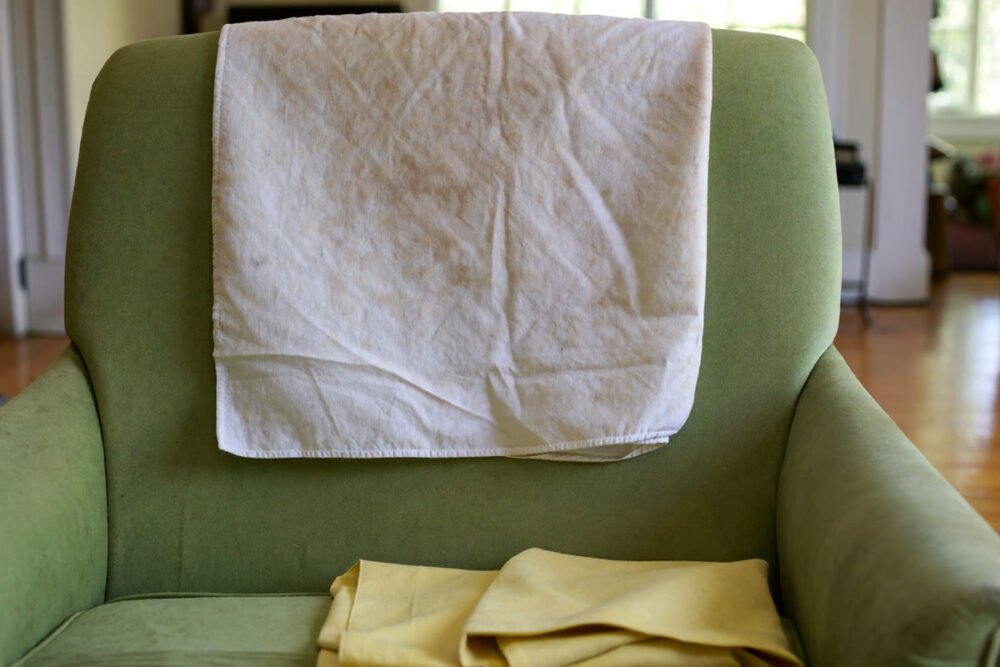
The difference between spit-up and vomit is not the amount and it is not what it looks like on your shirt. The AAP draws the line at force: vomiting is forceful, uses the abdominal muscles and usually leaves you with a crying baby, while spitting up flows out easily, often with a burp, in small amounts, and does not distress the baby at all.
Which means the thing you are staring at is the wrong evidence. Both of the events that would have answered this happened before you looked down.
The evidence was gone before you looked down
With my youngest there was a night when I knew before I saw anything. I was across the room with my back turned and the sound was wrong. Not the wet little cough that means a burp went sideways, something with a heave underneath it. I turned around already knowing which of the two it was going to be.
That is the whole trick and it is annoying, because it means what landed is not the exam. Force and distress are the two markers, and the AAP puts both of them in the moment rather than in the aftermath. Muscles that contract hard, and a baby who is upset about what just happened.
By the time you have looked down, the contraction is over and the face has usually reset. A baby who spat up is often already back to inspecting the ceiling. A baby who vomited is usually still telling you about it, which is the second half of the same test.
So if you missed it, you missed it, and that is not a failure of attention. It is a two second window and you were holding a bottle.
Why the size of it tells you almost nothing
I counted my eldest’s days in burp cloths. Four was a normal morning. Seven meant something, though I could never have told you what, and I remember genuinely believing the number was data.
It is not, and the reason is boring physics. A tablespoon of milk on a cotton shoulder makes a continent. The same tablespoon down the front of a sleepsuit vanishes. You are reading absorbency, not volume.
The phrase small amounts is doing real work in the AAP’s definition, but it describes what left the stomach rather than what you can see, and those are two measurements taken with completely different instruments.
There is also a whole category that leaves nothing to measure. Some babies have the symptoms without ever bringing milk up at all, which the NHS calls silent reflux, so a clean shirt is not proof of a settled stomach either.
Cluster feeding evenings make every part of this louder, because the volume going in climbs steeply and what comes back up follows it, which is why the evenings that feel like something has gone wrong are usually just the evenings.
It got decided at the last feed, not this one
My second barely spat up. Two shirts a week, and I concluded from that I had finally learned how to feed a baby. Better position, better burping, general competence acquired the hard way. My third took the whole theory apart in about two weeks, using nothing but her own opinion of it.
Some of it genuinely is technique, and the AAP’s list is short enough to actually do. Feed smaller amounts more often instead of letting the tank overfill. Burp during the feed as well as after it. Keep things calm afterward, which it puts at twenty to thirty minutes without bouncing or active play, and hold the baby upright for at least twenty minutes.
Notice what all of those have in common. They are things you do at this feed that pay out at the next one. There is nothing on that list you can do while it is already coming back up.
Air is the other half of it. Babies who gulp swallow air along with the milk, and escaping gas has a habit of bringing the rest with it, which is why the AAP answers a gassy gulper with positioning, burping during the feed, and trying a different bottle if you are bottle feeding.
Formula, and if you are breastfeeding your own diet, can both come into this, and both belong in a conversation with your pediatrician rather than in an experiment you run alone at midnight. Changing brands on a hunch at 2am is how you end up with two variables and no answer.
Which is why the honest answer to “was that spit-up or vomit” is often to watch the next one. You will be there. It comes around every couple of hours.
The one thing not to do to the crib
The night I came closest to getting this wrong, I was standing over my eldest’s crib at an indefensible hour with a folded towel in my hand, doing the arithmetic on whether it went under the mattress or under the sheet. It made complete sense to me at the time. Milk comes up, so tilt the baby, so it stays down.
Do not do it. The NHS is unusually blunt here and it is the only “do not” on its reflux page: do not raise the head of the crib or bassinet. Its sleep instruction for a baby with reflux is the same as for every other baby, flat on the back, not on the side and not on the front.
That instruction arrives without an exception for babies who bring milk up, which is the part worth saying twice. The sleep surface is not being weighed against the laundry here. It simply outranks it.
What you can do instead is upright before the crib, rather than the crib on a slope. Hold them up for a while after the feed, then put them down flat. The full set of sleep surface rules is in our post on where a baby should sleep, and reflux does not buy an exemption from any of them.
The ones that end the laundry problem and start a phone call
There is a short list where this stops being a question about washing and becomes a question about a phone. It is worth knowing by heart rather than by search bar, because you will want it at an hour when reading is hard.
The AAP’s version is one sentence with two halves. Contact your pediatrician if your baby vomits forcefully after every feeding, or if there is ever blood in the vomit. Every feeding, not one bad evening. The first can point to a narrowing at the stomach outlet called pyloric stenosis, the second to irritation of the esophagus or stomach, and both want a doctor rather than a plan.
The NHS urgent list adds colors and company. Vomit that is green or yellow, or has blood in it. Projectile vomiting. Blood in the stool. A swollen or tender belly. A very high temperature, or a baby who feels hot, cold or shivery. Being sick repeatedly and unable to keep fluid down. Diarrhea that has run for more than a week, or signs of dehydration. A baby who will not stop crying and is very distressed. Refusing to feed.
Blood in the stool is the one most likely to have you standing over a diaper in bad light trying to decide what you are looking at. That question deserves better than a 3am guess, so we gave it its own post.
There is a slower list too, for things that do not need tonight but do need an appointment. Not improving after you have tried the feeding changes, reflux appearing for the first time after six months, reflux still going past the first birthday, and weight that is not climbing or is falling. The NHS holds all four, and none of them are emergencies. They are just not wait and see either.
I called once, with my youngest, on a night that turned out to be nothing. The result was ordinary, I have never regretted the call, and I would rather write that sentence than a more impressive one.
For most babies the calendar does the work in the end. Reflux usually starts before a baby is eight weeks old and gets better by the time they are one, in the NHS account, which is a long stretch of laundry and a short chapter in the life of a person.
Mine is twenty months old now and the burp cloths have been demoted. They live in a drawer by the sink and they mop up spills that have nothing to do with her. That is what the end of this looks like, and nobody announces it when it arrives.
The short version
- The two things that answer this are force and the face, and both of them happen before you look down.
- What landed on you is a measure of the cloth, not of your baby.
- If you missed it, wait for the next feed. It is not a long wait.
- Everything that helps is done at the feed before, not during the mess.
- Nothing under the mattress and nothing under the crib legs. Flat and on the back, reflux or no reflux.
- Force at every single feeding, or blood, or a color that was never milk, and you put the laundry down and pick the phone up.
Sources
- American Academy of Pediatrics, HealthyChildren.org, “Why Babies Spit Up”, last updated 3 January 2025
- NHS, “Reflux in babies”, page last reviewed 10 June 2025
A note on this post. Written and edited by the NewBloom editorial team. NewBloom is not written by doctors, nurses or midwives, and nothing here is medical advice. We read the current guidance from bodies like the AAP, the CDC and the NHS and write down what it says, with every claim traced to its source and named in the sentence where it appears. General guidance is not the same as an answer about your baby. Your pediatrician, midwife or health visitor can see your child and we cannot, so anything here that raises a question about your own baby is a reason to ask them. If something is wrong right now, contact your doctor or your local emergency number. More about how we write these posts.