In the United States, the CDC says that most of the time it is safe to prepare powdered infant formula by mixing it with tap water, filtered or unfiltered, following the instructions on the container. The parts that actually change what ends up in the bottle are measuring the water before you add the powder, levelling every scoop, and knowing whether your baby is in the small group the CDC says needs the water boiled first.
That is the whole answer. The reason it takes longer than three sentences is that almost none of it is printed on the tin in a form you can read at three in the morning with one hand.
The water goes in first
The CDC’s instruction is to use the amount of water listed on the instructions of the infant formula container, and to always measure the water first and then add the powder.
It reads like a fussy detail, and it is the easiest thing in the whole process to do backwards. The measurements are printed on the side of the bottle, so the obvious move is to fill to the line and then start scooping. Nobody stops you. Nobody mentions it in the hospital either. Most people find out somewhere around week three, reading the side of the tin properly for the first time, and go quiet for a second.
The CDC is direct about what happens when the ratio drifts, in both directions. Too much water and, in its words, the formula would not meet the nutritional needs of your baby. Too little water may cause your baby’s kidneys and digestive system to work too hard, which the CDC says can make your baby dehydrated.
That is why stretching a tin is not a small economy. It comes up in the week the powder is running low and payday is Friday, and adding an extra ounce of water to make it last is an understandable thing to reach for. It is also the one shortcut that genuinely is not available, because the CDC ties it straight to a baby’s kidneys. If money is the reason, that is a call to the pediatrician’s office, and they will have heard it before.
Levelling the scoop is not fussiness
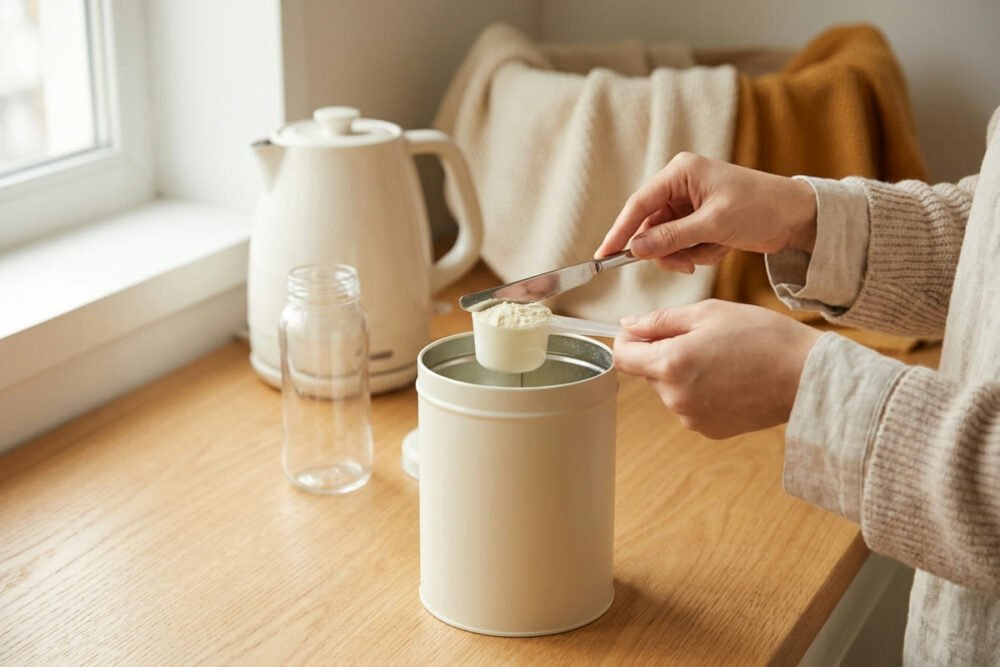
The NHS instruction is to loosely fill the supplied scoop and level it off using either the flat edge of a clean, dry knife or the leveller provided, and to put in only the number of scoops the manufacturer says.
Two words there are doing work. Loosely, and dry. Neither the NHS nor the CDC explains why in that sentence, and you do not need the reason to follow it, but the dry part lines up with the rest of the storage advice: the CDC says to keep an opened container in a cool, dry place with the lid tightly closed. A knife straight out of the drying rack puts water into a tin that is supposed to stay dry.
The NHS says the supplied scoop. The CDC says to follow the instructions on the container you are using. That is the same instruction twice. The scoop in your hand belongs to the tin in front of you, and a scoop that came free with a different brand is not a measurement.
There is a specific 4am failure state here that nobody warns you about, which is losing count. You are three scoops in, or four, and you genuinely cannot say. The only thing that works is starting the bottle again, and the reason it is worth the ninety seconds is the paragraph above.
You do not have to warm it
The CDC says infant formula does not need to be warmed before feeding. That sentence saves more nights than almost anything else on this page, because the warming step is what turns a two minute job into a six minute one while somebody is screaming.
If you do want it warm, the CDC says to place the bottle under running warm water, and to test the temperature by putting a few drops of formula on your wrist. It should feel warm, not hot. The NHS runs the same test from the other direction: cool the formula by holding the bottom half of the bottle under cold running water, moving the bottle about under the tap so it cools evenly, then test on the inside of your wrist. The NHS describes the target as body temperature, which it says should feel warm or cool, but not hot.
Same wrist, same answer, opposite starting points. The reason they start in different places is the next section.
Which babies need boiled water
This is the part not to skim.
The CDC says powdered infant formula is not sterile and can sometimes have germs such as Cronobacter, and that very hot water, around 158 degrees Fahrenheit or 70 degrees Celsius, is needed to kill these germs. Read that once more slowly: the germ being managed is in the powder, not in your tap.
For most babies, the CDC says tap water and the container instructions are enough. It then names three groups where extra precautions apply. Babies younger than 2 months. Babies born prematurely, meaning before 37 weeks of pregnancy. Babies with a weakened immune system. For those babies the CDC says to boil the water and then wait about five minutes before mixing with the powdered formula, and then to let the formula cool before feeding, because it will still be too hot.
The UK does this differently, for every baby, every feed. If you have been reading British parenting forums at 2am and quietly concluded you have been doing this wrong for four months, you have not. The full comparison is in Do You Have to Boil Water for Formula?
Bottled water, and the machine on the counter
The NHS says bottled water is not recommended to make up a feed, because it is not sterile and may contain too much salt, meaning sodium, or sulfate. The CDC’s position is narrower and situational. It says to use bottled water if you believe the tap water is unsafe, during something like a water main break, hurricane or flood, until local authorities say the tap water is safe to drink again.
The CDC adds one line worth remembering: water contaminated with harmful chemicals or toxins cannot be made safe by boiling, disinfecting or filtering. In that situation it says to mix formula with bottled water or use ready to feed formula, and to follow local public health advice.
On prep machines, the NHS is specific. If you use a machine to make up bottles, make sure the water that comes out of the machine is at least 70C when combined with the formula, and check it with a simple digital food thermometer. If the water is coming out below 70C, the NHS recommends you stop using the machine and go back to the manual method.
Before you start, and after you finish
The CDC’s first step is not about the bottle at all. Wash your hands, then clean and sanitize the workspace where you are going to prepare the formula. The bottles need to be clean and sanitized too.
The NHS adds one more, which is to make up feeds as your baby needs them, one at a time, to reduce the risk of infection. That one is genuinely hard at 3am and it is worth knowing it is a real instruction rather than a preference.
What happens to a bottle you have already made is a whole subject of its own, and it is written out in full in How Long Can a Bottle Sit Out?. The short version from the CDC is that prepared formula should be used within 2 hours of preparation and within one hour from when feeding begins, and that if you have not started it within 2 hours it goes straight into the fridge and gets used within 24 hours. Whatever is left in the bottle after a feed gets thrown out.
The tin itself
The CDC says to store unopened containers in a cool, dry, indoor place, and it specifically rules out vehicles, garages and outdoors. Once a container is open, keep it in a cool dry place with the lid tightly closed, and not in the refrigerator.
Most infant formulas need to be used within 1 month of opening, according to the CDC, which also says to confirm this on the label and to write the date on the lid when you open a new container. Never use formula after the Use By date.
Writing the date on the lid is the tip that survives sleep deprivation, because by week two you will not be able to reconstruct when you opened it and you will stand there trying.
What to actually do
- Wash your hands. Clean and sanitize the surface and the bottle.
- If your baby is under 2 months, was born before 37 weeks, or has a weakened immune system, boil the water and wait about five minutes.
- Measure the water into the bottle first.
- Add the number of scoops the tin says, using that tin’s scoop, filled loosely and levelled with a clean dry knife.
- Cap it and shake until the powder has dissolved.
- Cool it if it is warm, warm it only if you want to, and test a few drops on your wrist.
- Write the date on the lid when you open a new tin.
When to call the doctor
If you are not sure whether your baby falls into one of the three groups the CDC names, that is a question for the pediatrician’s office and not something to work out alone at 3am. The same goes for feeding volumes, weight gain, and any stretch where feeds have suddenly changed shape, which is often something else entirely and is covered in Cluster Feeding.
If money is making it hard to keep formula in the house, say so out loud to your pediatrician’s office rather than adjusting the ratio.
The short version
- The CDC says tap water, filtered or unfiltered, is fine for most babies.
- Water into the bottle first, then powder. Always that order.
- Use the tin’s own scoop, filled loosely, levelled with a clean dry knife.
- Boiled water is for babies under 2 months, babies born before 37 weeks, and babies with a weakened immune system. Boil, then wait about five minutes.
- Formula does not need warming. If you warm it, test it on your wrist.
- Write the date on the lid. Most tins are good for a month after opening.
If your baby is breastfed as well as bottle fed, the supplement question comes up around the same time and is answered in Iron for Breastfed Babies.
Sources
- Centers for Disease Control and Prevention, “Infant Formula Preparation and Storage”, Infant and Toddler Nutrition
- National Health Service (UK), “How to make up a feed”, Best Start in Life, bottle feeding
A note on this post. Written and edited by the NewBloom editorial team. NewBloom is not written by doctors, nurses or midwives, and nothing here is medical advice. We read the current guidance from bodies like the AAP, the CDC and the NHS and write down what it says, with every claim traced to its source and named in the sentence where it appears. General guidance is not the same as an answer about your baby. Your pediatrician, midwife or health visitor can see your child and we cannot, so anything here that raises a question about your own baby is a reason to ask them. If something is wrong right now, contact your doctor or your local emergency number. More about how we write these posts.