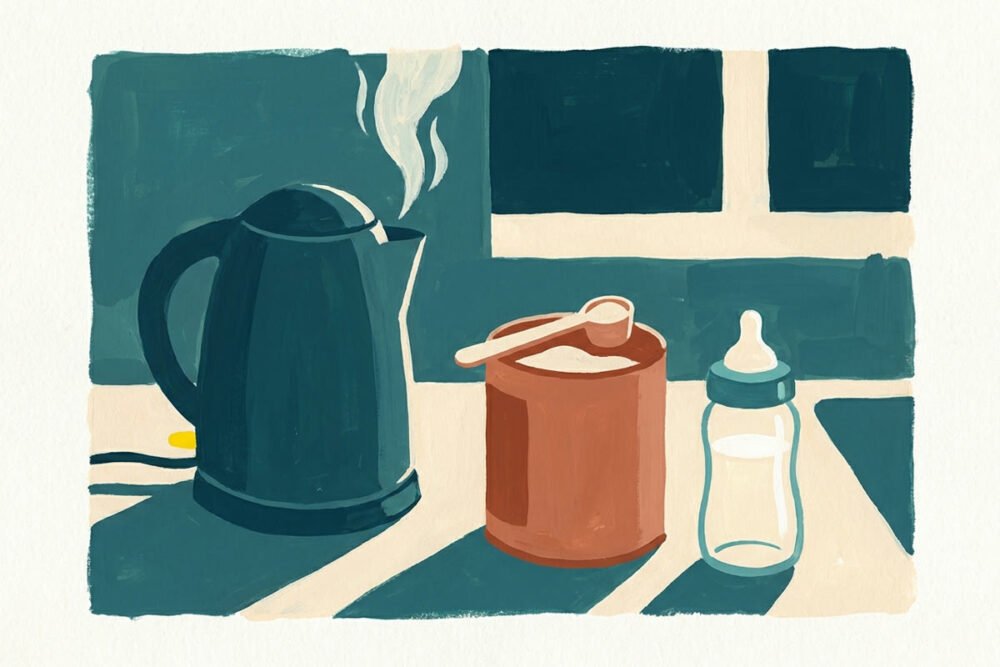
In the United States, no, not for most babies. In the United Kingdom, yes, every feed, every baby. Both are current national guidance and neither one is out of date.
If you found the British version at 2am and have spent the last hour deciding you have been doing this wrong since March, you have not. But the way this gets explained everywhere else, as two countries disagreeing, is what makes it impossible to settle. They are not disagreeing about the facts. They agree completely on the fact that matters, and it is not the one you think.
You are not boiling the water because of the water
This is the sentence that reorganizes the whole question, and neither health body puts it at the top.
The NHS says it plainly: even when tins and packets of powdered infant formula are sealed, they can sometimes contain bacteria. Powdered formula is not a sterile product. It is not supposed to be, and no amount of care in your kitchen changes what came in the tin.
So the water is not the suspect. The water is the tool. The NHS instruction to use it at 70C or above exists because, in its words, water at that temperature will kill any harmful bacteria. You are not cleaning the water. You are heating it enough to sterilize the powder as it goes in.
Once that is the frame, almost everything confusing about this stops being confusing. The tap water argument was never the argument.
The CDC names it. That is the difference
The CDC’s guidance is built around one organism, and it says so: Cronobacter. Its extra preparation steps are filed under preventing Cronobacter infection, and its list of who needs those steps is short and specific.
Babies younger than 2 months. Babies born prematurely, meaning before 37 weeks of pregnancy. Babies with a weakened immune system.
For those babies the CDC says to boil the water and then wait about 5 minutes before mixing it with the powder. For everybody else, it says most of the time it is safe to prepare powdered formula by mixing it with tap water and following the manufacturer’s instructions on the container.
Read the list again, because the first item is the one that catches people. Under 2 months is not a newborn-only rule that ends at the hospital door, and it is not a preemie-only rule. If your baby is seven weeks old today, you are on the list today. Next month you are not.
The real question is which baby you have
Here is the version that actually answers your night.
- Under 2 months, born before 37 weeks, or immunocompromised. Boil, and both countries now say the same thing. There is no ambiguity left for you at all.
- Older than 2 months, term, healthy. The CDC does not ask you to boil. The NHS still does.
The disagreement, the entire disagreement, lives in that second line. And it is not a disagreement about whether Cronobacter exists or whether the powder carries it. It is a disagreement about how much residual risk a national health service is willing to leave sitting with the general population, given that the illness is rare and the consequences when it happens are severe.
That is a policy judgment, not a laboratory finding. Two countries can look at the same organism and land in different places, and both can be defensible.
Which one to follow
Follow the one where you live and where your formula was made, because the manufacturer’s instructions on your tin were written for that system. If you are in the US and your baby is not on the CDC’s list, you are not doing anything wrong by not boiling.
And if you would rather boil anyway, that is not overcautious. It is the standard method for sixty million people. Nobody is going to tell you it is worse.
The thirty minutes nobody mentions
If you do boil, this is the part that goes wrong, and it goes wrong in both directions.
The NHS gives a window. Boil at least 1 liter of fresh tap water from the cold tap, then leave it to cool in the kettle for no more than 30 minutes, so it stays at a temperature of at least 70C. Not previously boiled water. Not artificially softened water.
Wait too long and the water drops below 70C, which means it no longer does the one job it was there for. You have gone through the whole ritual and produced an ordinary bottle. Do not wait at all and it is dangerously hot and has to be cooled afterwards anyway, which the NHS handles by telling you to hold the closed bottle under cold running water and test it on the inside of your wrist.
The CDC’s version for its three groups is different and worth not mixing up: boil, then wait about 5 minutes, then mix. Different number, different system. Use the one that goes with your instructions.
One more thing in the sequence that looks like fussiness and is not. The water goes into the bottle first, while it is still hot, before the powder. Powder into hot water is the point. Hot water poured onto powder that is already sitting there is not the same event.
The machine on the counter
Preparation machines are the one place where following the guidance and following the appliance can quietly diverge.
The NHS position is that if you use one, the water it delivers must be at least 70C when it mixes with the powder, and it suggests checking with a digital food thermometer. If the water is below 70C, stop using the machine and go back to the kettle method.
Worth doing once. A machine that dispenses at 65C is not a slightly worse kettle. It is a machine that is not doing the thing you bought it to do, and it will keep not doing it every night until somebody measures.
Bottled water is not the safe upgrade it sounds like
This one surprises people, because bottled water feels like the cautious choice.
The NHS does not usually recommend it for making up formula, because it is not sterile and may contain too much sodium or sulfate. It is for rare circumstances, such as when drinking water is unavailable or has been contaminated, and even then the same preparation steps apply.
The CDC treats it the same way, as the emergency option. If you believe the tap water is unsafe, during a water main break, a hurricane or a flood, use bottled water until local authorities say the tap water is safe to drink again. If tap water is the only thing you have, make it safe by boiling or disinfecting, and let it cool to room temperature before mixing.
And one line that is worth carrying out of here whatever country you are in. The CDC says water contaminated with harmful chemicals or toxins cannot be made safe by boiling, disinfecting or filtering. Boiling concentrates them. In that situation the answer is bottled water or ready to feed formula, plus local public health advice.
If you have been doing it the other way
Nothing to undo, and nothing to sit up over.
If you are in the US, have a healthy term baby over 2 months, and have never boiled, you have been following the CDC. If you have been boiling every feed because somebody’s mother in law is British, you have been following the NHS. Neither of those is a mistake you made.
The only thing worth changing tonight is if your baby is on the CDC’s list of three and nobody told you.
What to do tonight
- Check the list first. Under 2 months, under 37 weeks at birth, or a weakened immune system.
- On the list: boil, wait about 5 minutes, then mix. Both countries agree here.
- Not on the list, in the US: tap water and the tin’s instructions are the guidance.
- Boiling by choice: 30 minute window, no longer, so the water stays at 70C or above.
- Water into the bottle first, hot, then the powder.
- Using a machine: measure what it actually dispenses, once.
- Bottled water is the emergency answer, not the careful one.
When to call the doctor
If your baby was born preterm, has any condition affecting their immune system, or is being fed formula in a hospital or under any kind of medical supervision, ask them what they want rather than picking a country off a web page. That is exactly the situation the CDC’s list exists for, and your team may have their own instruction on top of it.
A baby with a fever, unusual irritability, poor feeding or low energy needs a call regardless of how the bottle was made. Those are reasons to phone somebody, not reasons to reread this page.
Sources
- Centers for Disease Control and Prevention, “Infant Formula Preparation and Storage”
- National Health Service (UK), “How to make up baby formula”
A note on this post. Written and edited by the NewBloom editorial team. NewBloom is not written by doctors, nurses or midwives, and nothing here is medical advice. We read the current guidance from bodies like the AAP, the CDC and the NHS and write down what it says, with every claim traced to its source and named in the sentence where it appears. General guidance is not the same as an answer about your baby. Your pediatrician, midwife or health visitor can see your child and we cannot, so anything here that raises a question about your own baby is a reason to ask them. If something is wrong right now, contact your doctor or your local emergency number. More about how we write these posts.