A newborn can stop breathing for several seconds in her sleep and be entirely fine. The American Academy of Pediatrics places it inside one specific sleep stage and gives it a name, normal periodic breathing of infancy.
What that means at two in the morning is worse than it sounds. It means your ears are not the instrument. The ordinary thing and the emergency make the same sound, which is no sound at all, and the two things that actually separate them are what color she is and whether it ends.
The stop is what wakes you, not the noise
I woke up once with my third because a sound stopped. There is no better way to put it. Nothing happened, and the nothing was loud enough to take me from asleep to upright in one movement.
I have also been woken by a noise she made, on a different night, and the two are not the same experience. A noise gives you something to walk toward. Silence gives you the whole length of the hallway to decide what you are about to find.
The AAP’s description of newborn sleep puts the pause inside REM sleep, which the page also calls active sleep. Breathing there is often irregular and may stop for 5 to 10 seconds. That is where the name lives: normal periodic breathing of infancy.
Newborn sleep is built in stages that look nothing like an adult’s, and that architecture explains most of the night. It is also why a pause is not a random event. It belongs to one part of the cycle.
A name is not nothing at that hour. Half of what makes the hallway unbearable is the private conviction that you are the first person this has ever happened to.
Count it before you touch her
With my eldest I put a hand on her back before I did anything else, every single time, which means I have no idea how long a single one of those pauses was. Not one of them. I turned every episode into a number I could never check, because the second I touched her she moved, and after that I could not tell whether it had ended by itself or ended because of me.
I changed the order eventually. Hand second. It is the least natural thing I have ever made myself do, it took months before it stuck, and I still do not think it is a fair thing to ask of anyone.
The reason it matters is that both of the numbers on these pages are lengths of time. The AAP’s newborn sleep page puts the ordinary pause at 5 to 10 seconds inside active sleep. Its sleep apnea page draws the 911 line at a breath that stops for more than 20 seconds. Neither number is available to somebody who reached into the crib at second three.
Counting is not a diagnosis and it is not being clinical about your own baby. It is the only way to answer the one question you can actually answer while standing there, which is whether it ended.
What her color is doing is the other half
Color is the only other thing in front of you doing any work, and unlike the counting it does not ask you to keep your hands to yourself.
The line on the AAP’s newborn sleep page is easy to skim straight past. During normal periodic breathing, the baby’s skin color does not change with the pauses, and the page sets apnea against that in a parenthesis immediately afterwards, as the contrast.
The sleep apnea page runs the same fact from the other direction. Skin that has changed to pale, bluish or grayish is one of the things on its list for calling 911, not for calling anybody else.
Reading color at night is genuinely difficult and nobody warns you about it. A hall light turns everything yellow. A phone screen turns everything blue, which is the exact word you are trying to decide about and the last color you want your own light source inventing for you.
The catch up breath sounds worse than the pause did
With my eldest the thing that got me out of bed was almost never the pause. It was what came after it. A pause is quiet, and a pause does not travel through a wall. The gasp does.
I spent months treating that sound as the emergency and I had it precisely backwards. The sound was the part where it was already over.
The AAP gives the sequence in order and the order is the whole point. The pause, then a burst of rapid breathing at the rate of 50 to 60 breaths a minute for 10 to 15 seconds, then regular breathing again until the cycle repeats. Its sleep apnea page describes the same shape in plainer words, as pauses followed by rapid catch up breathing and then a return to regular breathing.
That second page also gives an end to it, which almost nothing in newborn care does. Babies should outgrow periodic breathing of infancy by age 6 months, and that number belongs to the AAP’s 2024 sleep apnea page rather than to the sleep stages page.
Six months is not a promise about tonight. It is the difference between a thing you are living inside and a thing with a far wall, and on the fourth night of this that difference is not small.
Of every noise she makes, one of them is on a list
My son, the middle one, barely made a sound in his sleep. Whole nights of nothing. I took that as evidence that I had got better at this, which is a mistake I have now made in at least three separate forms.
So when the baby arrived and turned out to be noisy, I read her against my eldest, because my eldest was the only noisy baseline I had. Six years old by then, long out of that room, and still the ruler I was measuring with.
Here is what I did not know while I was doing it. The AAP’s description of ordinary newborn sleep does not name a single sound. Not one. It gives you twitching, irregular breathing, pauses, bursts of rapid breathing, skin color, and it never once tells you what any of that is supposed to sound like.
One sound does appear, and it appears on a different kind of list. In its rundown of common conditions in newborns, the AAP puts grunting while breathing among five warning signs of respiratory distress, and those five carry the instruction to notify your pediatrician immediately.
- Fast breathing, more than sixty breaths in one minute.
- Retractions, meaning the muscles between the ribs sucking in with each breath so that her ribs stick out.
- Flaring of her nose.
- Grunting while breathing.
- Persistent blue skin coloring.
The first item will stop you, because the same organization describes an ordinary burst at 50 to 60 breaths a minute somewhere else. The AAP writes the qualifier into that line itself, adding that you should keep in mind that babies normally breathe more rapidly than adults.
I am not going to resolve those two numbers for you. Nothing I opened resolves them, and the resolution is not the thing you need at three in the morning.
What you need is the axis that does not depend on you being right about a rate. That is her color, and whether it ended. Both of those have their own lines on these pages, and neither of them is a sound.
The line where you stop counting and call
There is a point where counting stops being useful and turns into a way of not doing the other thing. Knowing in advance where that point sits is most of what lets you stay calm on the way to it.
The AAP’s sleep apnea page names three, and these are a 911 call rather than a call to the office.
- Her breath stops for more than 20 seconds.
- Her skin color has changed to pale, bluish or grayish.
- There is a change in muscle tone, or she has a fever or other symptoms of illness.
The third one is worth reading twice, because most of it is not about breathing at all. A fever belongs on that list too, which means the pause is not the only thing you are being asked to look at.
Taking a newborn’s temperature at that hour is its own small ordeal, and it is worth having already settled how you do it in daylight, well before the night you need it.
None of this is a diagnosis and none of it replaces the person who knows your baby. A pause you are still thinking about at breakfast is a reason to say it out loud to your pediatrician, even if it never came close to twenty seconds.
What you actually do at three in the morning
Everything above collapses into a small number of physical decisions, and most of them turn out to be about the room rather than about the baby.
Leave the overhead light off. Partly for her sake, but mostly because you are about to read color, and I have stood in that room under two different lights and got two different answers about the same skin.
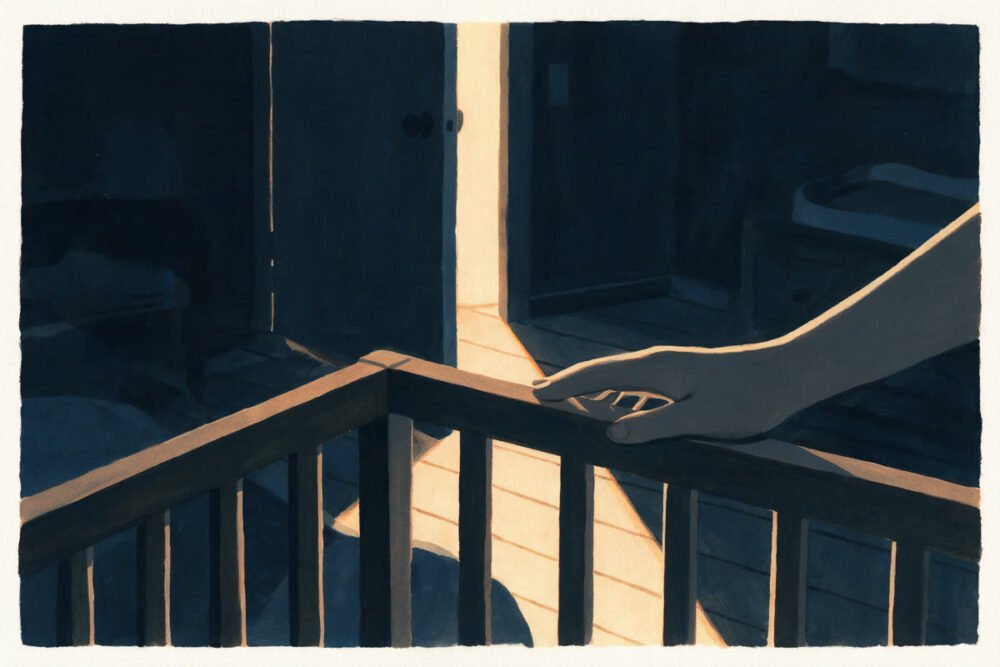
Work out the angle in the daytime. There is one position in most rooms where a door left ajar lays a band of light across the crib without putting it on her face, and finding that at 3am with your heart going is not the moment to be surveying.
Eyes first, hands second. Count out loud if it helps, quietly, because counting inside your own head at that hour produces numbers that are not real.
Decide about the temperature of the room while you are awake enough to think, since that is another judgment made by touching and looking rather than by a number on a wall, and it is the sort of thing you do not want to be reasoning about mid panic.
And keep the noise question in a separate box from this one. Newborn sleep is full of sounds that mean nothing whatsoever, and that belongs to a different conversation. This page is about the gaps between them.
The short version
- Look before I touch. Touching ends the pause, and then I never find out whether it was going to end on its own.
- The two things I can use are her color and whether it stopped. Both are things I see. Neither is a sound.
- The gasp afterwards is the loud part and it is the part where it is already finished. I had that the wrong way round for a year.
- Grunting is the one noise that belongs on somebody else’s list. What I do with it is repeat it to my pediatrician, not rank it myself.
- Know the light in that room before I need it. That decision gets made in daylight or it does not get made.
Sources
- American Academy of Pediatrics, HealthyChildren.org, “Stages of Newborn Sleep” (last updated 18 September 2013)
- American Academy of Pediatrics, HealthyChildren.org, “Sleep Apnea in Children: Detection & Treatment” (last updated 24 April 2024)
- American Academy of Pediatrics, HealthyChildren.org, “11 Common Conditions in Newborns” (last updated 12 March 2021)
A note on this post. Written and edited by the NewBloom editorial team. NewBloom is not written by doctors, nurses or midwives, and nothing here is medical advice. We read the current guidance from bodies like the AAP, the CDC and the NHS and write down what it says, with every claim traced to its source and named in the sentence where it appears. General guidance is not the same as an answer about your baby. Your pediatrician, midwife or health visitor can see your child and we cannot, so anything here that raises a question about your own baby is a reason to ask them. If something is wrong right now, contact your doctor or your local emergency number. More about how we write these posts.