Swollen feet in pregnancy do not come down because you sat down. They come down because you stopped staying in one position, and those two things feel identical from the inside while producing completely different days.
The NHS page on swollen ankles, feet and fingers in pregnancy gives four things that help. Two of them look like opposites when you read them one after the other, and which one you treat as the real instruction decides what your whole afternoon looks like.
The sandals fit this morning
The sandals fit this morning. I put them on standing in the hallway without thinking about it, which is how you know a thing fits.
By four in the afternoon there was a soft dent across the top of each foot where the strap had been sitting. By the evening I had let the buckle out a notch, and I had done it without deciding to, the way you push a sleeve up.
None of that surprises the guidance. On the NHS page, swelling in pregnancy is described as often worse at the end of the day and further into your pregnancy, which is a sentence that fits my sandals exactly and still tells me nothing about what to do at two in the afternoon.
The thing collecting in there is water. Your body holds more of it now, and the NHS explanation for where it ends up is gravity and time: it gathers through the day in the lowest parts of your body, especially if the weather is hot or you have been standing a lot. Both of those were true of my Tuesday, and I could not have told you which one mattered more.
So your feet are not a symptom. They are a record. At eight in the evening they are not telling you what is happening. They are telling you what shape your day had.
Two of the four things on the list argue with each other
Here are all four. The order is the NHS’s own, and the wording is close enough to theirs that you can go and check it. Avoid standing for long periods. Wear comfortable shoes and socks, avoiding tight straps or anything that might pinch if your feet swell. Rest with your feet up as much as you can. And exercise, which the page spells out as taking regular walks during the day or doing foot exercises.
Read the third one and the fourth one back to back. Rest with your feet up as much as you can, then take regular walks during the day. As much as you can is a phrase that will eat an entire afternoon if you let it, and regular walks needs several pieces of that same afternoon handed back.
I spent most of my first pregnancy quietly failing at both. I would sit with my feet on a cushion feeling like I should be walking, then walk feeling like I should have my feet up, and get to the evening having done a small unsatisfying amount of each while feeling behind on both.
The list is not wrong. It is four true things printed in the order somebody thought of them, and nobody who wrote it had to fit them into one Tuesday with a three year old in it.
What they agree about is not walking, it is standing still
Put the four beside each other and look for what they are all against, instead of what each one is for. There is only one answer, and it is not being upright.
The first item is the tell. It does not say avoid standing. It says avoid standing for long periods, and everything is being carried by the second half of that.
Walking is standing. It is standing with your calves working, which is the entire difference. The line at the store and the walk to the store put your body in almost the same shape, and only one of them is on the list of things to avoid.
Which is why foot exercises sit on that page next to walking rather than next to resting. There are two, and the NHS says you can do them sitting or standing:
- Bend and stretch your foot up and down 30 times.
- Rotate each foot in a circle 8 times one way and 8 times the other way.
The reason given for them is blood circulation, and the result claimed is less swelling in the ankles.
My daughter is three and she found me doing them on the kitchen floor. She sat down on my shins and did her own version, which involved much more of the leg than the ankle, and then asked for it again the next morning. That is the only reason I have done them more than twice.
I am not going to dress that up as a system. The version of any of this that survives contact with a toddler is the version that happens where the toddler already is.
And the shoes item, which looks like the softest one on the list, is the one I had most wrong. Avoiding tight straps is not advice about comfort. It is an acknowledgment that the foot you dressed at eight in the morning is not the foot you will be wearing at six.
The part of tonight that was decided before lunch
Once you take the feet as a record, the useful question moves. It stops being what do I do about this now, and becomes which parts of today were always going to end up in my ankles.
Mine were all in the middle of the day and none of them looked like standing. Waiting by the stove for the pasta. Standing at the bottom of the stairs having the sock negotiation for the fourth time. Standing in a bathroom doorway while somebody who is learning to use the toilet takes her time about it, because sitting down myself would end the entire procedure.
Not one of those is standing for long periods in the way that phrase sounds. There is no line and no waiting room anywhere in it. Added together it was most of an afternoon on my feet, in pieces too small for me to have pointed at any one of them as the problem.
This is a second pregnancy and the first thing to go was the idea that the day is mine to rearrange. I have written before about what that does to advice written for somebody who can lie down, and swelling advice has exactly the same blind spot.
Heat is doing separate work underneath all of this, and it is not really about your feet. The CDC’s page on heat and pregnancy says pregnancy can make you more likely to get heat exhaustion, heat stroke or other heat related illness sooner than someone who is not pregnant, because your body has to work harder to cool down both you and the developing baby.
There is a second line on that page that catches people, and it is about dehydration. The CDC’s point is not thirst. It is that when you are dehydrated you cannot cool yourself as well by sweating, which means the hot day is quietly removing the equipment you would use to get through a hot day.
Worth knowing at four in the afternoon, when the story you are telling yourself is that you have gone soft.
What actually changed my evenings was not a rule. It was finding three places in this house where my feet can go up without me having to relocate to a different room first.
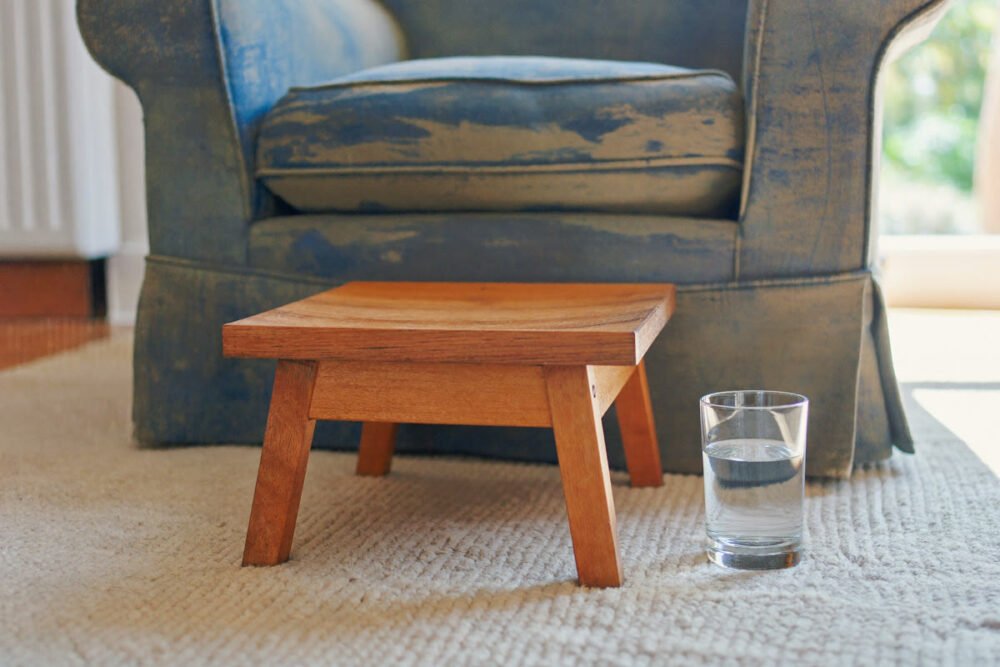
There is the low step just inside the front door, which is the right height if I sit on the second one. There is the spare kitchen chair, which I drag round with my foot while whatever is in the pan carries on doing its thing. And there is the arm of the sofa, which is the only one of the three that looks like resting, and was therefore the only one I had ever thought of.
That last part is the whole lesson. Feet up was competing with the rest of my life because I had filed it as an activity. It is not an activity. It is a position, and a position can happen inside something else you were already doing.
In my first pregnancy I had an explanation for all of it, and the explanation was that I had been standing. That was true. It was also gone by morning every single time, which is exactly what taught me to put it down and never pick it up again.
Nothing came of any of that. I am not telling it as a near miss, because it was not one. I am telling it because a symptom that clears overnight trains you to stop looking at it, and the looking is the part the next section needs.
The swelling this post is not about
Everything above is about swelling that arrives gradually. The NHS is direct that this kind is not usually harmful to you or your baby, and equally direct that it can be uncomfortable, which is a fair summary of a hot week.
There is another kind, and one word separates them. Sudden. A sudden increase in swelling can be a sign of preeclampsia, the NHS says, a condition that needs to be monitored as soon as possible.
The same page carries an urgent advice box. It asks you to call your midwife, GP or labor ward immediately if you have any of these:
- a sudden increase in swelling in your face, hands or feet
- a very bad headache
- problems with your vision, such as blurring or flashing lights in your eyes
- severe pain just below your ribs
- heartburn that does not go away when you take antacid medicine
- feeling very unwell
- feeling sick (nausea) and being sick (vomiting)
These could be symptoms of preeclampsia, the box adds, which can lead to serious complications if it is not monitored and treated.
I read that list on my phone one evening with my feet on the low step. Getting through seven items took under a minute. Putting the phone down took another twenty, and nothing on it applied to me.
The swelling item is the weakest one to lean on, and it is the one you will reach for first because it is the one you already have. The word doing the work in it is sudden, and sudden is a comparison rather than a feeling. It needs a yesterday to measure against, and the only person holding your yesterday is you.
Feet and hands are also where other pregnancy questions land, and not all of them are water. Itching in those two places in particular is a different question with a different answer, and folding it into this one is how it gets missed.
One more thing about that box, and it is the part I did not expect. This list does not end at the birth. Preeclampsia can start after the baby is out, and the version that does has its own name and its own timing. Nobody hands you that page on the way home, which is why it is worth reading while you still think of yourself as pregnant.
The short version
- Sitting down is not the lever. Not staying put is, and it costs you far less of the day than resting properly does.
- The feet you have tonight were built in the middle of the afternoon, and the middle of the afternoon almost never looks like standing.
- Find the places in your own house where your feet can go up inside something you were already doing. Mine are the two I would never have picked.
- Dress the foot you will have this evening, not the one you have now.
- Gradual is the ordinary one. Sudden is the one that gets a phone call, and sudden means compared to your own yesterday, not to anybody else.
Sources
- NHS, Swollen ankles, feet and fingers in pregnancy, page last reviewed 19 April 2024, next review due 19 April 2027
- Centers for Disease Control and Prevention, Heat and Pregnancy, Heat Health, June 25, 2024
A note on this post. Written and edited by the NewBloom editorial team. NewBloom is not written by doctors, nurses or midwives, and nothing here is medical advice. We read the current guidance from bodies like ACOG, the CDC and the NHS and write down what it says, with every claim traced to its source and named in the sentence where it appears. General guidance is not the same as an answer about your own body. Your doctor, midwife or health visitor can examine you and we cannot, so anything here that raises a question about your own pregnancy is a reason to ask them. If something is wrong right now, contact your doctor or your local emergency number. More about how we write these posts.