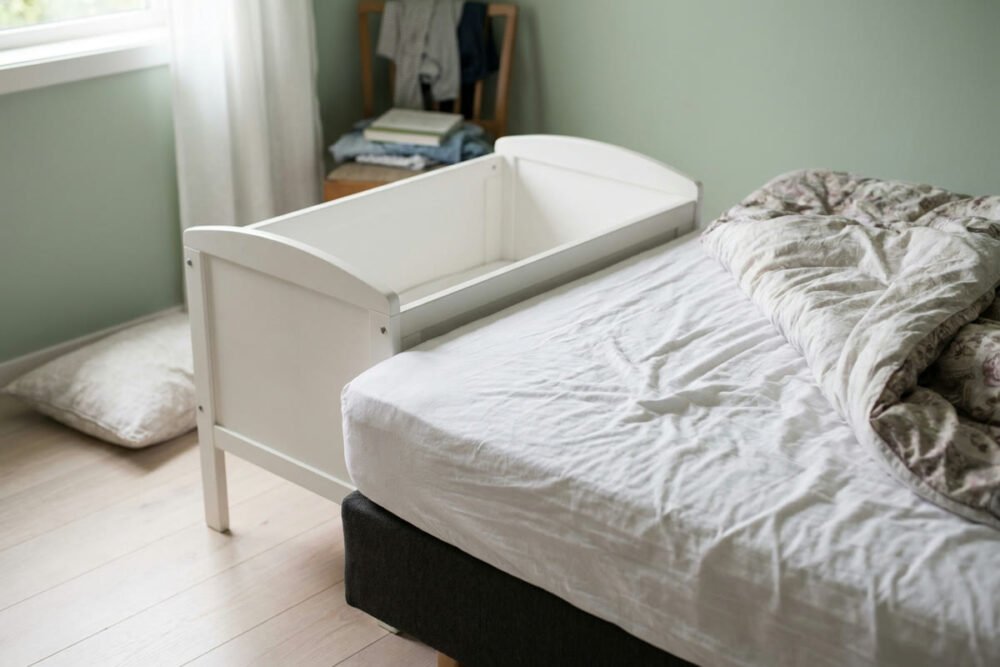
You woke up and the baby is still there beside you, and you are now holding a phone in the dark trying to find out how bad that was. Move the baby to their own sleep space first, before you read anything else, because that is the instruction the American Academy of Pediatrics writes for exactly this moment.
Then the honest part. This question is in the past tense, so the answer cannot be do not do it. The answer is what you look at in the next thirty seconds, and then what tomorrow night’s bed looks like before you get into it.
The first thirty seconds
My third was about four months old and I was feeding her lying on my side at four in the morning, which I had told myself was not the same as bed sharing because I was awake. I woke up an hour later with the ceiling light still on, my arm dead under my own weight, and my phone somewhere under my hip.
What I did next was nothing, for a good ten seconds, because I was busy being horrified. That is the part I would take back. The order should be baby first, feelings second, and the feelings will still be there.
The AAP puts it in one line for this exact situation. As soon as you wake up, move your baby to their own bed. That instruction sits inside its safe sleep guidance not as a punishment but as the thing to do when the night has already gone the way it went.
Do that before you start the search. The reading can happen with the baby in the bassinet.
What you are actually looking at
Once she was in the bassinet I went back and looked at the bed, and I could not tell you now what I thought I was looking for. Something obvious, I suppose. Some evidence.
There is a short list, and it is not mysterious, because it is the same list of hazards the guidance names. According to the AAP, the things that make a bed dangerous in this situation are pillows, sheets, blankets or any other item that could cover the baby’s face, head or neck, or that could overheat them. It also names the adult, because a parent can roll onto a baby during sleep and a baby can get tangled in the sheets.
So the scan is short. Was anything over her face. Was she hot. Where was she in relation to the edge of the bed and to the other person in it.
My own answers that night were fine, fine, and much too close to the edge, and the last one was the one I had not been thinking about at all. I had spent weeks worrying about the comforter and none at all about the eighteen inches of mattress between her and the floor.
This is not the post telling you it is fine
I am not going to soften the position, because you would find it in ten seconds anyway and then you would trust nothing else here. Based on the evidence, the AAP does not recommend bed sharing with a baby under any circumstances, and its guidance says that if you bring the baby into your bed to feed or comfort them, you put them back in their own sleep space when you are ready to go to sleep.
That is the plan, and the plan is the part you still control. What happened last night is not available for editing. The rest of this is about the nights that have not happened yet, which is the only place where any of this guidance can actually be used.
The full picture of what counts as a safe surface, and what room sharing means as distinct from bed sharing, sits in where your baby should sleep. This post assumes you already know the rule and broke it by falling unconscious, which is a different problem from not knowing.
If you woke up on the couch, that is a different question
With my second I did most of the night feeds in an armchair in the corner, and I want to be clear about why, because it was not laziness. I chose the chair precisely because I thought the bed was the dangerous option. Upright felt like a promise I would stay awake.
It is not, and the numbers are not close. The AAP says the risk of sleep related infant death is up to 67 times higher when infants sleep with someone on a couch, a soft armchair or a cushion, and it tells parents specifically not to fall asleep on a sofa or an armchair while holding their baby.
That changes what the fix is. If you woke up in bed, the work is bedding and position. If you woke up on the couch, the work is that the feed has to happen somewhere else from now on, and no amount of tidying the cushions touches it. The other risk multipliers, the ones about being exhausted or having taken something, are laid out alongside the surface rules in that post above.
My chair went out to the garage before my second was five months old. It was the single least sophisticated decision I made that year and probably the most useful one.
The bed you make before you are tired
Here is where all of this actually lands. Nobody makes a good decision at four in the morning with a screaming baby and a wet shirt. The decision gets made at nine at night, when you are still a person, and it takes about a minute.
The guidance is written for this, and it is not written as if you were going to be perfect. The AAP says that if there is any possibility that you might fall asleep while your baby is in your bed, make sure there are no pillows, sheets, blankets or any other items that could cover the baby’s face, head and neck or overheat them.
Notice what that assumes. It assumes you might. It is not asking you to guarantee anything, it is asking you to prepare the surface for the version of the night where your body wins.
By my third my side of the bed at bedtime looked stripped, which my husband hated. One pillow, on the floor once I lay down to feed. The comforter folded back to my knees. The bassinet pulled up against the frame, which is what the AAP is asking for when it says to keep the crib or bassinet within arm’s reach and to room share for at least the first six months, preferably the first year, because room sharing without bed sharing lowers the risk of SIDS by as much as half.
None of that stopped me falling asleep. It changed what she was lying on when I did.
And if these feeds have suddenly stacked up into a wall of them every evening, that is its own pattern with its own explanation, and cluster feeding is worth understanding before you decide your nights are broken forever. If it is the small hours specifically that have fallen apart, the reasons a baby keeps waking at night are more ordinary than they feel at the time.
When to call the pediatrician
I will be straight about what I could not find. There is no official after the fact checklist for a baby who was in the bed, woke up, and is now lying in a bassinet looking entirely unbothered. The guidance is all written facing forward, at the sleep that has not happened yet, and the absence of a checklist is itself an answer of a kind.
A baby who is not breathing, or who you cannot wake, is 911 and nothing else. That is not a judgment call and it is not a wait and see.
Short of that, call your pediatrician the same day if the baby was under bedding or wedged against something and afterwards seems different to you in how they are breathing, feeding or waking. You are allowed to make that call on the strength of something being off rather than something being wrong. That is what the number is for.
And if this has happened more than once, that is the thing to say out loud at the next visit, not the individual night. Once is a night. A pattern is a conversation about what your nights are actually like, which is a much more useful appointment.
The short version
- Move the baby before you read anything, then be upset. The order is the only part of it that is urgent.
- Look at three things on the bed. Anything near the face, how warm she is, and how close she was to the edge. Mine was always the edge.
- The couch and the armchair are not a milder version of the bed. If that is where you woke up, the feed moves rooms, and tidying the cushions is not the fix.
- Strip your side of the bed at bedtime, not at four in the morning. You are preparing for the night where your body wins, because sometimes it will.
- Once is a night. Twice is something to say to your pediatrician in a normal voice at a normal appointment.
Sources
- American Academy of Pediatrics, HealthyChildren.org, “How to Keep Your Sleeping Baby Safe: AAP Policy Explained”
- American Academy of Pediatrics, HealthyChildren.org, “Safe Sleep: 9 Ways to Reduce a Baby’s Risk of SIDS & Suffocation”
A note on this post. Written and edited by the NewBloom editorial team. NewBloom is not written by doctors, nurses or midwives, and nothing here is medical advice. We read the current guidance from bodies like the AAP, the CDC and the NHS and write down what it says, with every claim traced to its source and named in the sentence where it appears. General guidance is not the same as an answer about your baby. Your pediatrician, midwife or health visitor can see your child and we cannot, so anything here that raises a question about your own baby is a reason to ask them. If something is wrong right now, contact your doctor or your local emergency number. More about how we write these posts.