Most morning sickness advice works. What almost none of it admits is that it was written for a person whose day can bend, and a pregnant woman with a toddler does not have one of those days. I am pregnant with my second, my daughter is three, and this round of nausea is running on her schedule, not mine.
That changes which tricks survive. This post is the list that made it, plus the safety lines that matter more this time, exactly because you are too busy to watch yourself.
Nobody in this house cares that I’m nauseated
Breakfast in this house happens at seven. Not because a book said so, but because my three-year-old wakes up hungry and loud, and a closed bedroom door means nothing to her.
With my first pregnancy, a bad wave meant lying very still with my eyes closed until it passed. I remember that version of coping the way you remember a vacation. This time the wave lands while I’m pouring milk, and the milk still has to get poured.
Here is the thing I wish someone had told me at the start of round two. The lists all assume your day is yours to rearrange. The second time, morning sickness happens on a three-year-old’s schedule, and the only tricks that survive are the ones that fit inside it. Everything below passed that test. Everything that needed a quiet morning did not.
Too busy to notice is the actual risk
The second time, the risk isn’t ignorance. You already know what morning sickness is. The risk is that a toddler’s needs are loud and yours are quiet, and you can get to bedtime without once having asked how you actually are.
So the warning signs have to be checked on purpose, not noticed in passing. The NHS says to call your midwife or doctor if you are vomiting and your urine is very dark or you haven’t urinated in more than eight hours, if you can’t keep food or fluids down for 24 hours, if you feel very weak, dizzy or faint when you stand up, if you have belly pain or a fever, if you vomit blood, or if you are losing weight.
ACOG’s list of dehydration signs overlaps and adds one: small amounts of dark urine, being unable to urinate, not keeping liquids down, dizziness or faintness on standing, and a racing or pounding heartbeat. Any of those is a call to your provider, today.
Two more things are worth knowing cold. According to ACOG, nausea and vomiting that shows up for the first time after nine weeks of pregnancy usually isn’t morning sickness at all and points to another cause, so a late arrival is a call, not a wait. And the severe form, hyperemesis gravidarum, occurs in up to 3 percent of pregnancies and may be diagnosed when a woman has lost 5 percent of her pre-pregnancy weight along with signs of dehydration. Weight sliding away quietly is exactly the kind of thing a busy week hides.
My own check is almost embarrassingly small. Every time I refill my daughter’s water cup, I refill mine. On the days I realize I’ve been skipping my half of that ritual, that’s my flag that the day has been running me instead of the other way around.
Her breakfast is the worst meeting of my day
The single worst moment of my day is a plate of warm scrambled eggs. My daughter’s plate, not mine. The smell comes off it in a cloud, and I stand there serving it with the straight face of a diner cook who hates eggs.
The standard advice is to eat cold food instead of hot food when the smell of a hot meal sets you off, and the NHS is right about that as far as it goes. What it skips is that the hot meal making you sick might not be yours. You can stop cooking hot food for yourself. You cannot stop feeding a toddler.
So the menu I changed was hers. Cold breakfasts now: yogurt, fruit, bread, cheese. She did not mourn the eggs for a single morning, which stung a little, and the worst meeting of my day quietly fell off the calendar.
The trash became my husband’s, wordlessly and permanently. If a smell job in your house can move to someone else’s hands, move it, and don’t feel obligated to earn it back later.
Eating like a toddler, on purpose
Somewhere in the early weeks I noticed I was already living next to a working nausea diet. It belonged to my daughter.
A toddler eats little and often, and most of it is plain food anyway. That is close to word for word what the guidance prescribes. ACOG suggests five or six mini meals a day so your stomach never sits empty, plus crackers or dry toast in the morning before you get out of bed, and the NHS adds ginger, in food or drink, as worth a try.
So I stopped trying to build my own eating plan and boarded hers. When her mid-morning snack comes out, one comes out for me. When she gets her afternoon crackers, so do I. Her schedule is enforced by a person who will scream if it slips, which makes it more reliable than anything I would build for myself.
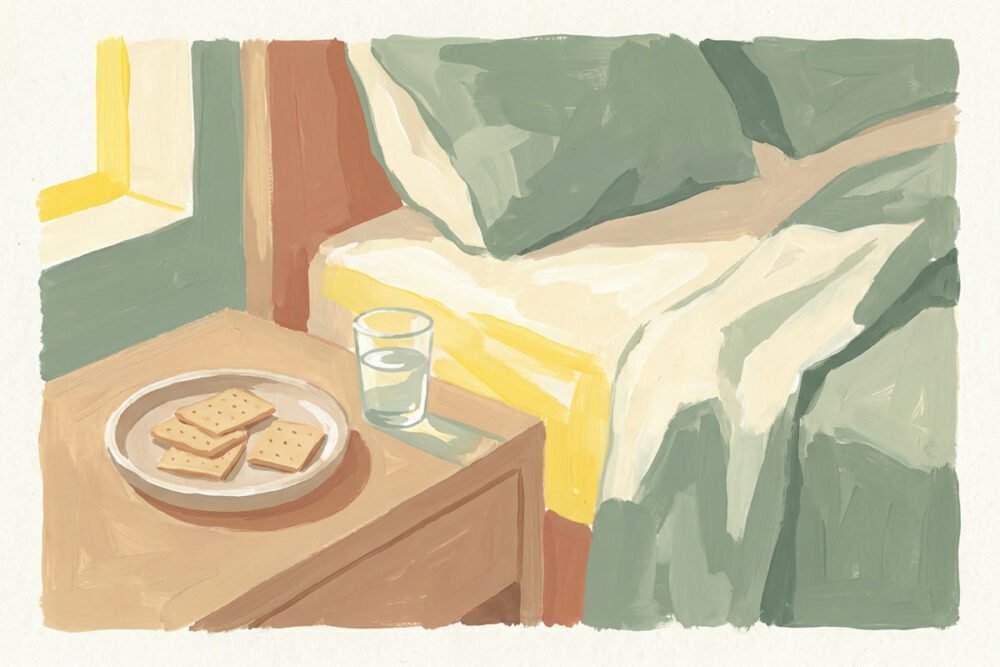
The before-you-get-up crackers turned into a game at our house. The little dish lives on my nightstand, and my daughter has appointed herself room service. She carries it to my side of the bed in the morning, deeply proud, and stands there supervising until I eat one. I get food in my stomach before I stand up. She gets a job. Everyone wins except the crumbs situation in my bed.
The pharmacy aisle, in order
A second pregnancy comes with a shortcut here, because you already know roughly how far up the aisle you had to go last time. But the order itself is worth having written down where you can find it.
The floor of the whole thing is the prenatal vitamin you’re already taking. According to ACOG, taking a vitamin supplement before and during pregnancy lowers the risk of severe nausea and vomiting, which makes it the one item on this list that works in advance.
Then comes the food shelf, ginger included, and after that the medicine shelf starts. ACOG lists vitamin B6 as a safe over-the-counter option that is usually tried first, with doxylamine added if B6 alone isn’t enough, and says both, alone or together, are safe in pregnancy with no harmful effects on the fetus.
Past that shelf, stop walking and call. Prescription anti-nausea drugs exist, but ACOG notes that ondansetron, while very effective, has studies that are not clear about its safety for the fetus. Your provider will also want to rule out other causes first. That decision belongs in an appointment, not in an aisle.
For me, the crackers and the toddler meal schedule have carried most of it this round. But I keep the whole ladder written down anyway, because the worst nights are the ones where you believe you’re out of options, and you almost never actually are.
When it ends, and what “usually” is carrying
Nobody agrees on the finish line, and it’s worth seeing exactly where the disagreement sits. On the start, the big bodies match: ACOG puts the usual start before nine weeks. On the end, they part ways. ACOG says it goes away by 14 weeks for most women, while the NHS says it usually clears up by weeks 16 to 20 of pregnancy.
Read the word “usually” with clear eyes, because it is carrying a lot. ACOG’s own page says that for some women it lasts several weeks or months past that, and for a few it lasts the whole pregnancy. A nausea due date that sails past you isn’t a sign that something is wrong. It’s the wide part of “usually,” and you’re allowed to be standing in it.
The second time around carries one more asymmetry. Nausea in a previous pregnancy, whether it was mild or severe, sits on both ACOG’s and the NHS’s lists of risk factors for having it again. It came for me this time, and the only thing I truly knew in advance was that it had come last time.
What I have this round that I didn’t have the first time is a view of the far side. I know what’s over there: the cluster feeding weeks, the checkup where someone finally examines you instead of the baby, the bleeding that tapers and stops. None of it is easy. But all of it is after, and after turns out to be a real place.
The short version
What I actually changed, in the order I changed it:
- Breakfast went cold, and the menu I changed was my daughter’s, not mine.
- I eat when she eats. Her snack schedule beats any plan I would have built for myself.
- The crackers live on my nightstand, and delivery is her job now.
- The trash belongs to my husband until further notice.
- I know which shelf of the pharmacy aisle is mine, and past it I call before I buy.
- And I check on myself on purpose, because nobody else in this house is going to.
Sources
- American College of Obstetricians and Gynecologists, “Morning Sickness: Nausea and Vomiting of Pregnancy” (FAQ126), published May 2020, last reviewed November 2025
- NHS, “Vomiting and morning sickness”, last reviewed 17 April 2024
A note on this post. Written and edited by the NewBloom editorial team. NewBloom is not written by doctors, nurses or midwives, and nothing here is medical advice. We read the current guidance from bodies like ACOG, the CDC and the NHS and write down what it says, with every claim traced to its source and named in the sentence where it appears. General guidance is not the same as an answer about your own body. Your doctor, midwife or health visitor can examine you and we cannot, so anything here that raises a question about your own pregnancy is a reason to ask them. If something is wrong right now, contact your doctor or your local emergency number. More about how we write these posts.