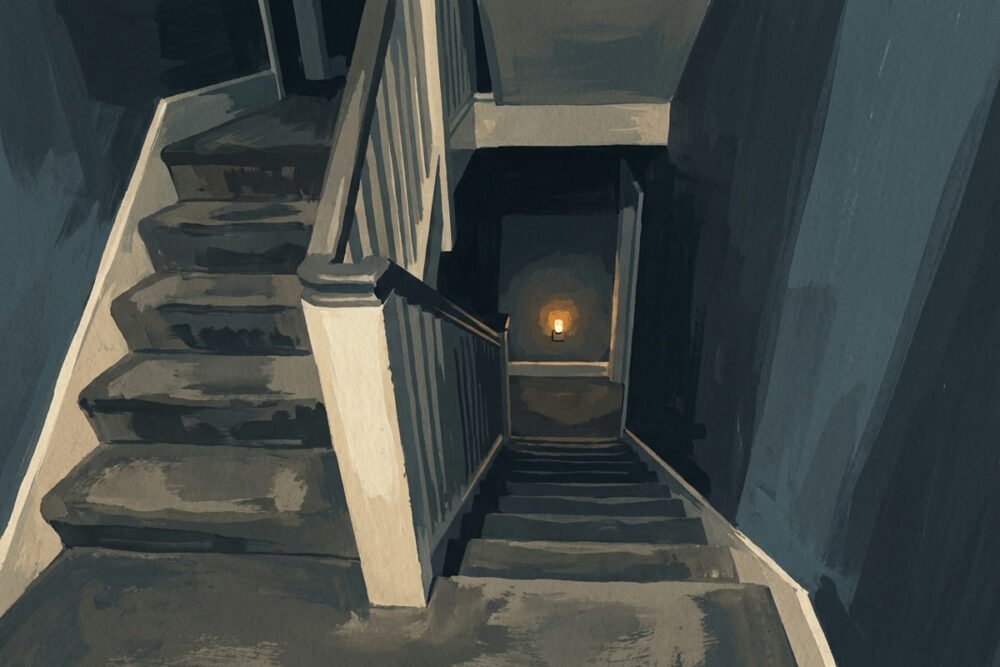
The picture that just went through your head is not a plan. It arrived without being asked for, it made you feel sick, and that reaction is the most useful piece of information in the whole thing.
What to do about it is simpler than the question feels at three in the morning. Say it out loud to somebody whose job it is to hear it. And learn the other kind, the one that does not frighten you at all, because that one is an emergency and it does not arrive looking like one.
The image is not a plan
Mine was the stairs. I would be carrying my eldest down them half asleep, and I would see her leave my arms. Not a worry about tripping. A picture, finished, of it having already happened.
It came back every time I went near the top step, for about two months. So I stopped carrying her down at all. I sat on the top stair and went down on my backside with her against my chest, one step at a time, like a five year old. I did not tell anybody why, and my husband thought it was a knee thing.
Years later I found out that the thing I had been reading as evidence about myself has a definition. The NHS describes an obsession as an unwanted and unpleasant thought, image or urge that repeatedly enters your mind, causing feelings of anxiety, disgust or unease, and says these can begin after a baby is born, with obsessions about harming the baby and compulsions such as repeatedly checking that the baby is breathing.
Read that description again for what it contains. The disgust is not a side effect of the thought. It is inside the definition of it.
The horror is the part you are misreading
Everybody who types this question into a phone is doing the same piece of arithmetic. The thought was about my baby. I am the one who had it. So it is about me.
That third step is where it goes wrong, and it goes wrong in a very specific way. You are reading the content as the signal when the reaction is the signal. A thought that is telling you something true about what you want does not usually make you want to put the baby down and leave the room.
I had three children and I assumed this part would get easier. It got worse. It was heaviest with my third, not my first, because by then I had a far better imagination for how a small body actually comes to harm, and I no longer had the excuse of not knowing anything. Nobody warns you that experience gives the thoughts better material. If you are waiting for a particular week to be past before you count yourself safe, that is not how the timing works either, and postpartum depression does not always start when you brace for it.
The checking is the other half
With my son it was breathing. I would put my hand flat on his back until I felt it move, and then I would get almost to the door and need to go back, because the memory of the last check had already gone soft and would not hold.
Four times was a normal night. Eight was not unusual. I told myself each trip was the responsible one and that the next one would settle it, and none of them ever did, because a check does not answer a thought, it feeds it. The thing that eventually helped was not stopping. It was saying the number out loud to somebody.
That pairing has a name too. Alongside the unwanted images, the NHS lists compulsions like repeatedly checking that the baby is breathing, and says that if you keep getting these thoughts and they are affecting your daily life, speak to your doctor or health visitor, who can refer you to a specialist mental health team.
Which is a plain sentence hiding a large permission. You do not have to be at the worst version of it to be allowed to mention it.
The one that does not scare you
Here is the reversal that made me pay attention, and it is the reason this post exists at all. The thought that has you terrified of yourself is the one behaving the way a frightening thought is supposed to behave. The one to move fast on is the one that turns up wearing no fear whatsoever, that feels reasonable, that sounds like a conclusion you have reached rather than an intruder.
Postpartum psychosis is a different illness from postpartum depression and anxiety, and the NHS calls it a medical emergency, affecting around 1 in 1,000 mothers after giving birth. According to the NHS, symptoms usually start suddenly within the first two weeks, often within hours or days of the birth, and include hallucinations, delusions, mania, severe confusion and rapidly changing moods. The National Institute of Mental Health describes it as a psychiatric emergency requiring hospitalization, and says to call 911 or go to the nearest emergency room.
The line that matters most for this post is the one the NHS puts at the end of its own advice on getting help. If you have postpartum psychosis, you may not realize you are ill, and your partner, family or friends may be the ones who spot the signs and have to act. The illness that most needs a phone call is the one least likely to make you pick up the phone.
So the practical thing, and it takes about two minutes, is to hand that job to somebody else in advance. Tell whoever is in the house with you what to watch for. Not the sad version and not the anxious version, both of which they will see anyway. The version where you are certain about something that is not true, or you are not sleeping and do not feel tired, or you are hearing something they cannot hear.
What you are really afraid of when you say nothing
I went months without telling anyone about the stairs, and if you had asked me why I would have said I did not want to make a fuss. That was not it. I thought that saying the sentence out loud would put something on a record somewhere, and that somebody official would then have to do something about it.
That fear is common enough that the NHS answers it directly on its postnatal depression page. You may be scared that your baby will be taken away if you ask for help or share how you are feeling, but this is very rare, and your care team will give you the support you need to look after your baby.
When I finally said it, at an ordinary appointment with my third, the reply was so unremarkable that I remember being almost annoyed. She had heard it before that week. What I had been carrying as the worst sentence about me turned out to be, for the person listening, a normal Tuesday.
If you are still trying to work out whether what you have is the two week dip or something that has settled in, that is a separate and answerable question, and the difference between the baby blues and postpartum depression is worth reading before you decide to wait it out.
When to call, and how fast
None of the above is a reason to sit on it. It is a reason not to be frightened of the conversation, which is not the same thing.
Scary thoughts are on the official list. The CDC’s urgent maternal warning signs include thoughts about harming yourself or your baby, and the CDC describes these as including scary thoughts that come when you do not want them or that are hard to get rid of. The CDC says to seek medical care immediately for anything on that list, and that these problems can happen at any point in the year after delivery.
Do not save it for the six week visit. ACOG says to call your ob-gyn or another health care professional right away if you think you may have postpartum depression, or if your partner or family members are concerned that you do, and specifically not to wait until your postpartum checkup. That checkup was never designed to be the first appointment anyway, which is why six weeks is not the whole plan.
Two numbers worth putting in your phone before you need them. The National Institute of Mental Health points to the 988 Suicide and Crisis Lifeline, reachable by call or text at 988, and to the National Maternal Mental Health Hotline at 1-833-852-6262, which is free, confidential and staffed 24 hours a day, seven days a week, in English and Spanish.
And if you are reading this at four in the morning with a sleeping baby on you and no chance of a call for another five hours, the useful move is to type it now. Put it in a message to your partner or a friend, unsent if you have to. It stops the night from being the only witness.
The short version
- The horror is the wrong thing to measure yourself with. The thought that made you feel sick is behaving the way an unwanted thought behaves.
- Watch instead for the thought that arrives without fear attached and feels reasonable. That is the one somebody else may have to notice for you, so tell them what to look for tonight.
- Checking is not neutral. Counting the trips is how I found out mine had stopped being a habit and started being a symptom.
- Saying it out loud is the whole treatment step. Nobody in that room is hearing it for the first time.
- You are allowed to call before it is bad. Waiting until you can prove it is serious is how six months go by.
Sources
- NHS, “Obsessive compulsive disorder (OCD): Overview”, nhs.uk (page last reviewed 2024)
- NHS, “Postnatal depression”, nhs.uk (page last reviewed 18 March 2026)
- NHS, “Postpartum psychosis”, nhs.uk (page last reviewed 18 October 2023)
- National Institute of Mental Health, “Perinatal Depression”, NIH Publication No. 23-MH-8116, revised 2023
- CDC, HEAR HER Campaign, “Urgent Maternal Warning Signs and Symptoms”, 15 May 2024
- American College of Obstetricians and Gynecologists, “Postpartum Depression”, ACOG FAQ
A note on this post. Written and edited by the NewBloom editorial team. NewBloom is not written by doctors, nurses or midwives, and nothing here is medical advice. We read the current guidance from bodies like ACOG, the CDC and the NHS and write down what it says, with every claim traced to its source and named in the sentence where it appears. General guidance is not the same as an answer about your own body. Your doctor, midwife or health visitor can examine you and we cannot, so anything here that raises a question about your own recovery is a reason to ask them. If something is wrong right now, contact your doctor or your local emergency number. More about how we write these posts.