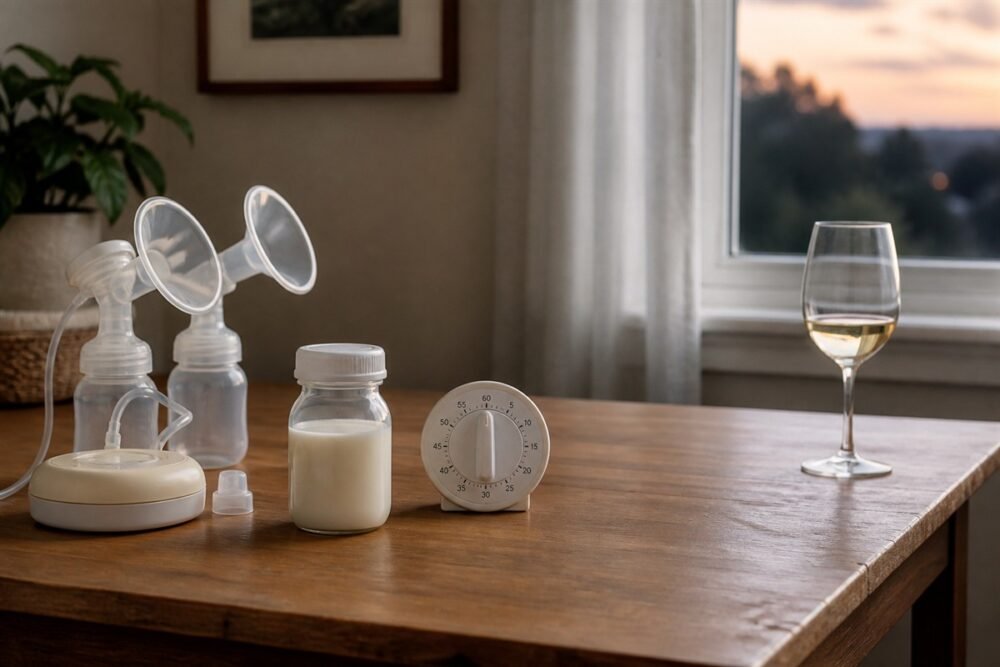
After my first baby, I had one drink, pumped because I was uncomfortable, and poured the milk down the sink. I assumed I had removed the milk that contained alcohol and that whatever came next would be clear.
I had misunderstood what pumping could do. It can relieve fullness and help you keep to an expression schedule, but it does not make alcohol leave breast milk faster. If you have already had a drink and are wondering what to do next, the amount you drank, the time that has passed, the baby’s next feed, and who is caring for the baby all matter more than whether you pump.
If you have already had a drink, start with time
Write down when you finished the drink and what was in the glass. Those details are the starting point for deciding when to nurse again.
The CDC says not drinking is the safest option while breastfeeding. It also says that moderate consumption of up to one standard drink in a day is not known to be harmful to the infant. To be safest after one drink, the CDC advises waiting at least two hours before nursing.
Alcohol in breast milk rises and falls with alcohol in the bloodstream. The CDC says the levels are essentially the same, so the amount in milk decreases as the body clears alcohol from the blood.
Pumping leaves the waiting time unchanged. Milk expressed during that time reflects what is happening in the body at that time, and the alcohol level falls as the body processes the alcohol.
Check whether the glass was one standard drink
The two-hour guidance begins with one standard drink, which may be smaller than the drink poured into a large glass.
The CDC defines one standard drink as 12 ounces of 5 percent beer, 5 ounces of 12 percent wine, or 1.5 ounces of 40 percent distilled spirits.
A strong beer, a generous wine pour, or a mixed drink with more than one shot may contain more than one standard drink.
The CDC says alcohol can generally be detected in breast milk for about two to three hours per drink. The timing varies with the amount consumed, how quickly it was consumed, whether food was eaten, body weight, and individual metabolism.
More alcohol usually means a longer wait.
If you cannot tell how many standard drinks were in what you had, avoid treating the two-hour figure as a guarantee. A clinician who knows the baby’s age, health, feeding pattern, and your situation can give more individual guidance.
Plan what the baby will eat next
If the baby may need to feed before enough time has passed, decide on the next feed before everybody is tired and hungry.
The CDC says that a mother who cannot wait to nurse can use milk that was expressed before she was drinking. The NHS also suggests expressing in advance for a social occasion and using that milk for the next feed.
Stored milk still needs to be handled safely. Our guide to how long breast milk and prepared bottles can sit out covers the relevant storage and room-temperature limits.
If there is no previously expressed milk and the baby is likely to feed during the waiting period, ask the baby’s pediatrician or a lactation professional about the available options. A general timing rule cannot account for every baby’s age, health, or feeding needs.
Pump for comfort or your schedule
You may still want or need to pump. The reason matters.
The CDC says pumping after drinking can relieve physical discomfort or help someone keep to a usual expression schedule. The NHS likewise notes that a long gap between feeds can leave the breasts uncomfortably full and that expressing may help with comfort.
Both sources make the same distinction: expressing may ease discomfort, while time is what lowers the alcohol level in milk.
If your breasts are painfully full or you notice a hard area, our guide to relieving engorged breasts explains comfort measures and warning signs. That is a separate problem from deciding when to nurse after alcohol.
If you express during the waiting period and are unsure what to do with the milk, label it and set it aside while you ask a clinician for advice. Do not rely on pumping itself as evidence that the next feed is ready.
Make a plan for who will care for the baby
The feeding question is only one part of the evening. Alcohol can also affect judgment and the ability to care for an infant safely.
The CDC says caring for an infant while intoxicated is unsafe and advises caregivers who drink excessively to arrange for a sober adult to care for the baby.
Make that arrangement before drinking rather than waiting to see how impaired someone feels.
The NHS says never to share a bed or sofa with a baby after drinking alcohol because of the strong association with SIDS.
Our guide to safe sleep surfaces and room sharing explains why an adult bed or sofa is not a safe backup sleep space.
Before the drink, decide who will handle the next feed, carry the baby, and settle the baby to sleep. If no sober adult is available, that changes the plan for drinking as well as the plan for feeding.
The short version
- Not drinking is the safest option while breastfeeding.
- After one standard drink, the CDC advises waiting at least two hours before nursing.
- A large or strong drink may contain more than one standard drink and require more time.
- Pumping can relieve fullness or maintain a schedule, but it does not clear alcohol faster.
- Use milk expressed before drinking if the baby needs to feed during the wait.
- Arrange for a sober caregiver when alcohol could impair infant care.
- Never share a bed or sofa with a baby after drinking alcohol.
Sources
- Centers for Disease Control and Prevention, “Alcohol”, Breastfeeding Special Circumstances, 13 April 2026
- NHS, “Breastfeeding and drinking alcohol”, page last reviewed 1 May 2026
A note on this post. Written and edited by the NewBloom editorial team. NewBloom is not written by doctors, nurses or midwives, and nothing here is medical advice. We read the current guidance from bodies like the AAP, the CDC and the NHS and write down what it says, with every claim traced to its source and named in the sentence where it appears. General guidance is not the same as an answer about your baby. Your pediatrician, midwife or health visitor can see your child and we cannot, so anything here that raises a question about your own baby is a reason to ask them. If something is wrong right now, contact your doctor or your local emergency number. More about how we write these posts.