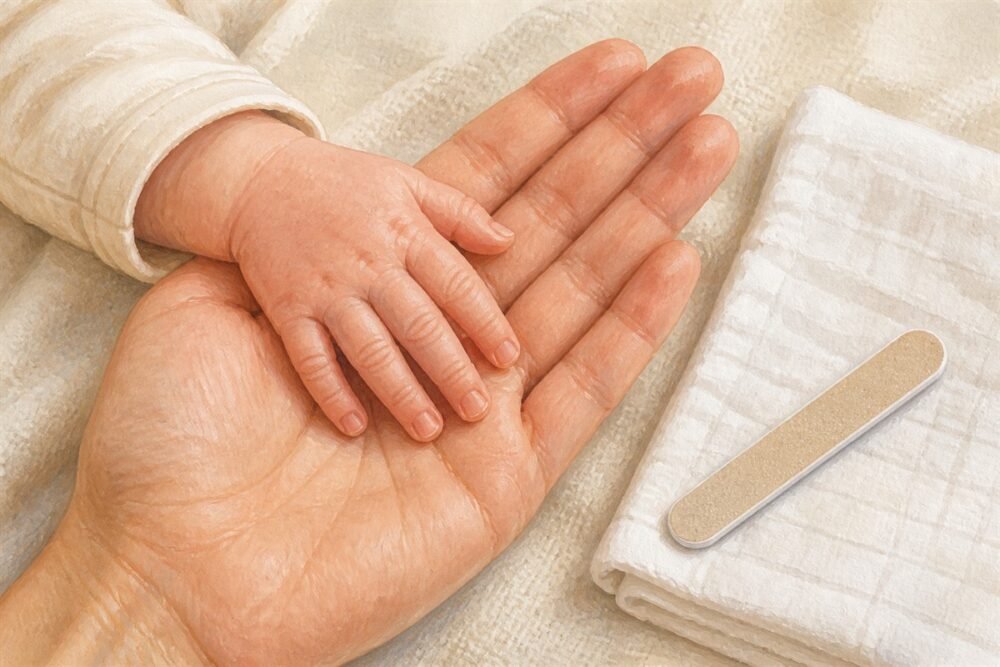
Trimming newborn nails is easier when you stop treating the clipper as the main skill. The NHS and MedlinePlus both put sleep or relaxation first because a quiet hand means less movement while you work.
You also do not have to begin with cutting. MedlinePlus calls a file the safest method, so it is a complete first tool, not the practice version of a “real” manicure.
The adult clipper made the whole job feel impossible
With my eldest, I put our ordinary nail clipper on the changing table and waited for her to open her fist. She did. Then she closed it around my finger, opened it again and moved every fingertip in a different direction.
The clipper suddenly looked enormous. I put it back in the bathroom and used the little file from the baby-care kit instead.
I finished three nails before she pulled her hand back into a fist. The other seven waited. That was the first time I understood that this job does not have to be completed in one sitting to count as done.
The next attempt did not look more impressive. I held one finger, filed the corner that had caught on her sleeve, and stopped when she stretched. By the end of the day I had not completed a manicure. I had completed the only nail that needed me.
That became the routine for a while: notice one sharp edge, wait for a loose hand, fix that edge. The ten-finger job existed mostly in my head.
That pause was the sensible part. MedlinePlus says not to use adult-sized nail clippers because they can catch the tip of a baby’s finger or toe instead of the nail.
A fine file is the lowest-pressure place to start
MedlinePlus calls a nail file or emery board the safest way to shorten and smooth newborn nails. The NHS also offers a fine emery board as an alternative to baby clippers or small, round-ended safety scissors.
A file is useful when the nail is soft, thin or only sharp at one corner. Support the finger in your hand and use short, gentle strokes on the nail edge. Stop when the rough point no longer catches; you do not need to make ten tiny nails look identical.
The file also made it easier for me to stop halfway through a movement. There was no tiny open clipper waiting for the hand to return. If my view changed, I lifted the file away and began again later.
That is a better measure of confidence than speed. You are not trying to prove that your hands never shake. You are arranging the task so a shaky moment can simply be the end of that attempt.
This is ordinary care, much like the setup in our newborn sponge-bath guide: put everything within reach first so you never have to leave a baby unattended while searching for the right item.
Wait for sleep or a relaxed hand
The NHS says it is best to cut a baby’s nails while the baby is asleep or relaxed so there is less movement. MedlinePlus gives the same reason: minimal movement lowers the risk of getting hurt.
That means timing is part of the equipment. Try during sleep or whenever your baby naturally lets their hands go loose. If the fist keeps closing, stop and come back later.
Do not wake a baby to finish the last two fingers. It is fine to do three nails now and seven later.
I used to wait for a long, perfect stretch of sleep and then lose it while gathering everything. A better attempt began with the file already in my hand and my arm supported. The quiet window could be brief because the setup was finished before I borrowed it.
If you clip, use a baby tool and move the skin away
The NHS recommends special baby nail clippers or small safety scissors with rounded ends rather than adult tools. MedlinePlus likewise recommends baby clippers or baby scissors with blunt, rounded tips.
The American Academy of Pediatrics gives one practical detail that changes the view: gently push the fingertip skin down so the clipper or scissors can sit around the nail without catching the finger. Keep the finger supported, make a controlled trim and put the tool down if the hand starts moving.
You do not need to cut close to the skin. The goal is to remove the length or corner that can scratch, not to create a perfectly curved edge.
Pause after each nail and reset your grip. A newborn hand can go from open to folded before you finish admiring the first trim. There is no prize for keeping the tool in place while the fingers reorganize themselves.
Smooth the corner that still catches
The American Academy of Pediatrics recommends finishing sharp or rough edges with an emery board. That last pass matters because a tiny corner can remain scratchy even when the nail looks short from above.
Run your fingertip lightly along the edge. If you can feel a point, file that point. If the nail is smooth, leave it alone.
This was the part I kept skipping because it did not look like progress. Then I would find one untouched corner against my wrist during the next feed. The finish is not how short the nail looks. It is whether an edge still catches.
Do not bite or peel the nail. The American Academy of Pediatrics warns that biting or peeling a newborn’s nails can lead to infection, and clippers, scissors or a file give you more control.
Fingernails and toenails do not keep the same schedule
MedlinePlus says newborn fingernails may need trimming at least once a week, while toenails may need attention only a couple of times a month. That is a guide to how quickly they can return, not a calendar you must obey.
MedlinePlus says to look for nails that are ragged or too long and notes that newborns do not yet control their movements, so they may scratch their own faces.
Because MedlinePlus says fingernails may need attention at least weekly, a regular glance during a bath or clothing change can keep all ten fingers from becoming one big job. The NHS says some babies are born with long nails, so the first trim may arrive much sooner than you expected.
Ask someone to show you if the edge is hard to see
If the nail and fingertip seem to blend together, you do not have to guess. The American Academy of Pediatrics says parents can ask a nursery nurse, pediatrician’s office or someone experienced with newborn nail care to demonstrate.
Bring the tool you plan to use. A demonstration with a different clipper may not answer the small question that is making your hand hesitate.
The same rule applies to other newborn tasks that turn on one precise view. Our guide to taking a newborn’s temperature starts by choosing the method before chasing a number, and our cradle-cap guide explains why using your own fingernail to pick at skin creates a different problem.
The short version
- Choose a time when your baby is asleep or relaxed.
- Start with a fine emery board if that feels easier.
- If clipping, use baby clippers or blunt, round-ended baby scissors.
- Support the finger and gently push the fingertip skin away from the nail.
- Trim only while the hand is still, then file any rough corner.
- Stop and finish later if your baby starts moving.
None of this requires steady hands for ten straight minutes. It requires a safe tool, a quiet moment and permission to stop.
Use the clear moment for one small step. When the hand closes, put the tool down and come back later.
Sources
- NHS, Washing and bathing your baby, cutting-your-baby’s-nails section, reviewed July 23, 2024
- MedlinePlus, Nail care for newborns, reviewed October 7, 2025
- American Academy of Pediatrics/HealthyChildren, Nailing It: How to Trim Your Baby’s Fingernails, updated November 23, 2020 and accessed September 1, 2026
- American Academy of Pediatrics/HealthyChildren, How Your Newborn Looks, current page accessed September 1, 2026
A note on this post. Written and edited by the NewBloom editorial team. NewBloom is not written by doctors, nurses or midwives, and nothing here is medical advice. We read the current guidance from bodies like the AAP, the CDC and the NHS and write down what it says, with every claim traced to its source and named in the sentence where it appears. General guidance is not the same as an answer about your baby. Your pediatrician, midwife or health visitor can see your child and we cannot, so anything here that raises a question about your own baby is a reason to ask them. If something is wrong right now, contact your doctor or your local emergency number. More about how we write these posts.