Round ligament pain is a sharp pull low on one side of your belly, and nearly every time, something you did in the second before it is what started it. The most useful thing you can do is find that move, because a pain with a move attached behaves completely differently from one without.
That matters because it arrives with no warning and the first thought is never ligament. The first thought is that something has gone wrong, and you spend the next hour holding still, working out whether to call someone.
Name the move
The first time it happened to me I was reaching across the kitchen counter for something at the back of it, twisting as I reached, and something low on my right side went sharp enough that I stopped moving entirely. I stood there with both hands flat on the counter, absolutely certain something had torn.
Nothing had torn. I know that because a few hours later I reached across the same counter the same way and got the same pain in the same place. That is the whole test, it took one afternoon to find, and nobody had ever mentioned it existed.
What the NHS describes under stomach pain in pregnancy matched what I felt exactly: ligament pain, a sharp cramp on one side of the lower belly, as the ligaments stretch to support a growing bump. Reading that afterward was reassuring. Reading it beforehand would not have helped me, because the page was describing the sensation and the thing I needed was the cause.
There is a usual window for it as well. MedlinePlus puts it most often between 18 and 24 weeks, which is roughly when everything is stretching fastest.
So when it grabs you, before anything else, name the move. Not the time of day, not the position you ended up frozen in. The specific thing your body did in the second before.
My own list turned out to be short and it has stayed short. Standing up out of something soft. Rolling over. Twisting to reach. Sneezing. Laughing. Getting up off the floor. Once I had the list, the pain stopped being an event and turned into a consequence, and a consequence you can see coming is a different experience entirely.
Nobody stands up slowly with a toddler in the house
Every piece of advice about this pain has the word slowly in it. Stand up slowly. Roll over slowly. Change position slowly. I would like to introduce whoever wrote that to a three-year-old in the middle of potty training.
My daughter announces it at the last possible moment, and by the time the announcement is finished we are both already moving. I get off the couch the way you get off a couch when someone small is about to have an accident on a rug, which is all at once, from the middle, twisting toward the hallway before my feet are properly under me.
It is not that this pregnancy hurts more than the first one. It is that this time there is no occasion to stand up slowly. The first time around I could take an entire afternoon to get off a piece of furniture and the only person affected was me.
ACOG’s lifting advice for pregnancy in general was not written about this pain at all, and it is still the most useful sentence I have found for it: squat down, bend your knees, keep your back straight, and do not bend at the waist to pick things up. That advice exists for backs. It happens to describe the only way to pick up a toddler that this particular pain does not punish.
The rest of the day is not fixable and I have stopped pretending otherwise. What is fixable is the handful of moments where you get a second of warning, and there are more of those than you would think. Running a pregnancy symptom alongside a toddler is mostly the business of finding those seconds and spending them well.
The four seconds before you sneeze
A sneeze gives you notice. Not much, but enough to matter. There is a gap between the first tickle and the sneeze itself, and inside that gap you can get a hand onto a counter and let your knees bend a little, so the sneeze arrives into a body that is braced instead of a body that is surprised.
I have done this in the middle of a conversation. It looks like I am about to be sick. I stopped caring about that fairly quickly.
Laughing is worse, because it does not give you notice, it gives you duration. A sneeze is one event and then it is finished. A laugh is a series of them, and somewhere around the fourth one the same side lights up, and I am holding the edge of the table with one hand and laughing with the rest of me.
Coughing is the same shape as laughing, and a cold turns a whole week into that. There is no clever answer to it. You brace early, you brace often, and you accept that you look peculiar doing it.
One line from the NHS is worth holding next to all of this: pain that is mild and goes away when you change position, rest, have a bowel movement or pass gas is probably nothing to worry about. Braced or not, the pain that follows a sneeze should be gone before you have finished apologizing for the sneeze.
Getting up off the floor, and the other one that gets you
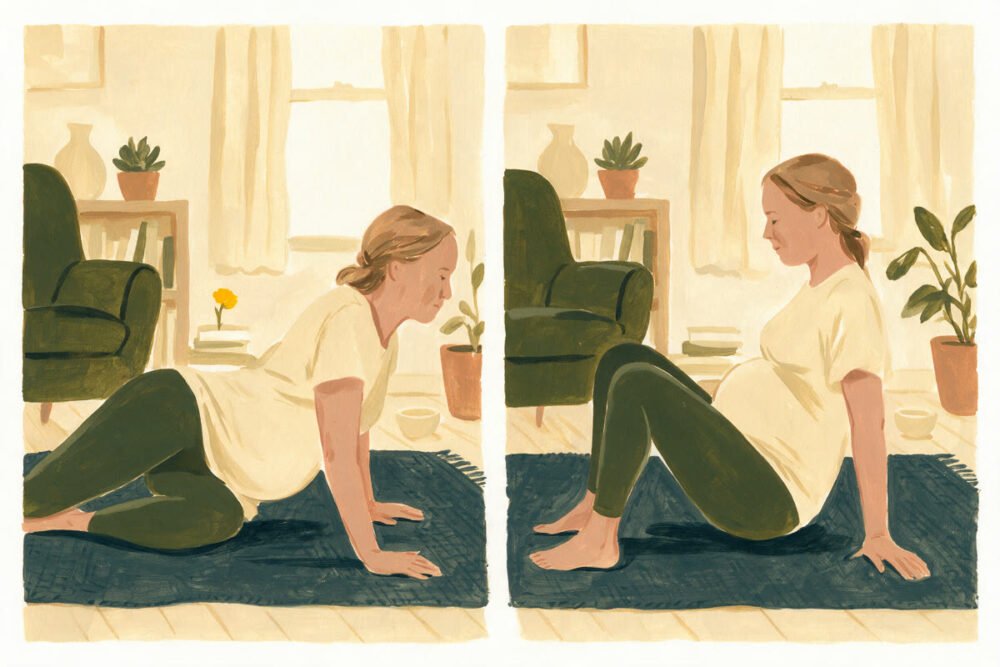
Getting off the floor is the move I had to relearn from scratch, and with a three-year-old you are on the floor constantly. I do it in two stages now. Roll onto one side, get a hand and a forearm underneath me, push up to sitting, and stop there. Then use my legs.
The stop in the middle is the whole thing. It looks slow, it is slow, and it is the difference between standing up and standing up with a rope pulling down one side of me.
The other one catches you when you are least equipped to prepare, because you are asleep. Rolling over in bed offers no bracing at all. You surface at two in the morning already halfway through the turn, with the pain arriving at the same moment as consciousness.
ACOG’s sleep advice for pregnancy in general is a pillow between your knees and another under your belly, offered for back support rather than for this. What it also does is shorten the roll. You are not turning a whole body over a hinge in the middle. You are shifting a body that is already propped, and there is less of it to move.
My daughter has started putting her hand flat on my belly and asking whether it hurts there. She means the baby is hurting me. I have not found a way to explain that it is the ropes and not the baby, so I tell her the baby is fine, and she pats it twice and goes back to whatever she was doing.
The pains with no move behind them
All of that assumes you found a move. The reason to go looking for one is that the pains with nothing behind them are a different category, and those are the ones that belong on a phone call.
Two things mark them out, and neither asks you to diagnose anything. The first is that nothing you did started it. The second is that resting does not end it.
The NHS attaches a number to that second one, which is what makes it usable: stomach pain in pregnancy that is severe, or that does not go away after you have rested for 30 to 60 minutes, is a reason to contact your midwife or maternity unit. That is a clock you can run in your own living room. Sit down, note the time, find out whether an hour changes anything.
The list sitting next to it is worth reading once now rather than at speed later. Vaginal bleeding or spotting, regular cramping or tightening, lower back pain, discharge that is unusual for you or fluid leaking, pain when you pee or needing to pee suddenly or more often than usual, and pee that looks cloudy, pink, red or brown are all on the NHS list of reasons to call. MedlinePlus draws the harder line, the one for going in rather than calling: constant severe abdominal pain, possible contractions, or pain together with bleeding or fever.
What I did not understand the first time is that the two categories can feel almost identical for the first few seconds. Sharp is sharp. What separates them is what came immediately before, and what happens over the following hour, and both of those are things you can observe without knowing any anatomy at all.
The same shape runs underneath the other question that has people staring at their phones in the evening, which is whether the baby is moving less than usual. Nothing you did explains it, and waiting does not resolve it. That is what the calling ones look like, and it is worth having read the fuller version of how to decide when to make the call before the evening you need it.
The short version
- Name the move before you name the pain. It is still in your memory a second later, and it will not be in ten minutes.
- If the same ordinary move keeps bringing the same pain, you have learned more in a minute than an evening of searching gives you.
- If there is no move to find, treat that as information rather than as a gap.
- Brace before the sneeze, not after. The warning is short but it is real.
- Off the floor in two stages, with a full stop at sitting.
- Rest is not only comfort here. It is a test, and it answers itself if you actually sit down and let it.
Sources
- NHS, “Stomach pain in pregnancy”, page last reviewed 18 November 2024
- MedlinePlus (US National Library of Medicine), “Aches and pains during pregnancy”, review date 8 November 2024
- American College of Obstetricians and Gynecologists, “Back Pain During Pregnancy”, published May 2020, last reviewed October 2025
A note on this post. Written and edited by the NewBloom editorial team. NewBloom is not written by doctors, nurses or midwives, and nothing here is medical advice. We read the current guidance from bodies like ACOG, the CDC and the NHS and write down what it says, with every claim traced to its source and named in the sentence where it appears. General guidance is not the same as an answer about your own body. Your doctor, midwife or health visitor can examine you and we cannot, so anything here that raises a question about your own pregnancy is a reason to ask them. If something is wrong right now, contact your doctor or your local emergency number. More about how we write these posts.