The cramp that arrives once your baby is latched on is your uterus contracting back down to its normal size, and the feeding itself is what sets it off. It has a name, afterpains, and its particular cruelty is the timing: it starts at the exact moment you have committed both arms and can no longer get up to fetch anything.
Which is why almost everything useful about it happens before you sit down.
It starts the second she latches
With my first I was still in the hospital bed when it happened, and the pain was not where I had braced for pain. I was braced low, for stitches. This came from higher up, in a wave, and I lay there certain something had been missed.
Nobody had given me the word. There was a word, it had existed the entire time, and if one person had said afterpains out loud at any point in the previous nine months I would have spent that first feed in a completely different frame of mind.
The mechanism is not complicated. Breastfeeding makes the uterus contract, which the NHS states plainly on its page about your body after the birth, and the same page notes you may feel cramps similar to period pains while you are feeding. The contraction is not a side effect. It is the point.
The other half of that same page is what I failed to connect for days. During that first feed my pad got noticeably heavier, and I filed it in my head under a separate heading, as a bleeding problem rather than as the same event. The NHS puts the two together: bleeding is redder and heavier when you breastfeed, and it happens because breastfeeding makes the uterus contract. One thing, two symptoms. How long the bleeding goes on is its own question, and I had that one tangled up as well.
So the first useful thing is simply knowing which department the pain belongs to. It is not a wound. It is not an infection. It is the organ that spent nine months getting larger doing the reverse, on a schedule that has nothing to do with your convenience.
MedlinePlus makes the scale of that concrete in a way that stayed with me. Right after birth the uterus is hard and round and can usually be felt near your navel. After a week it is difficult to find by pressing on your abdomen at all. That entire journey happens in the first days, and the cramps are the sound of it happening.
Why the third one hurt more than the first
With my first I barely registered them. I took the wave in the hospital bed to be part of the general condition of having recently given birth, it stopped after a couple of days, and I did not think about it again for years.
With my second I spent three days convinced I was feeling my milk let down. The two sensations arrive at nearly the same moment in a feed, and if you have already decided that one of them is the other, you will keep deciding it. I worked it out late, which is how I have worked out most things about my second.
With my third I knew exactly what it was in advance and it did not help in the slightest. That was the round where I counted through them with my eyes shut. Knowing the name of a thing does not lower its volume.
The direction of that is not only my house. ACOG says afterpains are more common in women who have given birth before, and more common during the first few days of breastfeeding. MedlinePlus describes contractions for a few days that are most often mild, but says they can be stronger if you have already had several babies.
Neither of them says it climbs one, two, three in a straight line, and I would not want anyone sitting down to a first feed with a fourth baby already braced for the worst pain of their life. Your order may well be different from mine. What the guidance gives you is a direction, not a ranking, and the useful half of the direction is this: the surprise belongs to the first baby, and the volume belongs to the later ones.
Set the chair up before you sit in it
This is the part I would tell someone in their last week of pregnancy, and acting on it takes about ninety seconds.
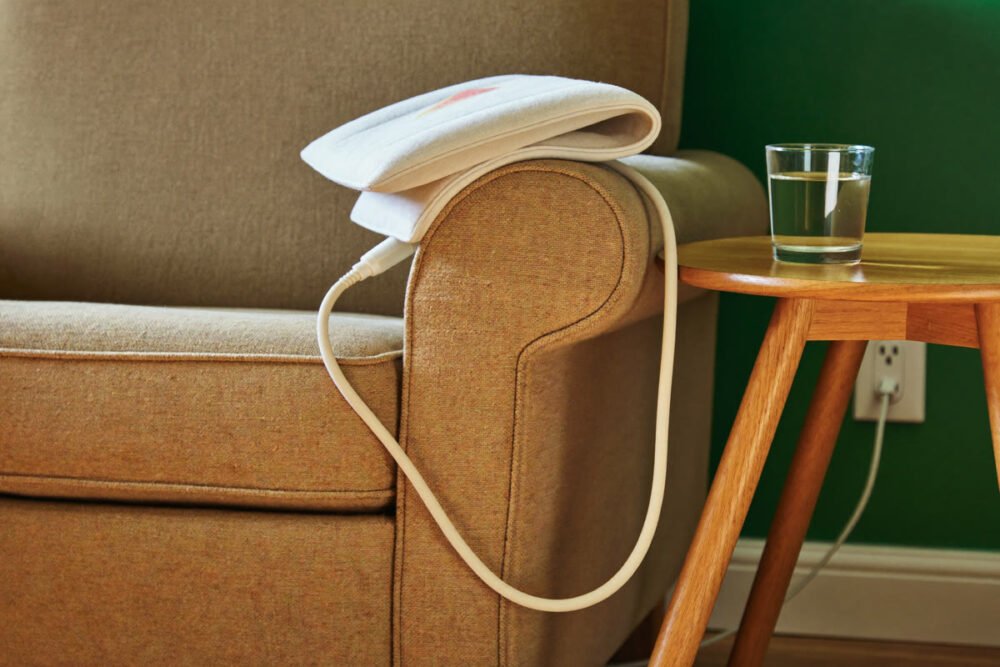
Pick the chair you will feed in at night. Put the heating pad on it or next to it, and check that the cord actually reaches an outlet from where the chair is standing. Put water within arm’s reach. Put whatever pain reliever you have been cleared to take in the same reach, with the cap already loose.
With my third I knew every word of that and sat down anyway with none of it done. The cramp arrived, I did the arithmetic on standing up mid feed with a baby who had taken twenty minutes to settle, and I sent my six-year-old for the water instead. She was thrilled. She carried it in two hands with her tongue between her teeth and lost most of it on the way.
A run of cluster feeding is what turns this from an event into a shift. Every latch in that run started it again for me, one after another through an evening, and that is not the part anybody warns you about when they warn you about cluster feeding.
The chair does not have to be the good chair. Mine was not. It has to be the one with an outlet behind it and a surface beside it, because those two things decide what your next forty minutes look like far more than the upholstery does.
What actually takes the edge off
Heat on the belly, not on the back. That surprised me, because everything else that hurt after birth wanted heat or ice somewhere else entirely.
ACOG’s answer for afterpains is a heating pad applied to your abdomen, and if you need something over the counter, ibuprofen may work better than acetaminophen for this particular pain. On the feeding question the same page is unusually direct: ibuprofen is usually the preferred first step because little of it passes through breastmilk, and acetaminophen is also safe to take while breastfeeding.
Whatever you take is still a conversation with the person who discharged you, especially if you came home with something already. Use the word afterpains when you have it. It moves the conversation along faster than describing the sensation does.
The night I remember most clearly is the one where I found out the cord did not reach. I had the heating pad, I had the chair, and they were about four feet apart. I fed her holding the pad against myself with one forearm, unplugged and going cold, and somewhere around two in the morning I stood up with her still attached and dragged the chair across the floor with one foot. It has stayed in the new spot ever since.
The other thing that helped costs nothing and looks like nothing. I breathe out through the cramp instead of holding my breath. I had that piece of information free of charge from labor and did not think to use it for two babies.
The cramp that is not this one
Everything above describes a cramp that comes with a latch and eases when the feed ends. The reason to be able to describe it that precisely is so a cramp behaving differently stands out immediately, without you having to work anything out.
ACOG puts severe pain in your lower abdomen on the list of things that mean call 911 or seek emergency help right away, alongside chest pain, gasping for air, seizures, thoughts of hurting yourself or your baby, and pain, swelling and tenderness in your legs. That list does not ask you to establish first whether the pain is afterpains.
Bleeding carries its own thresholds and they are worth holding separately in your head. Heavy bleeding that soaks through two sanitary pads an hour for more than an hour or two is a call your doctor item on the same ACOG page, and the NHS is blunt about clots: if you are losing blood in large clots, tell your midwife, because you may need treatment.
Then there is the cramp that turns up months later, long after all of this has stopped, which is not this question at all. That one usually belongs to your first period after birth, and it runs on a completely different schedule.
The short version
- Set the chair up before you sit down in it. The cramp starts at the exact moment you can no longer stand up.
- Heat goes on the belly, and the cord has to reach from where the chair actually is.
- If the pad gets heavier during a feed, that is the same event as the cramp, not a second problem.
- Say the word out loud to whoever discharged you. It is faster than describing the feeling.
- Do not brace for a ranking. Brace for a direction, and let your own order be whatever it is.
- A cramp that is not tied to a feed is a different question, and a phone answers it faster than you will.
Sources
- American College of Obstetricians and Gynecologists, “Postpartum Pain Management”, published October 2020, last reviewed August 2022
- NHS, “Your body after the birth”, page last reviewed 25 April 2024
- MedlinePlus (US National Library of Medicine), “Vaginal delivery – discharge”, review date 8 November 2024
A note on this post. Written and edited by the NewBloom editorial team. NewBloom is not written by doctors, nurses or midwives, and nothing here is medical advice. We read the current guidance from bodies like ACOG, the CDC and the NHS and write down what it says, with every claim traced to its source and named in the sentence where it appears. General guidance is not the same as an answer about your own body. Your doctor, midwife or health visitor can examine you and we cannot, so anything here that raises a question about your own recovery is a reason to ask them. If something is wrong right now, contact your doctor or your local emergency number. More about how we write these posts.