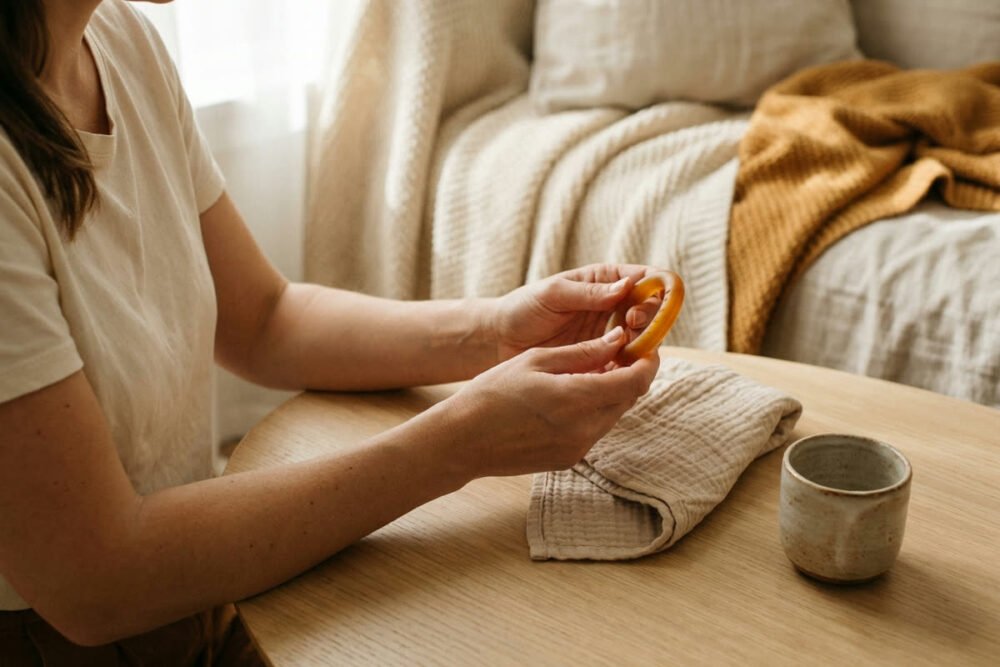
Four teething products sit in most nursery drawers and the American Academy of Pediatrics says not to use any of them. Gels, teethers you freeze, amber necklaces, homeopathic tablets. All four on the list.
What it recommends instead is a clean finger and a firm rubber ring. That is the entire approved list, and it costs about four pounds.
The drawer
By the time the first tooth actually shows up, most people have accumulated a small graveyard of teething equipment. Some of it bought at 11pm in a burst of doing something. Some of it given, which is worse, because the amber necklace was a present from somebody who meant well and is going to ask about it.
Almost none of it gets used twice. The pattern is always the same: buy the thing, try the thing, baby is unimpressed, thing goes in the drawer, and two weeks later you are back on the same search results reading the same listicle that sold you the last one.
The gap between what the shelf sells and what the guidance says is the actual problem here, so here is what each source states.
The four to put down
Teething gels. The AAP’s wording is unusually blunt. Never use teething gels to numb the gums, because in rare cases they can poison babies’ blood cells and stop them carrying oxygen. The NHS is softer and lands nearby, saying there is a lack of evidence that teething gels are effective, and warning that adult oral pain relief gels are not suitable for children at all.
Anything you froze. This is the one that surprises people, because the freezer feels like the fridge but better. It is not. The AAP says frozen teethers tend to get too hard and can cause more harm than good. The NHS is plainer: never put a teething ring in the freezer, because a frozen ring can damage your baby’s gums. The fridge is the right temperature and the packaging will say how long.
Amber necklaces. The AAP says they do nothing at all for pain and have caused cases of choking and strangulation, and follows it with a broader rule worth keeping: never leave anything around your baby’s neck. The NHS says the same about tying a teething ring on.
Homeopathic tablets. The AAP says no benefit, and that some have been made with potentially harmful toxins. The NHS does not recommend them either and notes that unlicensed ones sold online have been linked to serious side effects.
The question you will actually be asking at 2am
Not which product. The real one is is this teething or is she ill, and it runs on a loop for months.
Teething overlaps with every nursery cold, every ear infection and every stretch of ruined nights, and the temptation to file everything under teeth is enormous, because teeth are an explanation that requires nothing of you.
The AAP puts a number on it, and this is the most useful line in this whole post. Teething can cause a slight rise in temperature, but not over 101 degrees Fahrenheit, 38.3 Celsius. Above that is a fever, and a fever is not teething.
Write it on something. That number is the difference between a rough night and a missed illness, and it is very hard to recall at 2am from a standing start.
The AAP’s other listed signs are mild irritability, heavy drooling and a strong urge to chew something hard, though more than any of those, the gums around the new tooth swell and get tender.
Timing tells you nothing
The AAP puts the usual start at 4 to 7 months, front teeth first, then the opposite front teeth, then first molars, then canines.
If nothing has appeared, the AAP is direct: the timing of teething varies a lot, it may be influenced by heredity, and it does not mean anything is wrong.
Which is correct and will not stop anybody. There is always a baby in the group chat with two teeth at four months, and there is no version of that message that does not make you look at your own baby’s gums afterwards. A late first tooth carries about as much information as a late first crawl, which is to say almost none. Our post on babies who are not crawling covers why that one comes off the checklists entirely.
What actually helps is boring
Rub the gums with a clean finger. Both the AAP and the NHS put this first. It is free, it works on the part that hurts, and it is the single most effective thing on any list. Nobody sells it, which is roughly why nobody told you.
A firm rubber ring, chilled in the fridge. The AAP specifies firm rubber. The NHS notes some rings are designed to be cooled and the instructions say for how long.
Distraction. The NHS lists comforting or playing with your baby as a real option, which sounds like filler until an evening when it is the only thing that works.
Wipe the drool. The NHS says gently wiping the face helps prevent a rash. The drool is startling. It arrives before the tooth by weeks and soaks through everything, and the rash it causes on the chin is a separate small problem you will otherwise spend an evening researching.
Something safe to chew, if they are on solids. For babies six months and up who have started weaning, the NHS suggests healthy things to chew and says soft fruit like melon can soothe the gums. Watch them the whole time, because food is also a choking risk. The NHS advises skipping rusks, since nearly all brands contain sugar.
On painkillers, ask before you need them
The NHS says paracetamol, sold as acetaminophen in the US, can be given for teething from two months, and ibuprofen from three months. Children under 16 should never have aspirin.
Doses depend on weight rather than age, so the right answer for your baby comes from your pediatrician or pharmacist. Get that answer on a Tuesday afternoon, not on the night you need it. Standing in a kitchen at 1am doing arithmetic off a box is a genuinely bad way to make that decision.
Once the teeth are in
The AAP says start brushing as soon as you see teeth, with a soft child’s brush and a smear of fluoride toothpaste the size of a grain of rice.
It also flags the bottle. Never let a baby fall asleep with one, at naptime or at night, because milk pools around the new teeth. If you are already rethinking what goes in the bottle at this age, our post on how long a bottle can safely sit out is the other half of that.
On the dentist, the AAP says within six months of the first tooth and no later than 12 months, whichever comes first. A pediatric dentist is trained for infants, but the AAP says a family dentist is entirely adequate for routine care and may already be on your insurance.
When to call
The AAP’s line: if your child seems particularly miserable, or has a temperature over 101 degrees Fahrenheit (38.3 Celsius), it is probably not from teething. Call your pediatrician.
The short version
- Teething usually starts between 4 and 7 months, and a late start does not mean anything is wrong.
- 101°F (38.3°C) is the ceiling. Above that is a fever, not a tooth.
- The AAP says no to gels, frozen teethers, amber necklaces and homeopathic tablets.
- What it says yes to: a clean finger on the gums, and a firm rubber ring chilled in the fridge, never the freezer.
- Ask about acetaminophen dosing before the night you need it.
- Brush from the first tooth with a rice grain of fluoride toothpaste. Dentist within six months of it.
Sources
- American Academy of Pediatrics, HealthyChildren.org, “Teething: 4 to 7 Months” (updated 26 June 2024)
- NHS, “Tips for helping your teething baby” (updated 23 October 2025)
A note on this post. Written and edited by the NewBloom editorial team. NewBloom is not written by doctors, nurses or midwives, and nothing here is medical advice. We read the current guidance from bodies like the AAP, the CDC and the NHS and write down what it says, with every claim traced to its source and named in the sentence where it appears. General guidance is not the same as an answer about your baby. Your pediatrician, midwife or health visitor can see your child and we cannot, so anything here that raises a question about your own baby is a reason to ask them. If something is wrong right now, contact your doctor or your local emergency number. More about how we write these posts.