A newborn can sound dramatically congested while lying beside you, then settle once you pick them up. The hard part is deciding whether the nose needs simple clearing or the breathing needs medical attention.
Start with what you can see. If your baby is alert, feeding normally, and breathing comfortably apart from a stuffy nose, plain saline and gentle suction may help. If feeding or breathing has changed, call the pediatrician instead of adding stronger products.
Watch one feed before reaching for a remedy
Notice what happens when your baby tries to latch onto a breast or bottle. Can they stay attached, suck, swallow, pause, and begin again? Are they finishing something close to their usual feed, or stopping repeatedly because breathing looks hard?
Listen, but also look at the chest, ribs, nostrils, lips, and face. Noise alone is difficult to interpret. A change in effort, color, alertness, or feeding gives the pediatrician more useful information.
The American Academy of Pediatrics’ HealthyChildren site says a blocked nose can interfere with sleep, feeding, and comfort because a baby’s nasal passages are small. It recommends saline to loosen mucus and a bulb syringe or aspirator to remove it gently.
Write down when the change began and whether anyone at home is sick. If you call, describe what you saw during the feed rather than saying only that the baby “sounds congested.”
Use plain saline, then gentle suction
Put the supplies beside the place where you feed, not on the far side of the house. Wash your hands and check that the saline contains no medicine.
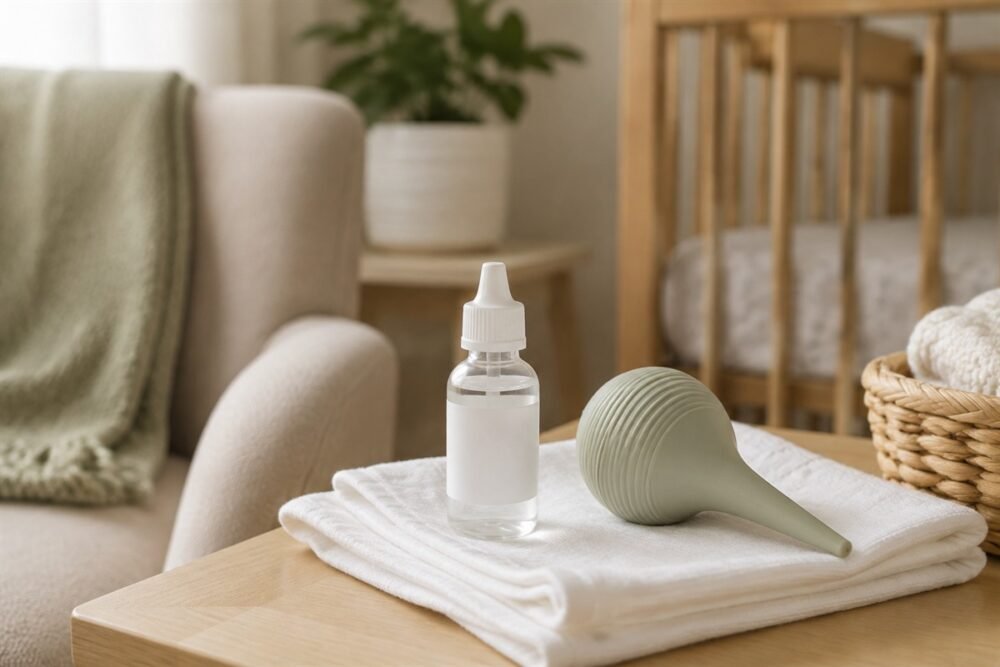
HealthyChildren advises one or two plain saline drops or sprays in each nostril for a congested baby. Squeeze a rubber bulb before placing the tip gently at the nostril, then release it slowly to draw out loosened fluid and mucus.
Do not push the tip deep into the nose. Empty and clean the device according to its instructions after use. Stop if the nostril looks irritated or the process makes breathing harder.
The AAP’s current over-the-counter medicine guide warns not to use medicated decongestant drops or sprays in a baby and cautions that suctioning too often can make the nose sore and swollen. More suction is not automatically better.
Time it for the task that is difficult
If congestion is interfering with feeding, clear the nose shortly before the feed rather than repeatedly through the day without a reason. Then pause and watch whether feeding becomes easier.
HealthyChildren notes that suction before a breast or bottle feed can help an infant who is struggling to breathe through the nose while eating. If the baby still cannot feed comfortably, call the pediatrician; the device has answered as much as it can.
Keep the sleep space unchanged. Congestion is not a reason to add pillows, wedges, positioners, loose blankets, or an inclined surface. Our guide to where a baby should sleep covers the flat, separate sleep-space basics.
If the room air is dry, ask the pediatrician whether a cool-mist humidifier is appropriate and follow the manufacturer’s cleaning directions. A dirty humidifier creates another problem beside the one you were trying to solve.
Know what breathing trouble looks like
A stuffy nose should not make you responsible for deciding whether a newborn is in respiratory distress. Use the signs as a reason to get help, not as a home score.
HealthyChildren tells parents to notify the pediatrician immediately for fast breathing above 60 breaths in one minute, the skin pulling in between the ribs, nostrils flaring, grunting with breaths, or persistent blue coloring. Call 911 in the US for severe breathing trouble or blue coloring.
Call promptly as well if your newborn is hard to wake, is not waking for feeds, seems too tired to eat, has fewer wet diapers than usual, or is feeding much less. A baby under 3 months with a temperature of 100.4°F (38°C) or higher needs immediate medical evaluation.
Our article about pauses and breathing during newborn sleep addresses a different fear. If you are unsure which pattern you are seeing, do not choose between articles; call.
Leave a simple handoff for the next caregiver
Put the saline and clean suction device in one known place. Tell the next caregiver what you observed, when you last cleared the nose, how the last feed went, and which signs mean they should call you or the pediatrician.
Do not ask them to repeat suction on a fixed schedule unless your pediatrician gave one. The useful handoff is based on what the baby needs: before a difficult feed, with attention to irritation and breathing effort.
For bottle-fed babies, keep the congestion routine separate from bottle preparation and storage decisions. Our guide to how long a bottle can sit out answers that question without turning a stressful feed into several overlapping rule sets.
A clear nose may make the next feed easier. Comfortable breathing, normal color, alertness, and the ability to feed are the outcomes to watch.
Sources
- American Academy of Pediatrics, HealthyChildren: A Parent’s Guide to Over-the-Counter Medicines for Children — current page checked September 7, 2026.
- American Academy of Pediatrics, HealthyChildren: 11 Common Conditions in Newborns — current page checked September 7, 2026.
- American Academy of Pediatrics, HealthyChildren: How to Care for Your Child’s Cold — current page checked September 7, 2026.
- American Academy of Pediatrics, HealthyChildren: Fever and Your Baby — updated September 23, 2025.
A note on this post. Written and edited by the NewBloom editorial team. NewBloom is not written by doctors, nurses or midwives, and nothing here is medical advice. We read the current guidance from bodies like the AAP, the CDC and the NHS and write down what it says, with every claim traced to its source and named in the sentence where it appears. General guidance is not the same as an answer about your baby. Your pediatrician, midwife or health visitor can see your child and we cannot, so anything here that raises a question about your own baby is a reason to ask them. If something is wrong right now, contact your doctor or your local emergency number. More about how we write these posts.