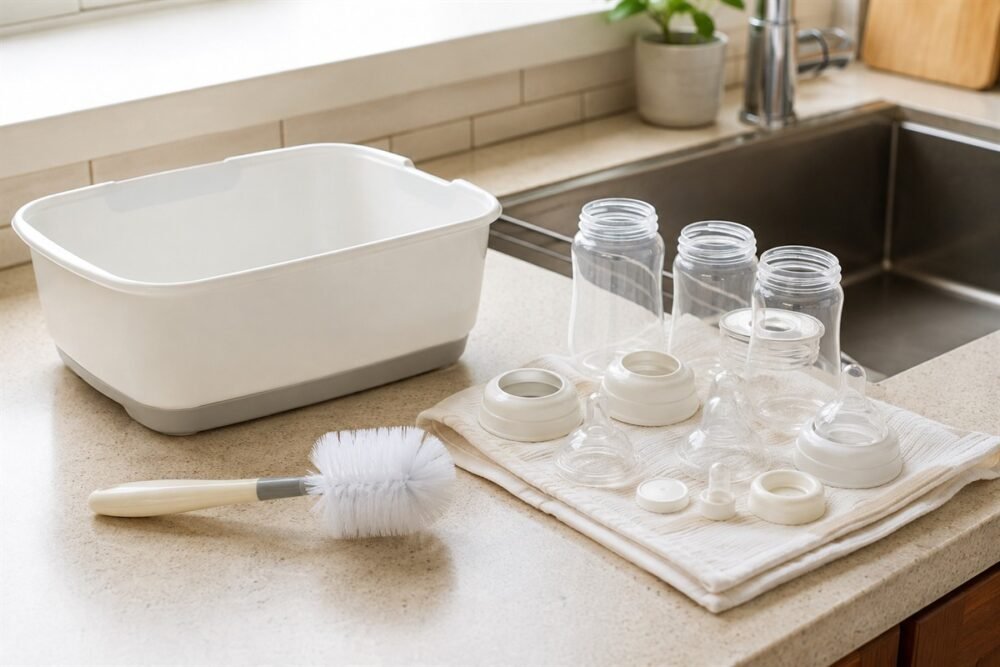
The used bottle is beside a breakfast plate, the brush is somewhere near the sponge, and there is no obvious place for the small parts. Before buying another appliance, it helps to decide where the washing will happen.
For handwashing, the CDC recommends a basin reserved for infant feeding items rather than washing directly in the kitchen sink, where germs could contaminate them; the FDA also specifies a separate basin for washing formula-feeding parts.
You can use that distinction to arrange a routine in an ordinary shared kitchen. The aim is to make the steps clear enough that the person who washes the next bottle does not have to ask where everything goes.
Give the bottle parts their own place
Choose where to keep the basin and where the washed parts will dry. Clear that space of the things that usually migrate there: mail, cups, the pan someone is saving for later. Tell other people what the space is for.
The brush needs its own job too: the CDC specifies a brush used only for infant feeding items, and says bottles should be cleaned after every feeding.
A simple household arrangement is to keep the bottle brush with the bottle basin so it does not get borrowed for ordinary dishes. This is an organizing suggestion, not a requirement to buy a matching set. Ask anyone helping with washing to use the same arrangement.
If several people handle feeds, agree how they will distinguish used bottles from clean ones. The useful question is whether someone arriving in the kitchen can tell, without guessing, which items still need attention.
Work from the used bottle to the drying area
Have the bottle instructions available for any pieces that come apart. Some designs are more fiddly than they look assembled, and a small diagram can be easier to follow than trying to remember how a valve fits.
Begin with hands washed using soap and water for 20 seconds, then separate all bottle parts and rinse under running water without putting them in the sink, following the CDC method.
Lay out the task in the order you will do it. If you are showing someone else, let them locate the pieces themselves instead of taking over as soon as they hesitate. You want them to recognize the whole set when you are not standing beside them.
For the wash itself, the CDC directs caregivers to scrub the parts with the dedicated brush in the basin of hot, soapy water, squeezing water through nipple holes; the CDC then calls for rinsing under running water or in fresh water in another dedicated basin.
It is worth deciding which rinsing option you will use before the counter is covered in parts. A shared kitchen does not always have room for another container. Put the equipment for your chosen method where you will actually use it.
There is no need to turn this into a formula-making lesson at the same time. Preparing formula is a separate task, with its own instructions. Finish one explanation before adding the next.
Leave the towel underneath
Someone trying to help may pick up a towel and start drying every piece. Explain this part of the routine before they do: the towel has a different role here.
After rinsing, the CDC says to air-dry parts thoroughly on a clean, unused dish towel or paper towel, protected from dust and dirt, without rubbing or patting them dry.
Leave enough room for the arrangement to stay there. If dinner preparation will take over the same counter, choose another suitable spot rather than creating a setup you will immediately have to dismantle. Tell the next person that the pieces are still drying.
Once everything is dry, the CDC advises washing your hands before reassembling the items and storing them in a clean, protected place.
A cupboard space that everyone knows is easier to use than several changing hiding places. Put only the completed set there, so “in the cupboard” means the same thing to whoever is getting ready for a feed.
Decide where sanitizing fits
Washing is only part of the question for some families. Check which additional step applies to your baby and your equipment, and include it in the routine you show other caregivers.
After cleaning, the CDC calls for at least daily sanitizing for babies younger than 2 months, babies born prematurely, or babies with weakened immune systems; daily sanitizing may be unnecessary for older, healthy babies whose items are carefully cleaned after each use.
For a steam system, follow the manufacturer’s sanitizing, cooling and drying instructions, as the CDC directs. The CDC also says a dishwasher using hot water and heated drying or a sanitizing setting removes the need for a separate sanitizing step.
This is not a recommendation to buy a steam appliance. It is an example of a method that needs its own instructions, rather than an improvised time or temperature. The linked CDC guide describes other options. Choose a manufacturer-compatible method and write down the steps you will use.
The basin and brush need care as well: the CDC says to rinse and air-dry them after use and wash them every few days, or after every use when the baby is under 2 months, premature or immunocompromised.
Add those tools to the household explanation. Otherwise it is easy for “the bottles are done” to mean different things to different people. Include the tools when you check the manufacturer’s instructions for your chosen sanitizing method.
Show the next person the whole job
Walk through the routine with whoever will take the next turn. Show where used items wait, which brush and basin belong to this task, where parts dry, and where completed sets go. Point out the instructions for any extra sanitizing step.
Then ask whether anything is awkward about the arrangement. Perhaps the basin has no convenient home, or the small parts are difficult to keep track of. Solve that practical problem together instead of assuming the other person will remember a spoken list indefinitely.
For questions about milk left in a bottle, use our separate guide to how long a bottle can sit out. Do not borrow a cleaning schedule to decide whether milk can be kept.
Once the arrangement works, leave it recognizable. The next person should find the same basin, the same brush and a clear place to begin.
Sources
- CDC: How to Clean, Sanitize, and Store Infant Feeding Items — March 19, 2025.
- FDA: Handling Infant Formula Safely — current page checked for this article.
A note on this post. Written and edited by the NewBloom editorial team. NewBloom is not written by doctors, nurses or midwives, and nothing here is medical advice. We read the current guidance from bodies like the AAP, the CDC and the NHS and write down what it says, with every claim traced to its source and named in the sentence where it appears. General guidance is not the same as an answer about your baby. Your pediatrician, midwife or health visitor can see your child and we cannot, so anything here that raises a question about your own baby is a reason to ask them. If something is wrong right now, contact your doctor or your local emergency number. More about how we write these posts.