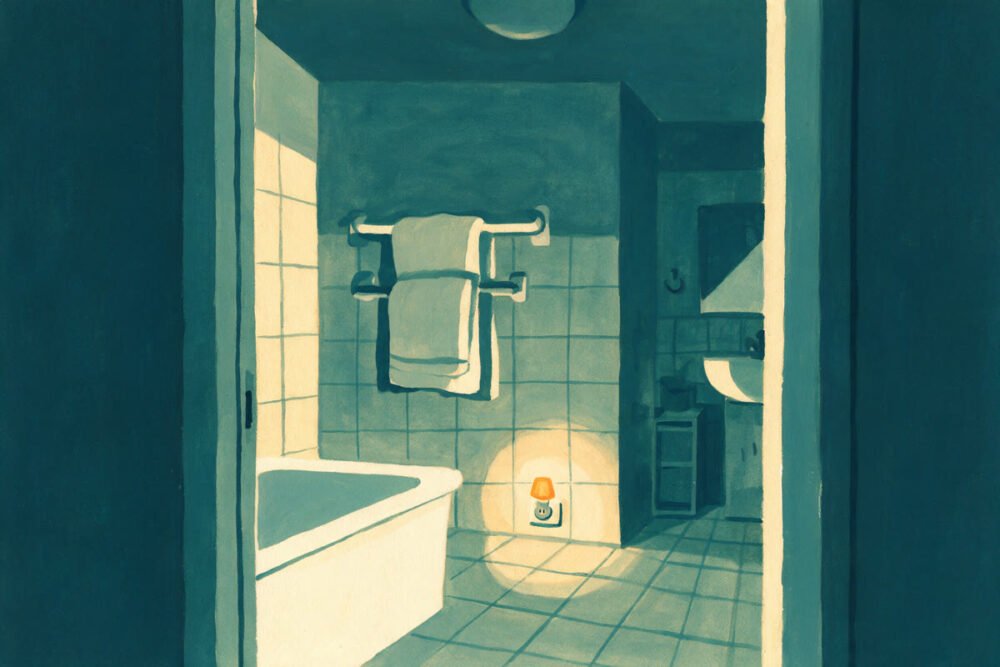
If you are standing in a bathroom at some ugly hour trying to work out whether that was your water breaking, the short answer is that you probably cannot tell, and you are not supposed to be able to. The NHS says it plainly on its own page about the signs of labor: sometimes it is difficult to tell amniotic fluid from urine.
So this next hour is not for deciding. It is for keeping the three things that let somebody else decide, and the first of them disappears the moment you get in the shower.
You will want to shower first. That is the one thing to skip
I woke up wet in my first pregnancy and spent about forty minutes arriving at the conclusion that it was nothing. Not calmly. I checked the sheet with the light off, then with the light on, then sat on the edge of the bath with the towel still folded on the rail, because unfolding the towel felt like agreeing to something.
Then I had a shower. It made complete sense at the time. If I was going to phone anybody, I did not want to be standing there in the state I was in while I did it.
I worked it out somewhere around the shampoo. I had just washed off the only thing anybody was going to ask me about.
The instruction from the American College of Obstetricians and Gynecologists is one line long and getting clean is not in it. If your water breaks, call the office of your ob-gyn or other obstetric care provider and follow their instructions. ACOG also supplies the only physical description you will get from a medical body, fluid that trickles or gushes, which covers nearly everything and rules out nearly nothing.
A shower is not the danger here, and I want to be clear about that, because the guilt does its own damage. There is no evidence that a bath or shower after your water breaks raises your risk of infection, and the NHS says so on the same page. The problem is only that a shower is extremely good at removing evidence, and none of it comes back.
It is also not really a hygiene decision at that hour. It is twenty minutes that belong to you, and if this pregnancy has a toddler attached to it, it may be the only twenty minutes on offer. Take them afterwards. They will still be there.
Note the time before you note anything else
Somebody asked me later what time it had happened and I did not know. Not roughly. Not within an hour either side. I had the whole night filed in my head as one undifferentiated block of being awake, which is how I have most of that pregnancy stored.
That question is not conversation. The NHS puts a clock on it. It is usual to go into labor within 24 hours of your water breaking, and if you have not, you will be offered an induction, because without amniotic fluid there is a small increased risk of infection for the baby.
A clock that runs for a whole day has to be started by somebody, and the only person in the room when it started was me. That is the entire reason the time matters, and it is why it sits this high up the page instead of somewhere sensible near the end.
Say it out loud to whoever is in the house. Put it in your phone. Not the time you accepted it was real, which in my case was roughly forty minutes late. The time it happened.
If you do end up waiting out that window, there is a job to do inside it, which is a relief in its own strange way. The NHS asks you to watch for the baby moving less than usual and for any change in the color or smell of what is coming out, and to take your temperature every four hours while you are awake. It treats anything above 37.5C, which is 99.5F, as raised, and adds that you should check with your midwife, because you may need to call before that.
Keep the pad. Somebody else reads it
There was a bag of pads at the bottom of my wardrobe that I had bought for after the birth. It had a ridiculous amount of ceremony attached to it in my head, because it belonged to the after part, and I had a whole idea about the day I would open it. I opened it that night instead, months early, standing up, in the dark.
The pad turns up twice on the NHS labor page and the two mentions are doing different jobs. The first is preparation, something to keep handy when you go out in case this happens away from home. The second is an instruction for afterwards: use a period pad, not a tampon, so your midwife can check the color of the fluid.
Read that second one again. It does not say so that you can check. The pad is not a test you are running. It is a thing you are holding for somebody qualified to look at it, which is the same reason a lab never asks you what you think.
Two things read off that pad mean you call immediately rather than at a reasonable hour. The NHS names both.
- The fluid smells, or it has color in it.
- You are losing blood.
The second of those deserves a word, because the same page also says amniotic fluid is normally clear and pale and may be a little bloodstained to begin with. Two facts a paragraph apart, and nothing anywhere tells you where one of them stops and the other starts.
That gap is not an oversight. It is the part somebody else does, from the thing in your hand, which is why the thing in your hand goes into a bag rather than a bin.
The comparison you are looking for does not exist
What I actually wanted that night was something to hold it up against. A picture, a description, anything that produced a yes or a no. I read until the words stopped meaning anything, and every description I found fit what was in front of me and also fit the thing I was hoping it was.
Here is why that happened. The NHS describes amniotic fluid as clear and pale, and then, more or less in the next breath, takes the certainty back: sometimes it is difficult to tell amniotic fluid from urine. A national health service wrote that down and published it. You are not failing at something other people find easy.
Nobody has written the comparison because the comparison is not the test. The test is a person looking at the pad, and every page I have opened on this quietly assumes you will hand the question over rather than answer it.
Which changes what you are doing between now and then. You are not assembling enough evidence to reach a verdict. You are assembling enough to make a phone call, and that bar is far lower than the one you are currently holding yourself to.
The two other things it could be, and why neither one buys you sleep
At that hour everybody runs the same arithmetic, which is to line the possibilities up in order of how little each one would cost. Nothing at all goes at the top. It goes at the top because you put it there, not because it earned the spot.
The one most people land on is a show, and a show does have its own look. Both NHS pages describe it identically, sticky, jelly-like pink mucus, pink because there is a small amount of blood in it. That is a different object from a wet pad and you would know it if you saw it.
It is also not a reason to go back to bed. A show means the cervix is starting to open, and labor may follow quickly or may take days. On the same page, if you are losing more blood than that small amount, the instruction is to phone the hospital or midwife straight away.
The other candidate is simply more discharge, which is genuinely normal. There is more of it in pregnancy and more again toward the end, and in the last week or so it may carry those pink streaks, all of which the NHS treats as ordinary.
So the list does not do the job you want it to do. One of the three sends you to the phone tonight. One of them tells you something has started without telling you when, and has its own line about blood attached. And the one you are hoping for is the only one of the three you cannot confirm on your own.
Four sentences, and the call is over
I stood in the hall holding the phone for longer than I want to admit, because I could not work out what the first sentence was. Everything I tried sounded either hysterical or like I was wasting somebody’s night, and I could not find the version in between.
There is no version in between. There is information, and there is less of it than you think.
Four things. What happened and what time. What is on the pad right now, which means color and smell and whether there is any blood. How many weeks you are. Whether you are having contractions.
That last one is not small talk. ACOG’s list of things that send you to the hospital rather than to the phone includes your water having broken while you are not having contractions, so the answer changes where you are going, not only what gets said to you.
The weeks matter for the same kind of reason. Being less than 37 weeks pregnant and thinking you might be in labor sits on the NHS urgent list by itself, with your water doing nothing at all.
Most of what makes that call hard is not the medical part. It is the first ten seconds, and I have written before about getting through those when the thing you are calling about feels too small to bother anybody with. This one is not too small. This one is on every list there is.
The ones that mean now and not the morning
I read a list like this more than once during that pregnancy and it never occurred to me that the first item on it was the exact thing I would later stand in a bathroom arguing with myself about. Lists have a way of being about other people right up until they are not.
The NHS says to contact your midwife or maternity unit urgently if any of these are true.
- Your water breaks.
- You have vaginal bleeding.
- Your baby is moving less than usual.
- You are less than 37 weeks pregnant and think you might be in labor.
- Any one of your contractions lasts longer than two minutes.
- You are having six or more contractions every ten minutes.
The first line has no qualifier on it. Not if it is a lot, not if you are certain. Your water breaking sits on that list beside bleeding, and the page adds that these are not things to hold until the next day, even in the middle of the night.
Which is the answer to the question you actually arrived with, and it is slightly rude about it. You wanted to know whether this counts yet. It counts whether or not you can identify it.
The short version
- The time is the first thing to go and it goes fastest. Say it out loud to somebody, or put it in your phone, before anything else happens.
- Skip the shower. Not because it is risky, but because it takes the evidence with it, and you can have one afterwards.
- Use a pad rather than a tampon, and do not throw it out. It is being kept for somebody else to read.
- Stop trying to identify the fluid. That was never the job, and the pages that describe it say as much.
- Make the call before you feel organized enough to make it. Nobody at the other end is scoring you.
Sources
- NHS, Pregnancy guidance on the signs that labor has begun (page last reviewed 9 November 2023)
- American College of Obstetricians and Gynecologists, “How to Tell When Labor Begins”, FAQ004 (published May 2020, last reviewed November 2025)
- NHS, Pregnancy guidance on vaginal discharge in pregnancy, Pregnancy symptoms (page last reviewed 17 April 2024)
A note on this post. Written and edited by the NewBloom editorial team. NewBloom is not written by doctors, nurses or midwives, and nothing here is medical advice. We read the current guidance from bodies like ACOG, the CDC and the NHS and write down what it says, with every claim traced to its source and named in the sentence where it appears. General guidance is not the same as an answer about your own body. Your doctor, midwife or health visitor can examine you and we cannot, so anything here that raises a question about your own pregnancy is a reason to ask them. If something is wrong right now, contact your doctor or your local emergency number. More about how we write these posts.