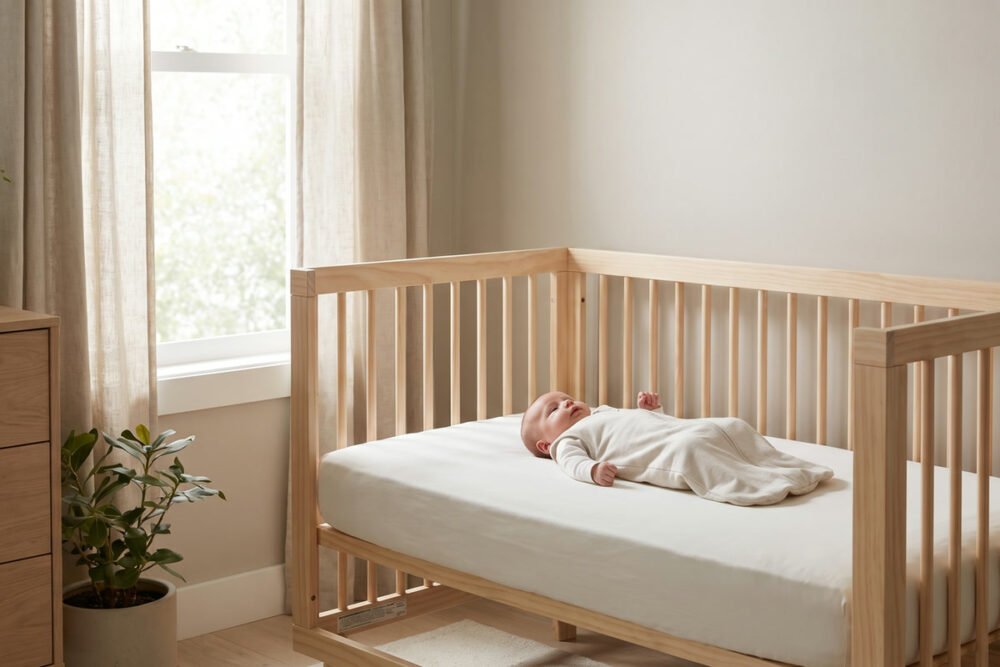
Most of what helps a newborn sleep is not a trick. It is a safe sleep space, a dark and boring night, a short routine, and knowing that a baby who wakes every two hours is doing what a newborn is built to do.
Every tip below traces to the American Academy of Pediatrics, the CDC or the NHS. This post used to carry ten. Two had no source behind them and both are dealt with near the end.
One note before the list. Sleep is the one topic where the guidance is not just advice, and this page does not thin it out to make room for anything else.
What newborn sleep actually looks like
The CDC puts recommended sleep at 14 to 17 hours a day from 0 to 3 months, and 12 to 16 hours including naps from 4 to 12 months. The AAP supports the same guidelines.
The surprise is never the total. It is the shape. The AAP says newborns sleep about 16 to 17 hours a day but often only one or two hours at a time, and regular sleep cycles do not appear until around four months. The NHS puts newborn daily sleep at around 18 hours and says your baby’s pattern is unlikely to match any other baby you know.
Which is the thing that actually breaks people. Not the quantity. The fact that it arrives in pieces, at unpredictable hours, with no accumulation. A baby who wakes every two hours is not sleeping badly, that is the design, and if the waking is what is wearing you down, our post on why your baby keeps waking up at night goes into it properly.
1. Get the sleep space right before anything else
This is the one item where the stakes are safety rather than sleep, so it comes first and it comes in full.
The CDC reports that about 3,700 US babies died suddenly and unexpectedly in 2022, and it backs the AAP’s 2022 safe sleep recommendations. That policy comes down to a short list.
- On the back for every nap and every night, until 1 year of age.
- A firm, flat surface that does not indent under the baby. Nothing inclined more than 10 degrees.
- A crib, bassinet, portable crib or play yard meeting CPSC standards, with a mattress made for it.
- A fitted sheet and nothing else. No pillows, quilts, blankets, bumper pads or stuffed toys.
- No weighted blankets, sleepers or swaddles.
- Asleep in a car seat, stroller, swing or carrier means moving them to a firm flat surface on their back as soon as you can.
The AAP also says to be careful with anything sold as a sleep aid claiming to reduce SIDS risk, because there is no evidence any of it does.
Here is the part that nobody prepares you for. Almost everything that arrives before the baby does is not allowed in the crib. The quilt somebody’s mother made. The bumper set that came with the bedding. The cuddly toy with the name embroidered on it. All of it thoughtful, all of it out.
Stripping the crib back to a sheet feels wrong the first time, because a bare crib looks cold and unwelcoming and every catalogue photograph you have ever seen looks like the opposite. It is worth doing it once, properly, before the baby comes home, rather than negotiating with yourself about a single blanket at midnight.
2. Share a room, not a bed
The AAP recommends keeping the sleep space in your room but not in your bed for at least the first six months, and says room sharing can lower the risk of SIDS by as much as 50%. The NHS gives the same six month advice.
On bed sharing the AAP does not hedge. It does not recommend it under any circumstances, and it flags where exhausted parents actually end up: the risk of sleep related infant death is up to 67 times higher when a baby sleeps with someone on a couch or a soft armchair.
That 67 times is the number to hold, because it is not about a decision anybody makes deliberately. Nobody plans to fall asleep on the sofa. It happens at the end of a feed, at 4am, in the eleventh hour of being awake, and the AAP guidance is aimed squarely at that moment rather than at a considered choice.
The honest downside of room sharing, which nobody mentions: you will hear everything. Newborns are astonishingly loud sleepers. Grunting, snuffling, the occasional noise that makes you sit bolt upright. Some of that is a baby moving between sleep cycles, and you will spend the first fortnight learning which noises mean anything.
3. Keep nights dark and dull, and days the opposite
The AAP says to stay calm and quiet at night, avoid stimulating the baby during feeds and changes, and speak softly if you speak at all. Its guidance for exhausted parents is blunter: nighttime feedings are not play time.
The NHS lists the same rules. Lights low, little talking, baby down as soon as they are fed and changed, and skip the diaper change unless they need it.
The daytime half is the one everybody skips, and it is half the mechanism. The AAP says keep babies awake longer during the day and spend it talking, reading and playing. The NHS says open the curtains and do not worry much about ordinary household noise during naps.
The less you do at 3am, the shorter the whole event is. That is the entire principle and it is genuinely hard to follow, because at 3am with a baby awake in your arms the temptation to talk to them is enormous. It is the only time all day that nobody wants anything from you. If you bottle feed, our post on how long a bottle can safely sit out covers what you can set up in advance. If evening feeds have turned relentless, that may be cluster feeding rather than a sleep problem.
4. Build a routine short enough to run half asleep
The AAP says do the same things in the same order at naptime and bedtime, and build the routine with your partner so both of you can do all of it.
That second clause is the one that matters and the one that quietly fails. Routines grow. A bath becomes a bath and a massage and two specific books and a song in a particular order, assembled over weeks by whoever does bedtime most, until it exists only in one person’s head.
Then that person has a night off, or gets ill, and the routine cannot be run. A routine only one of you can perform stops being a routine on the night it is needed most.
The NHS version can be as small as a bath, a clean diaper, dimmed lights, a story and a lullaby. Length is not what makes it work. Sameness is.
5. Learn the drowsy face
The AAP describes six states a newborn cycles through. The one to recognize is State 3, drowsiness, where the eyes roll back under drooping eyelids and the baby may stretch, yawn, or jerk their arms and legs.
That is the window, and it is much shorter than it looks. Miss it and you are not dealing with a sleepy baby anymore.
The AAP tells tired parents to put the baby down while still a little bit awake, so they learn to fall asleep on their own rather than only in your arms. One honest note: the AAP gives that advice on its newborn page but files the same tip under babies four months and older elsewhere. Try it early, expect more from it later, and do not treat an early failure as a verdict.
6. Swaddle if it helps, and stop at the first sign of rolling
Swaddling can calm a newborn and the AAP says so. It also says two things the packaging never does.
The first: swaddling does not reduce the risk of SIDS. It may reduce a baby’s arousal, which is part of why swaddled babies sleep longer, and reduced arousal may be one of the main reasons babies die of SIDS.
The second is the stop date. Stop as soon as your baby shows any sign of trying to roll, which the AAP says can be as early as 2 months. The same goes for sleep sacks that compress the arms and chest. Sacks that let the baby move freely can carry on.
Two months is much earlier than most people expect, and the sign is often not a full roll. It is a determined lean onto one side that was not happening last week. That is the notice.
Swaddle on the back only, leave room for two or three fingers between the chest and the wrap, and keep the hips loose enough to bend up and out. Tight straight legs are linked to hip dysplasia.
7. Give the noise a minute, then respond in steps
Newborns alternate between deep and light sleep, cycling through both within an hour. In light sleep they move and startle, so some of what you hear on the monitor is a baby between cycles rather than a baby awake.
One thing needs separating out, because it gets applied to the wrong age constantly. The AAP’s “do not rush in to soothe a crying baby” sits on its list for babies 4 months and older, not newborns. A newborn who is crying usually needs something.
What the AAP suggests is a ladder rather than a leap. Look at your baby first, then use your voice softly, then move through light touch and massage before picking them up and rocking, with time between each step. Hunger, a dirty diaper and illness jump the queue.
8. Protect your own sleep, and watch the feeding chair
The AAP tells new parents to nap or at least rest when the baby naps, and to go to bed straight after the last feed rather than reclaiming the evening.
Reclaiming the evening is the hardest habit to give up, because that hour after the baby goes down is the only part of the day that belongs to you. Everybody trades it for sleep they need, knowingly, night after night.
The chair matters most. Before a night feed, think about how tired you are. The AAP suggests avoiding the couch and the armchair, clearing bedding out of the area, setting a phone alarm or a podcast running, and asking someone to sit with you if there is any chance of dropping off. If you do fall asleep holding your baby, move them onto their back in the crib the moment you wake.
Set the alarm before the feed, not during it. During it you will decide you do not need one.
9. Ask for help, and say something if it is more than tiredness
Accepting help is on the AAP’s list for sleep deprived parents. So is this: if you think you may have postpartum depression, tell your doctor or your pediatrician. The National Maternal Mental Health Hotline is 1-833-TLC-MAMA, free and open all day and night.
Exhaustion and depression overlap so heavily in this stretch that they are genuinely hard to separate from the inside, which is exactly why the guidance is to say it out loud to somebody rather than work it out alone. Our post on baby blues and postpartum depression covers where the line sits.
Two claims this post used to make
That newborns can only stay awake 45 to 60 minutes. That number is not in AAP, CDC or NHS material, so we are not printing it as guidance. Wake windows came out of the parenting world rather than a clinical guideline, and the minutes vary from chart to chart.
What the sources do say is close enough to be useful. Newborns wake at the end of each sleep cycle, as often as every one or two hours, and regular cycles arrive around four months. Use awake time as a rough signal and the drowsy face as the real one.
That sleep deprivation affects milk supply. Also not in AAP, CDC or NHS material, so it has been removed rather than softened into something vaguer.
What about white noise?
Worth using, worth turning down.
In its 2023 policy statement on excessive noise exposure, the AAP notes that some studies show potential benefits from infant sleep machines, that one study raised concern about the sound levels they produce, and that pediatricians should be counseling families on safe use.
That study, published in Pediatrics in 2014, measured 14 infant sleep machines at maximum volume. All 14 exceeded 50 A-weighted decibels at 30 cm, the recommended noise limit for infants in hospital nurseries, and three went above 85 decibels, a level that risks hearing damage over long exposure.
The question is not whether to use one. It is how loud and how close, and the honest answer is that most people set it once in week one at whatever volume worked that night and never touch it again.
Two things that will not buy you more sleep
Starting solids early. The AAP says not before about 6 months and is direct about why parents try: solid food sooner will not help your baby sleep through the night, and may make sleep worse.
A bottle in the bed. The AAP says not to put a baby down with a bottle of juice, milk or formula, because of tooth decay. Feed first, then put them down. Water is the only exception.
When to talk to your pediatrician
The AAP suggests bringing sleep habits and problems to your pediatrician, since most are straightforward to treat. Snoring, loud or heavy breathing during sleep and frequent night wakings are on its list.
Raise how you are doing as well. Exhaustion and postpartum depression are not the same thing and your pediatrician can help work out which one you are in. Nobody at that appointment will find the question odd.
The short version
- Back, firm, flat, empty. A fitted sheet is the only thing in there with your baby.
- Your room, not your bed, for at least 6 months. Never a couch or an armchair.
- Nights dark and boring. Days bright, noisy and awake.
- Stop swaddling at the first sign of rolling, which can be as early as 2 months.
- Waking every one or two hours is normal until around 4 months. It changes on its own.
- Build the routine so both parents can run it.
- Set the alarm before the night feed, not during it.
If the nights got worse suddenly and there is drooling and chewing involved, our guide to teething remedies worth skipping may be the more useful page.
Sources
- American Academy of Pediatrics, HealthyChildren.org, “How to Keep Your Sleeping Baby Safe: AAP Policy Explained” (last updated 8 January 2026)
- American Academy of Pediatrics, HealthyChildren.org, “Safe Sleep Tips for Sleep-Deprived Parents” (last updated 12 March 2026)
- American Academy of Pediatrics, HealthyChildren.org, “Getting Your Baby to Sleep” (last updated 4 June 2024)
- American Academy of Pediatrics, HealthyChildren.org, “Swaddling: Is it Safe for Your Baby?” (last updated 15 July 2022)
- American Academy of Pediatrics, HealthyChildren.org, “States of Consciousness in Newborns” (last updated 2 November 2009)
- American Academy of Pediatrics, HealthyChildren.org, “Healthy Sleep Habits: How Many Hours Does Your Child Need?” (last updated 16 November 2020)
- American Academy of Pediatrics, HealthyChildren.org news, “AAP Sounds Alarm on Excessive Noise Risks to Children”, 21 October 2023, on the policy statement “Preventing Excessive Noise Exposure in Infants, Children, and Adolescents”, Pediatrics, November 2023
- Hugh SC, Wolter NE, Propst EJ, Gordon KA, Cushing SL, Papsin BC. “Infant sleep machines and hazardous sound pressure levels.” Pediatrics 2014;133(4):677-681. DOI 10.1542/peds.2013-3617, PMID 24590753
- CDC, “About SUID and SIDS”, 17 September 2024
- CDC, “About Sleep”, 15 May 2024
- NHS, “Helping your baby to sleep”, page last reviewed 28 January 2025
A note on this post. Written and edited by the NewBloom editorial team. NewBloom is not written by doctors, nurses or midwives, and nothing here is medical advice. We read the current guidance from bodies like the AAP, the CDC and the NHS and write down what it says, with every claim traced to its source and named in the sentence where it appears. General guidance is not the same as an answer about your baby. Your pediatrician, midwife or health visitor can see your child and we cannot, so anything here that raises a question about your own baby is a reason to ask them. If something is wrong right now, contact your doctor or your local emergency number. More about how we write these posts.