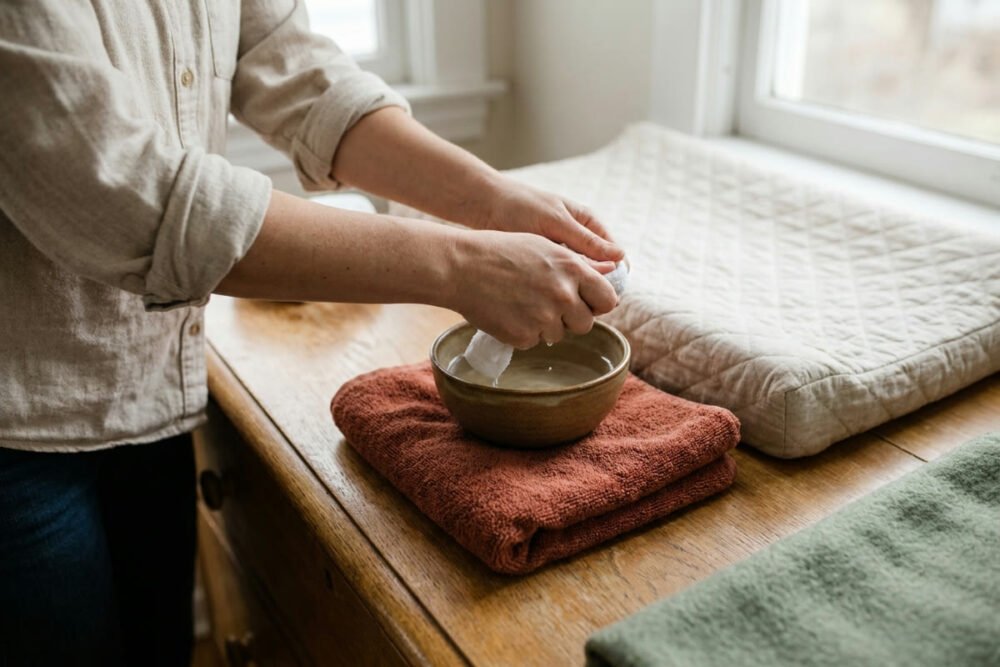
Not in water. According to the American Academy of Pediatrics, a newborn gets sponge baths only until the stump of the umbilical cord falls off, usually by about one or two weeks of age, because the stump has to stay clean and dry while it shrivels.
That is the whole rule, and it is not the hard part. The stump decides when the tub is allowed. It was never the thing you were waiting for. You were waiting to be willing to hold a wet newborn over water, and two weeks is about how long that takes.
Night one, and the bowl you already own
The first thing to settle is not technique, it is geography. You will do this about forty times, so what decides whether the two weeks are easy is which surface in your house it happens on.
With my eldest I set up on the changing table in her room, about as far from a faucet as it was possible to get. I carried a bowl down a hallway twice a day and it was lukewarm by the time it arrived. By my third I had moved everything to the counter beside the kitchen sink, and it stopped being a production.
The AAP is wider on this than people assume. A changing table, a bed, the floor, or the counter next to the sink will all do, padded if it is hard, with a safety strap or a hand on your baby if it is off the floor.
Then leave it set up. A bowl you have to go and fetch is a wash you talk yourself out of at eleven at night.
The washing you think you are skipping is not happening anyway
About a week in with my first, I put her into a clean sleeper and stood there feeling like I had gotten away with something. I had wiped a face, a neck, two hands and a bottom. She had not been in water, and it did not feel like it counted.
So I started doing it twice a day to make up the difference, which is exactly the wrong direction. According to the AAP, newborns do not need a bath every day, and three a week during the first year may be enough, because they rarely get dirty enough to need more. Washing more often dries their skin out.
Hold that against the two weeks and the waiting mostly dissolves. You were never going to bathe this baby daily. Same number of washes, different container.
The everyday version the NHS describes is face, neck, hands and bottom, and it says not to do it straight after a feed, or when your baby is hungry or tired.
Which sounds easy and is the entire difficulty. In a week where the feeds run into each other, that window is about fifteen minutes wide and it moves every day. Finding it is a scheduling problem, not a skill problem.
The stump itself gets less attention than anything else on the baby. Wash around it only if it is dirty with urine or stool, says the NHS, then pat it dry. The AAP adds the habit that keeps that from coming up, which is folding the diaper down below the cord.
In a first week where the diapers are doing a great deal, that fold earns its keep. Otherwise you leave the thing alone, which is the whole shape of cord care.
The stump falls off before you are ready
You will not find it during a bath. It turns up in a diaper or on the sheet, smaller and drier and less dramatic than anything you had braced for. Then you look at the belly button underneath and have no idea whether that counts as healed.
The AAP does not hang the decision on the stump coming off. It says that once the umbilical area is healed you can try placing your baby directly in the water, and that the first baths should be as gentle and brief as possible.
A stump still attached past three weeks is a doctor’s visit rather than more waiting, and so is any sign of infection. Both are in the full post on cord care.
Nothing written down prepares you for how little of a wet newborn there is to hold. The instructions are all correct and they are also weightless until it is your two hands and a baby who has just discovered she can arch her back.
If that first try goes badly, the AAP says to go back to sponge baths for a week or two and try again.
My son screamed from the second his back touched the water and we took ten days. What I changed in those ten days was not the baby, it was the hour. Same time every evening, before the house got loud, so the tub stopped being a decision I could put off until tomorrow.
The two weeks were the safe part
Bath night is the loudest fifteen minutes in our house. The older two want to be in the room, and the phone rings then, reliably, as though it can hear the water.
What never leaving them alone actually means is that you do not stand up. Not for the towel, not for the door. You learn that the first time you reach for a towel one step too far away.
According to the AAP, most child drownings inside the home happen in bathtubs, and more than half of bathtub deaths involve children under one year of age. The sponge bath weeks are the stretch where that risk does not exist yet.
Two inches, and the inside of your wrist
Two inches is much less water than you will instinctively run, and in a full sized tub it looks like a mistake.
The AAP says to fill the basin with about two inches that feels warm, not hot, against the inside of your wrist or elbow. Never bathe a baby in running water, and turn the faucet off before your baby goes in, because temperature shifts as water moves through the pipes and small changes are enough to scald. The AAP puts the hottest temperature at your faucet at no more than 120 degrees Fahrenheit, which is a water heater setting rather than anything you do at bath time.
Skip the bath seat
Bath seats are the one thing both bodies tell you to leave in the store. The AAP says to avoid them because they tip easily and a child can fall into the water and drown. The NHS carries the same recommendation from the Royal Society for the Prevention of Accidents, which adds that babies of any age can drown in very shallow water, quickly and with no noise or struggle at all.
The no noise part is the one to keep. You spend the whole bath listening for a splash or a cry, and that is the sound that never comes.
The short version
- The rule is one word long, and the word is dry. Sponge baths until the stump is off and the area has healed, usually one to two weeks
- You are not behind. Three baths a week is enough for the entire first year
- Set up one spot near warm water and leave it set up. That is what makes two weeks bearable, not technique
- The tub is the risky part, not the wait. Two inches, wrist test, faucet off, never step away, no bath seat
Sources
- American Academy of Pediatrics, HealthyChildren.org, “Bathing Your Baby”, Dipesh Navsaria MPH MSLIS MD FAAP (last updated 7/6/2025)
- American Academy of Pediatrics, HealthyChildren.org, “Umbilical Cord Care in Newborns” (last updated 7/6/2025)
- National Health Service (UK), “Washing and bathing your baby” (page last reviewed 23 July 2024), including guidance from the Royal Society for the Prevention of Accidents
A note on this post. Written and edited by the NewBloom editorial team. NewBloom is not written by doctors, nurses or midwives, and nothing here is medical advice. We read the current guidance from bodies like the AAP, the CDC and the NHS and write down what it says, with every claim traced to its source and named in the sentence where it appears. General guidance is not the same as an answer about your baby. Your pediatrician, midwife or health visitor can see your child and we cannot, so anything here that raises a question about your own baby is a reason to ask them. If something is wrong right now, contact your doctor or your local emergency number. More about how we write these posts.