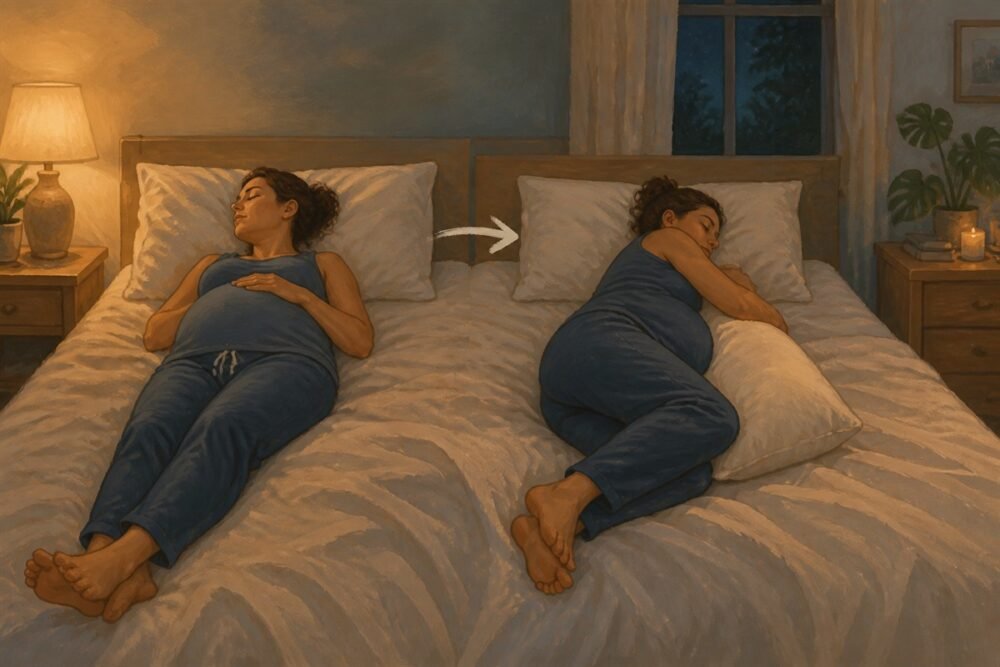
I woke up on my back, reached for my phone, and saw that three hours had passed since I last remembered being awake. My first thought was not to roll over. It was to work out how long I had been lying there.
I could not know, of course. Neither can you if this has just happened. Turn onto either side, get comfortable, and try to go back to sleep. The advice is about the position you choose when you fall asleep, not about reconstructing the hours you cannot remember.
If this just happened, turn onto either side
The next step is small: roll onto a side and settle back into the bed. You can do that without turning the wake-up into a calculation.
The NHS gives a simple instruction for this exact situation: if you wake on your back, do not worry. Turn onto your side before going back to sleep.
That is the whole next step when nothing else is wrong. There is no way to tell whether you were on your back for five minutes or two hours because waking in that position does not reveal when you moved into it.
If your mind is still trying to fill in the missing time, bring it back to what you can do now. Choose a side. Adjust the pillow. Let yourself return to sleep.
The advice is about how you fall asleep
After 28 weeks of pregnancy, the NHS advises going to sleep on your side because research suggests that going to sleep on your back after that point can increase the risk of stillbirth. The safest position to fall asleep in is either the left or right side.
The words fall asleep matter. You can choose your starting position at bedtime and after a nighttime bathroom trip. You cannot control every movement your body makes once you are asleep.
Following the guidance therefore looks quite ordinary: begin the night on a side, and return to a side whenever you wake. Rolling over during sleep does not turn the night into something you have to investigate the next morning.
Left and right both count
You may have heard that the left side is the only correct choice. The NHS guidance says either side is safe for falling asleep.
MedlinePlus explains why many health care providers recommend the left side: it can improve blood flow among the heart, fetus, uterus, and kidneys. It also says that switching to the right side is okay if the left hip becomes uncomfortable.
Start on the side that lets you settle. If one hip begins to ache, change sides instead of staying awake because you think moving is a mistake.
Make the bed easy to return to
A useful sleep setup should still work when you come back from the bathroom half awake. It does not need to hold you in one position all night.
MedlinePlus suggests lying on your side with your knees bent. A pillow between the legs or under the belly can add support, and a bunched pillow or rolled blanket at the small of the back may relieve pressure.
Try one change at a time. Put a pillow between your knees if your hips are pulling, or add support under your belly if that is where you feel the strain. Too many pillows can become one more thing to rearrange every time you wake.
If heartburn is the reason you keep sitting up, treat that as a separate sleep problem. Our guide to heartburn at night in pregnancy covers meal timing and ways to raise your upper body.
Other warning signs still need their own call
Finding yourself on your back has a calm, immediate response. Reduced fetal movement, abdominal pain, or vaginal bleeding needs separate attention.
The NHS says to contact your maternity team immediately if your baby is moving less than usual or the usual pattern has changed. There is no single movement number that replaces knowing your baby’s normal pattern. Our guide to what to do when your baby is moving less explains what to notice and whom to call.
The NHS also advises reporting abdominal pain or vaginal bleeding to your midwife on the same day. Turning onto your side is not a reason to wait on either symptom.
If you are unsure whether something else that woke you matters, tell your own doctor or maternity team what you noticed. Our pregnancy call guide can also help you put the concern into words.
The short version
- After 28 weeks, go to sleep on either side rather than on your back.
- If you wake on your back, turn onto a side and go back to sleep.
- There is no reliable way to calculate how long you were in that position.
- Left and right both count. Change sides if one hip is uncomfortable.
- Use pillows for comfort rather than trying to stop every movement.
- Call about reduced or changed fetal movement, abdominal pain, or vaginal bleeding instead of blaming those signs on sleep position.
Sources
- NHS, “Preventing stillbirth”, page last reviewed 24 April 2024
- MedlinePlus Medical Encyclopedia, National Library of Medicine, “Problems sleeping during pregnancy”, review date 14 May 2024
A note on this post. Written and edited by the NewBloom editorial team. NewBloom is not written by doctors, nurses or midwives, and nothing here is medical advice. We read the current guidance from bodies like ACOG, the CDC and the NHS and write down what it says, with every claim traced to its source and named in the sentence where it appears. General guidance is not the same as an answer about your own body. Your doctor, midwife or health visitor can examine you and we cannot, so anything here that raises a question about your own pregnancy is a reason to ask them. If something is wrong right now, contact your doctor or your local emergency number. More about how we write these posts.