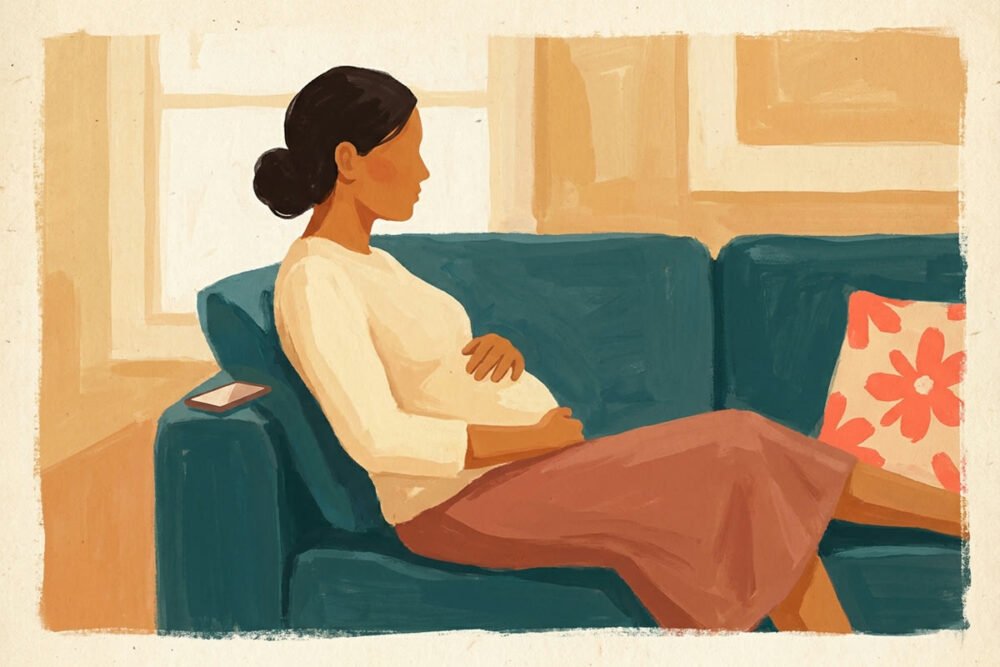
An anterior placenta is a placenta attached to the front wall of your uterus, and it can genuinely muffle your baby’s kicks for a good stretch of pregnancy. What it cannot do is rewrite the rule that matters: a drop from your baby’s own usual pattern means a call to your midwife or doctor, placenta or no placenta.
I’m writing this from inside the question. This pregnancy came with an anterior placenta and my first didn’t, so I’ve now run both versions, the baby you feel everywhere and the baby behind a wall. The difference is real. It’s also nowhere near as meaningful as the quiet makes it feel at night, and that gap is worth a whole post.
The wall between you and the kicks
I found out at a scan, the way most of us do. The sonographer mentioned it the way you’d mention weather, one word inside a stream of measurements, and I spent the ride home deciding how worried to be.
The anatomy fits in one breath. My placenta grew on the front wall of the uterus instead of the back, so it sits between the baby and my hands, and every kick has to come through it before I can feel anything. The Royal College of Obstetricians and Gynaecologists says it plainly in its patient guidance on movements: with the placenta at the front of the womb, it may not be so easy for you to feel your baby move.
Day to day, that doesn’t mean silence. It means a filter. Big rolls come through. The small jabs and flutters mostly don’t, or they arrive so faint I catch myself asking whether I invented them.
My daughter, who is three, likes to press an ear flat against my belly and wait. She usually gives up before the baby gives her anything, and the unfairness of that makes me laugh, because when I was pregnant with her she drummed. By the end you could watch my shirt move from across the room. This baby is just as busy in there. The kicks are all happening. They’re just being played through a wall.
Your app is counting weeks. Your placenta doesn’t care
Every pregnancy app has a week when flutters are supposed to begin, written as if every body shipped with the same parts. The honest window is wide before a placenta ever complicates it: the NHS puts first movements anywhere from 16 to 24 weeks, and notes that in a first pregnancy you may feel nothing until after 20.
A front-wall placenta drags your first clear kicks toward the late end of that window, which is exactly what a filter would do, and it also scrambles the folklore. Whether the baby is head down or bottom first makes no difference to what you feel, the RCOG’s clinical guideline is specific on that. What does show up in its data is the baby’s back: among women who couldn’t feel movements a scan could see, 80 percent were carrying a baby whose spine lay along the front.
If this is your second baby, there’s a quieter trap here: comparing. I kept measuring this pregnancy against the memory of the first, and the memory always won. A different placenta makes that comparison worthless. The only pattern that matters belongs to the baby currently behind the wall.
One line in all this is fixed no matter where the placenta sits. If you have never felt the baby move by 24 weeks, tell your midwife, the NHS says, and they’ll check the heartbeat and the movements. Not as an alarm. As the point where “probably just the placenta” needs someone qualified to agree.
The 28-week expiry date
Here’s the sentence I made myself memorize, because it has a clock inside it. The RCOG’s clinical guideline on reduced fetal movements states that prior to 28 weeks of gestation, an anteriorly positioned placenta may decrease a woman’s perception of movements.
Notice the boundary. Before 28 weeks. The guideline doesn’t claim the placenta stops muffling at midnight on the first day of week 28; bodies don’t read calendars. What it does is quieter and more important: past that line, it simply stops offering the placenta as an explanation. Quiet after 28 weeks is treated as quiet, period.
The same college’s advice for anyone past 28 weeks who notices reduced movements is to contact the midwife or maternity unit immediately and not wait until the next day. I went looking for the placenta asterisk on that instruction. There isn’t one.
So the wall gets a deadline. Early on, it’s allowed to explain faint; that’s real and written down. What it never earns, at any week, is the right to explain less than yesterday. And past 28 weeks it loses its speaking role entirely.
A quiet afternoon is not data. A quiet baby is
Most of the quiet I’ve panicked over wasn’t the baby. It was me. On days I chase a three-year-old from breakfast to bath, I feel almost nothing, and the RCOG’s patient information says exactly that: you’re less likely to notice movements while you’re active or busy.
Babies also nap on their own schedule in there. Sleep cycles in the womb mostly run 20 to 40 minutes and rarely pass 90, by the RCOG’s description, which reclassifies a lot of scary half hours as naps.
My fix is an evening appointment with the couch. Phone face down on the armrest, hand flat where the app would be, the same couch where I once counted my way through a scare in my first pregnancy and ended up calling. Stillness plus attention catches more than any busy afternoon.
What stillness is for is learning the pattern, because pattern is the entire test. A quiet stretch is an afternoon fact; a change from your baby’s own normal is a different animal, and I’ve already gone through what moving less actually means and what to do about it, so I won’t rebuild that argument here. The wall’s alibi has a hole in it anyway: the placenta was in the same place yesterday. It can muffle the volume. It cannot explain why today sounds different.
When the placenta is not allowed to be the answer
I keep the next list where I can find it at 2am, because that’s when the wall argument gets loudest and most reasonable sounding.
Call your midwife or maternity unit immediately, the NHS instructs, if any of these is true:
- your baby is moving less than usual
- you cannot feel your baby moving anymore
- there is a change to your baby’s usual pattern of movements
Immediately is meant literally. The same page says not to wait until the next day, even if it’s the middle of the night.
Two more pieces belong beside that list. Don’t use a home doppler to reassure yourself; the NHS warns that hearing a heartbeat does not mean your baby is well. And the RCOG’s patient advice adds the line I’d print on the refrigerator: never go to sleep ignoring a reduction or change in movements, and call every single time it happens, no matter how many times that is.
Now notice what’s missing from that entire pathway. Nobody asks where your placenta is before deciding whether your call is welcome. The muffling is documented, the response protocol exists, and the two never meet: there is no placenta branch on the phone tree. If the pattern changed, you call, and the people who answer will sort out what the wall did and didn’t hide.
If the calling itself is the hard part, I get it, and I’ve had the lesson before: real problems don’t always announce themselves loudly. Morning sickness taught me that all over again this pregnancy. Serious is often quiet. That’s not a reason to hesitate. It’s the reason the rule says tonight.
The short version
- I let the wall explain volume, never change. Faint is the placenta’s doing. Different from yesterday is not.
- I stopped comparing this baby to my first. Different placenta, different broadcast, and the only baseline I trust is this baby’s own.
- Evenings, still, hand on the belly. That’s when the wall leaks the most through.
- A real drop or change gets a call that night, every time it happens. The one time I’ve had to, the call was shorter than the worrying.
Sources
- Royal College of Obstetricians and Gynaecologists, Green-top Guideline No. 57, “Reduced Fetal Movements”, February 2011
- Royal College of Obstetricians and Gynaecologists, patient information, “Your baby’s movements in pregnancy”, February 2019
- NHS, “Your baby’s movements”, reviewed 8 July 2024
A note on this post. Written and edited by the NewBloom editorial team. NewBloom is not written by doctors, nurses or midwives, and nothing here is medical advice. We read the current guidance from bodies like ACOG, the CDC and the NHS and write down what it says, with every claim traced to its source and named in the sentence where it appears. General guidance is not the same as an answer about your own body. Your doctor, midwife or health visitor can examine you and we cannot, so anything here that raises a question about your own pregnancy is a reason to ask them. If something is wrong right now, contact your doctor or your local emergency number. More about how we write these posts.